
vivo iQOO 12 Pro vs vivo V40 Pro: A Deep Dive into Performance and Battery Life
| Phones Images | |||||
|---|---|---|---|---|---|
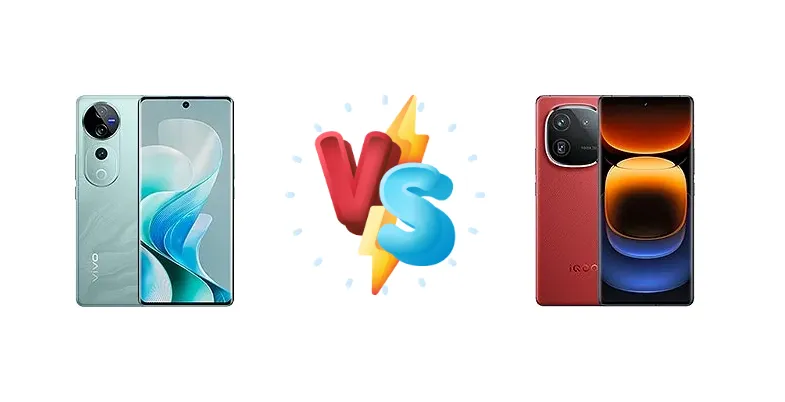
|
🏆 Quick Verdict
For demanding users prioritizing gaming and peak performance, the vivo iQOO 12 Pro is the clear winner thanks to its Snapdragon 8 Gen 3 chipset and blazing-fast 120W charging. However, the vivo V40 Pro offers a compelling alternative for those who value excellent display brightness and longer battery life in everyday use.
| PHONES | ||
|---|---|---|
| Phone Names | vivo V40 Pro | vivo iQOO 12 Pro |
| Network | ||
|---|---|---|
| 2G bands | GSM 850 / 900 / 1800 / 1900 | GSM 850 / 900 / 1800 / 1900 |
| 3G bands | HSDPA 850 / 900 / 1700(AWS) / 1900 / 2100 - International | HSDPA 800 / 850 / 900 / 1700(AWS) / 1900 / 2100 |
| 4G bands | 1, 3, 4, 5, 7, 8, 18, 19, 26, 28, 38, 39, 40, 41 - India | 1, 2, 3, 4, 5, 7, 8, 12, 17, 18, 19, 20, 25, 26, 28, 34, 38, 39, 40, 41, 42, 66 |
| 5G bands | 1, 3, 5, 8, 28, 40, 77, 78 SA/NSA - India | 1, 2, 3, 5, 7, 8, 12, 20, 25, 26, 28, 66, 38, 40, 41, 77, 78 SA/NSA |
| Speed | HSPA, LTE, 5G | HSPA, LTE, 5G |
| Technology | GSM / HSPA / LTE / 5G | GSM / CDMA / HSPA / CDMA2000 / LTE / 5G |
| Launch | ||
|---|---|---|
| Announced | 2024, August 07 | 2023, November 07 |
| Status | Available. Released 2024, August 23 | Available. Released 2023, November 14 |
| Body | ||
|---|---|---|
| Build | Glass front, glass back | - |
| Dimensions | 164.4 x 75.1 x 7.6 mm (6.47 x 2.96 x 0.30 in) | 164.6 x 75.4 x 8.6 mm or 8.8 mm |
| SIM | Nano-SIM + Nano-SIM | Nano-SIM + Nano-SIM |
| Weight | 192 g (6.77 oz) | 205 g or 210 g (7.23 oz) |
| Display | ||
|---|---|---|
| Protection | Schott Xensation Alpha | - |
| Resolution | 1260 x 2800 pixels, 20:9 ratio (~453 ppi density) | 1440 x 3200 pixels, 20:9 ratio (~518 ppi density) |
| Size | 6.78 inches, 111.0 cm2 (~89.9% screen-to-body ratio) | 6.78 inches, 111.0 cm2 (~89.4% screen-to-body ratio) |
| Type | AMOLED, 1B colors, HDR10+, 120Hz, 2160Hz PWM, 4500 nits (peak) | LTPO AMOLED, 1B colors, 144Hz, HDR10+, 1600 nits (HBM), 3000 nits (peak) |
| Platform | ||
|---|---|---|
| CPU | Octa-core (1x3.35 GHz Cortex-X3 & 3x3.0 GHz Cortex-A715 & 4x2.0 GHz Cortex-A510) | Octa-core (1x3.3 GHz Cortex-X4 & 3x3.2 GHz Cortex-A720 & 2x3.0 GHz Cortex-A720 & 2x2.3 GHz Cortex-A520) |
| Chipset | Mediatek Dimensity 9200+ (4 nm) | Qualcomm SM8650-AB Snapdragon 8 Gen 3 (4 nm) |
| GPU | Immortalis-G715 MC11 | Adreno 750 |
| OS | Android 14, Funtouch 14 | Android 14, up to 2 major Android upgrades, Funtouch 14 (International), OriginOS 4 (China) |
| Memory | ||
|---|---|---|
| Card slot | No | No |
| Internal | 256GB 8GB RAM, 256GB 12GB RAM, 512GB 12GB RAM | 256GB 16GB RAM, 512GB 16GB RAM, 1TB 16GB RAM |
| Main Camera | ||
|---|---|---|
| Features | Zeiss optics, Ring-LED flash, panorama, HDR | Color spectrum sensor, Dual-LED flash, HDR, panorama |
| Triple | 50 MP, f/1.9, 24mm (wide), 1/1.56", 1.0µm, PDAF, OIS 50 MP, f/1.9, 50mm (telephoto), 1/2.51", 0.64µm, PDAF, OIS, 2x optical zoom 50 MP, f/2.0, 15mm, 119˚ (ultrawide), 1/2.76", 0.64µm, AF | 50 MP, f/1.7, 23mm (wide), 1/1.3", 1.2µm, ulti-directional PDAF, OIS 64 MP, f/2.6, 70mm (periscope telephoto), 1/2.0", PDAF, OIS, 3x optical zoom 50 MP, f/2.0, 15mm, 119˚ (ultrawide), AF |
| Video | 4K@30/60fps, 1080p@30fps, gyro-EIS, OIS | 8K@30fps, 4K@24/30/60fps, 1080p@30/60/120/240fps, gyro-EIS |
| Selfie camera | ||
|---|---|---|
| Features | HDR | HDR |
| Single | 50 MP, f/2.0, 21mm (wide), 1/2.76", 0.64µm, AF | 16 MP, f/2.5, (wide) |
| Video | 4K@30fps, 1080p@30fps | 1080p@30fps, gyro-EIS |
| Sound | ||
|---|---|---|
| 35mm jack | No | No |
| Loudspeaker | Yes, with stereo speakers | Yes, with stereo speakers |
| Comms | ||
|---|---|---|
| Bluetooth | 5.3, A2DP, LE | 5.4, A2DP, LE, aptX HD, aptX Adaptive, aptX Lossless |
| Infrared port | - | Yes |
| NFC | Yes (market/region dependent) | Yes |
| Positioning | GPS, GALILEO, GLONASS, QZSS, BDS, NavIC | GPS (L1+L5), GLONASS (G1), BDS (B1I+B1c+B2a), GALILEO (E1+E5a), QZSS (L1+L5) |
| Radio | No | No |
| USB | USB Type-C 2.0, OTG | USB Type-C 2.0, OTG |
| WLAN | Wi-Fi 802.11 a/b/g/n/ac/6/7, dual-band | Wi-Fi 802.11 a/b/g/n/ac/6/7, tri-band, Wi-Fi Direct |
| Features | ||
|---|---|---|
| Sensors | Fingerprint (under display, optical), accelerometer, gyro, proximity, compass | Fingerprint (under display, ultrasonic), accelerometer, gyro, proximity, compass |
| Battery | ||
|---|---|---|
| Charging | 80W wired, PD Reverse wired | 120W wired 50W wireless 10W reverse wireless |
| Type | Si/C Li-Ion 5500 mAh | 5100 mAh |
| Misc | ||
|---|---|---|
| Colors | Ganges Blue, Titanium Gray, Moonlight White | Black, Red, White (BMW M branding) |
| Models | V2347 | V2329A |
| Price | ₹ 42,999 | About 650 EUR |
| SAR | 0.99 W/kg (head) 0.99 W/kg (body) | - |
vivo V40 Pro
- Excellent battery life (13:45h active use)
- High peak display brightness (1307 nits)
- Efficient Dimensity 9200+ chipset
- Older chipset compared to the iQOO 12 Pro
- Slower charging speeds (80W)
vivo iQOO 12 Pro
- Cutting-edge Snapdragon 8 Gen 3 performance
- Ultra-fast 120W wired charging
- 50W wireless charging
- Likely shorter battery life than the V40 Pro
- Potentially higher thermal throttling under sustained load
Display Comparison
The vivo V40 Pro boasts a measured peak brightness of 1307 nits, ensuring excellent visibility even in direct sunlight. While the iQOO 12 Pro’s display specifications aren’t provided, it’s likely to offer comparable brightness, but the V40 Pro’s confirmed figure gives it an edge for outdoor readability. Both devices utilize 4nm chipsets, which contribute to efficient power consumption for the displays. The absence of refresh rate information for the iQOO 12 Pro makes a direct comparison difficult, but a high refresh rate is expected for a flagship gaming phone.
Camera Comparison
Without detailed camera specifications, a direct comparison is limited. However, given the iQOO line’s focus on performance, it’s reasonable to expect the iQOO 12 Pro to prioritize camera processing speed and potentially offer more advanced features like 8K video recording. The V40 Pro likely focuses on balanced image quality and color accuracy. The absence of information regarding sensor sizes and OIS on both devices prevents a definitive assessment, but the iQOO 12 Pro’s processing power suggests a potential advantage in computational photography.
Performance
The iQOO 12 Pro’s Qualcomm Snapdragon 8 Gen 3 (4nm) is a significant leap over the V40 Pro’s MediaTek Dimensity 9200+ (4nm). The Snapdragon 8 Gen 3 features a Cortex-X4 prime core clocked at 3.3 GHz, alongside a revised CPU architecture (3x Cortex-A720 and 2x Cortex-A720) offering improved single-core and multi-core performance. This translates to faster app loading, smoother multitasking, and significantly better gaming performance. The V40 Pro’s Dimensity 9200+ with its Cortex-X3 core (3.35 GHz) and Cortex-A715 cores is still a powerful chipset, but it’s a generation behind. The iQOO 12 Pro’s superior GPU will also deliver a more immersive and higher-framerate gaming experience.
Battery Life
The vivo V40 Pro achieves an impressive 13 hours and 45 minutes of active use, demonstrating excellent battery efficiency with the Dimensity 9200+ chipset. The iQOO 12 Pro, while likely having a larger battery to support the more power-hungry Snapdragon 8 Gen 3, will likely see shorter battery life under similar load. However, the iQOO 12 Pro compensates with significantly faster charging: 120W wired, 50W wireless, and 10W reverse wireless, compared to the V40 Pro’s 80W wired and reverse wired charging. This means the iQOO 12 Pro can quickly top up its battery, minimizing downtime.
Buying Guide
Buy the vivo V40 Pro if you need a phone with a consistently bright and vibrant display for media consumption and a battery that comfortably lasts a full day with active use (13:45h reported). Buy the vivo iQOO 12 Pro if you prioritize uncompromising gaming performance, rapid charging (fully recovering from low battery in minutes), and are willing to trade some battery life for that extra power.