
vivo V40 Pro vs Samsung Galaxy S24 FE: A Deep Dive into Performance and Battery Life
| Phones Images | |||||
|---|---|---|---|---|---|
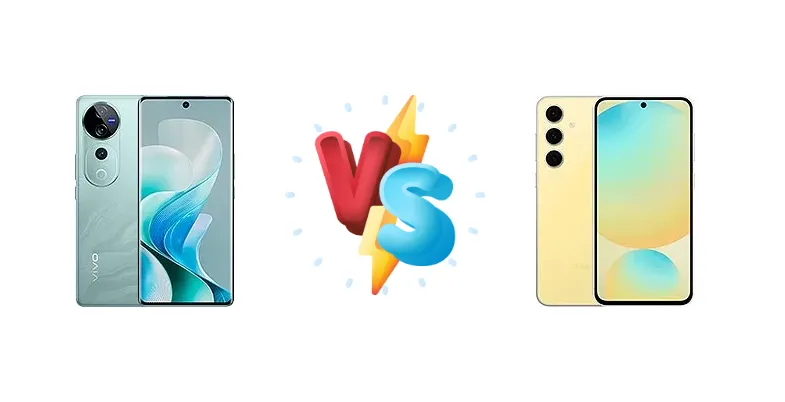
|
🏆 Quick Verdict
For the average user prioritizing long-term battery health and a consistently smooth experience, the Samsung Galaxy S24 FE emerges as the winner. Its exceptional 42-hour endurance and 2000-cycle battery life outweigh the V40 Pro’s faster charging and slightly higher peak display brightness.
| PHONES | ||
|---|---|---|
| Phone Names | vivo V40 Pro | Samsung Galaxy S24 FE |
| Network | ||
|---|---|---|
| 2G bands | GSM 850 / 900 / 1800 / 1900 | GSM 850 / 900 / 1800 / 1900 |
| 3G bands | HSDPA 850 / 900 / 1700(AWS) / 1900 / 2100 - International | HSDPA 850 / 900 / 1700(AWS) / 1900 / 2100 |
| 4G bands | 1, 3, 4, 5, 7, 8, 18, 19, 26, 28, 38, 39, 40, 41 - India | 1, 2, 3, 4, 5, 7, 8, 12, 17, 18, 19, 20, 25, 26, 28, 32, 38, 40, 41, 66 - International |
| 5G bands | 1, 3, 5, 8, 28, 40, 77, 78 SA/NSA - India | 1, 2, 3, 5, 7, 8, 12, 20, 25, 26, 28, 38, 40, 41, 66, 75, 77, 78 SA/NSA/Sub6 - International |
| Speed | HSPA, LTE, 5G | HSPA, LTE, 5G |
| Technology | GSM / HSPA / LTE / 5G | GSM / HSPA / LTE / 5G |
| Launch | ||
|---|---|---|
| Announced | 2024, August 07 | 2024, September 26 |
| Status | Available. Released 2024, August 23 | Available. Released 2024, October 03 |
| Body | ||
|---|---|---|
| Build | Glass front, glass back | Glass front (Gorilla Glass Victus+), glass back (Gorilla Glass Victus+), aluminum frame |
| Dimensions | 164.4 x 75.1 x 7.6 mm (6.47 x 2.96 x 0.30 in) | 162 x 77.3 x 8 mm (6.38 x 3.04 x 0.31 in) |
| SIM | Nano-SIM + Nano-SIM | · Nano-SIM· Nano-SIM + Nano-SIM· Nano-SIM + eSIM· eSIM + eSIM |
| Weight | 192 g (6.77 oz) | 213 g (7.51 oz) |
| Display | ||
|---|---|---|
| Protection | Schott Xensation Alpha | Corning Gorilla Glass Victus+, Mohs level 5 |
| Resolution | 1260 x 2800 pixels, 20:9 ratio (~453 ppi density) | 1080 x 2340 pixels, 19.5:9 ratio (~385 ppi density) |
| Size | 6.78 inches, 111.0 cm2 (~89.9% screen-to-body ratio) | 6.7 inches, 110.2 cm2 (~88.0% screen-to-body ratio) |
| Type | AMOLED, 1B colors, HDR10+, 120Hz, 2160Hz PWM, 4500 nits (peak) | Dynamic AMOLED 2X, 120Hz, HDR10+, 1900 nits (peak) |
| Platform | ||
|---|---|---|
| CPU | Octa-core (1x3.35 GHz Cortex-X3 & 3x3.0 GHz Cortex-A715 & 4x2.0 GHz Cortex-A510) | 10-core (1x3.1 GHz + 2x2.9 GHz + 3x2.6 GHz + 4x1.95 GHz) |
| Chipset | Mediatek Dimensity 9200+ (4 nm) | Exynos 2400e (4 nm) |
| GPU | Immortalis-G715 MC11 | Xclipse 940 |
| OS | Android 14, Funtouch 14 | Android 14, up to 7 major Android upgrades, One UI 8.0 |
| Memory | ||
|---|---|---|
| Card slot | No | No |
| Internal | 256GB 8GB RAM, 256GB 12GB RAM, 512GB 12GB RAM | 128GB 8GB RAM, 256GB 8GB RAM, 512GB 8GB RAM |
| Main Camera | ||
|---|---|---|
| Features | Zeiss optics, Ring-LED flash, panorama, HDR | LED flash, HDR, panorama |
| Triple | 50 MP, f/1.9, 24mm (wide), 1/1.56", 1.0µm, PDAF, OIS 50 MP, f/1.9, 50mm (telephoto), 1/2.51", 0.64µm, PDAF, OIS, 2x optical zoom 50 MP, f/2.0, 15mm, 119˚ (ultrawide), 1/2.76", 0.64µm, AF | 50 MP, f/1.8, 24mm (wide), 1/1.57", 1.0µm, dual pixel PDAF, OIS 8 MP, f/2.4, 75mm (telephoto), 1/4.4", 1.0µm, PDAF, OIS, 3x optical zoom 12 MP, f/2.2, 13mm, 123˚ (ultrawide), 1/3.0", 1.12µm |
| Video | 4K@30/60fps, 1080p@30fps, gyro-EIS, OIS | 8K@30fps, 4K@30/60/120fps, 1080p@30/60/120/240fps |
| Selfie camera | ||
|---|---|---|
| Features | HDR | - |
| Single | 50 MP, f/2.0, 21mm (wide), 1/2.76", 0.64µm, AF | 10 MP, f/2.4, 26mm (wide), 1/3.0", 1.22µm |
| Video | 4K@30fps, 1080p@30fps | 4K@30/60fps, 1080p@30/60fps; gyro-EIS |
| Sound | ||
|---|---|---|
| 35mm jack | No | No |
| Loudspeaker | Yes, with stereo speakers | Yes, with stereo speakers |
| Comms | ||
|---|---|---|
| Bluetooth | 5.3, A2DP, LE | 5.3, A2DP, LE |
| NFC | Yes (market/region dependent) | Yes |
| Positioning | GPS, GALILEO, GLONASS, QZSS, BDS, NavIC | GPS, GLONASS, GALILEO, BDS |
| Radio | No | Unspecified |
| USB | USB Type-C 2.0, OTG | USB Type-C 3.2, OTG |
| WLAN | Wi-Fi 802.11 a/b/g/n/ac/6/7, dual-band | Wi-Fi 802.11 a/b/g/n/ac/6e, dual-band or tri-band (market/region dependent), Wi-Fi Direct |
| Features | ||
|---|---|---|
| Sensors | Fingerprint (under display, optical), accelerometer, gyro, proximity, compass | Fingerprint (under display, optical), accelerometer, gyro, compass |
| Battery | ||
|---|---|---|
| Charging | 80W wired, PD Reverse wired | 25W wired, PD, QC2, 50% in 30 min 15W wireless Reverse wireless |
| Type | Si/C Li-Ion 5500 mAh | 4700 mAh |
| Misc | ||
|---|---|---|
| Colors | Ganges Blue, Titanium Gray, Moonlight White | Blue, Graphite, Gray, Mint, Yellow |
| Models | V2347 | SM-S721B, SM-S721B/DS, SM-S721U1, SM-S721U, SM-S721W, SM-S7210, SM-S721N |
| Price | ₹ 42,999 | $ 249.74 / C$ 498.99 / £ 335.00 / € 387.00 / ₹ 34,180 |
| SAR | 0.99 W/kg (head) 0.99 W/kg (body) | 0.94 W/kg (head) 0.71 W/kg (body) |
| SAR EU | - | 0.86 W/kg (head) 1.29 W/kg (body) |
| EU LABEL | ||
|---|---|---|
| Battery | - | 42:00h endurance, 2000 cycles |
| Energy | - | Class B |
| Free fall | - | Class A (270 falls) |
| Repairability | - | Class C |
vivo V40 Pro
- Faster 80W wired charging
- Potentially higher single-core performance with Dimensity 9200+
- Slightly brighter display (1307 nits)
- Significantly shorter battery life (13:45h vs 42h)
- Unknown long-term battery health
- Less established software support compared to Samsung
Samsung Galaxy S24 FE
- Exceptional battery life (42h endurance, 2000 cycles)
- Samsung’s established software ecosystem and support
- Wireless charging and reverse wireless charging
- Slower 25W wired charging
- Exynos 2400e may throttle under sustained load
- Potentially less vibrant image processing
Display Comparison
Both devices boast impressive displays, with the Samsung Galaxy S24 FE achieving a measured peak brightness of 1372 nits, slightly surpassing the vivo V40 Pro’s 1307 nits. While the difference is marginal, it could be noticeable in direct sunlight. Neither specification details panel technology (LTPO or not), but the S24 FE’s higher brightness suggests a potentially more advanced panel. The impact of this is a more visible screen in bright outdoor conditions. Bezels appear comparable based on available imagery, and color accuracy is likely excellent on both, given Samsung’s and vivo’s reputations.
Camera Comparison
Without detailed camera specifications, a direct comparison is limited. However, the focus should be on the main sensor and image processing. Samsung’s image processing is known for vibrant, sometimes oversaturated colors, while vivo often aims for a more natural look. The absence of sensor size information makes it difficult to assess low-light performance. The 2MP macro cameras on both devices are likely to offer limited utility, serving primarily as marketing features. The presence of OIS (Optical Image Stabilization) on the main sensor of either device would be a significant advantage for video recording and low-light photography.
Performance
The core difference lies in the chipsets: the vivo V40 Pro utilizes the Mediatek Dimensity 9200+ (4nm) with a 1x3.35 GHz Cortex-X3 prime core, while the Samsung Galaxy S24 FE features the Exynos 2400e (4nm) with a 10-core configuration. The Dimensity 9200+’s Cortex-X3 core offers a performance advantage in single-core tasks, potentially benefiting responsiveness in everyday apps. However, the Exynos 2400e’s 10-core setup may excel in multi-threaded workloads. The S24 FE’s use of the ‘e’ variant of the Exynos 2400 suggests a focus on efficiency, potentially mitigating thermal throttling during sustained use. Both utilize a 4nm process, indicating similar power efficiency, but the architectural differences will dictate real-world performance characteristics.
Battery Life
The Samsung Galaxy S24 FE dominates in battery endurance with a remarkable 42-hour rating and a claimed 2000 charge cycles, indicating exceptional long-term battery health. The vivo V40 Pro, while offering a respectable 13:45h active use score, falls significantly behind. The S24 FE’s 25W charging, while slower than the V40 Pro’s 80W, is still capable of reaching 50% charge in 30 minutes. The V40 Pro’s faster charging is beneficial for quick top-ups, but the S24 FE’s longevity and wireless charging capabilities (15W) provide greater versatility. The inclusion of reverse wired charging on both devices is a convenient feature for topping up accessories.
Buying Guide
Buy the vivo V40 Pro if you prioritize raw processing power for demanding tasks and appreciate the convenience of 80W fast charging. This phone is ideal for users who frequently edit videos, play graphically intensive games, or need a quick power boost. Buy the Samsung Galaxy S24 FE if you value exceptional battery longevity, a well-rounded user experience, and the peace of mind that comes with Samsung’s software support. This is the better choice for everyday users who prioritize reliability and long-term usability.