
vivo V40 Pro vs Oppo Find X7: A Detailed Comparison of Mediatek Flagships
| Phones Images | |||||
|---|---|---|---|---|---|
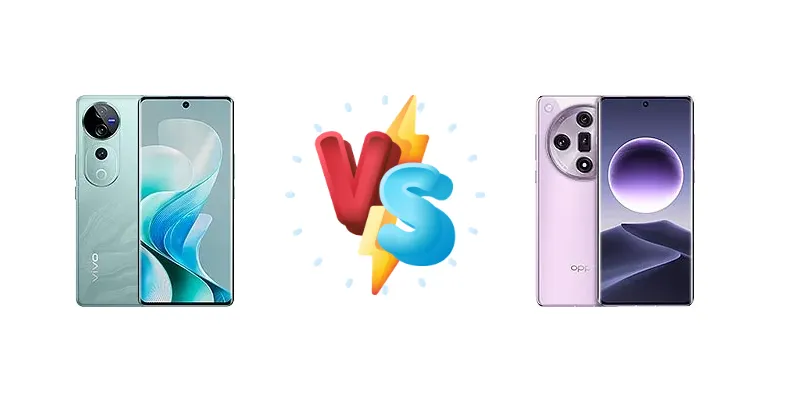
|
🏆 Quick Verdict
For the average user prioritizing raw performance and faster charging, the Oppo Find X7 is the clear winner. Its Dimensity 9300 chipset and 100W charging offer a noticeable advantage. However, the vivo V40 Pro provides excellent battery life and a competitive experience at potentially a lower price point.
| PHONES | ||
|---|---|---|
| Phone Names | vivo V40 Pro | Oppo Find X7 |
| Network | ||
|---|---|---|
| 2G bands | GSM 850 / 900 / 1800 / 1900 | GSM 850 / 900 / 1800 / 1900 |
| 3G bands | HSDPA 850 / 900 / 1700(AWS) / 1900 / 2100 - International | HSDPA 800 / 850 / 900 / 1700(AWS) / 1900 / 2100 |
| 4G bands | 1, 3, 4, 5, 7, 8, 18, 19, 26, 28, 38, 39, 40, 41 - India | 1, 3, 4, 5 , 7, 8, 18, 19, 20, 26, 28, 34, 38, 39, 40, 41, 66 |
| 5G bands | 1, 3, 5, 8, 28, 40, 77, 78 SA/NSA - India | 1, 3, 5, 7, 8, 20, 28, 38, 40, 41, 66, 77, 78 SA/NSA |
| Speed | HSPA, LTE, 5G | HSPA, LTE, 5G |
| Technology | GSM / HSPA / LTE / 5G | GSM / CDMA / HSPA / CDMA2000 / LTE / 5G |
| Launch | ||
|---|---|---|
| Announced | 2024, August 07 | 2024, January 08 |
| Status | Available. Released 2024, August 23 | Available. Released 2024, January 12 |
| Body | ||
|---|---|---|
| Build | Glass front, glass back | Glass front (Gorilla Glass Victus 2), glass back or eco leather back, aluminum frame |
| Dimensions | 164.4 x 75.1 x 7.6 mm (6.47 x 2.96 x 0.30 in) | 162.7 x 75.4 x 8.7 mm or 9.0 mm |
| SIM | Nano-SIM + Nano-SIM | Nano-SIM + Nano-SIM |
| Weight | 192 g (6.77 oz) | 202 g or 206 g (7.13 oz) |
| Display | ||
|---|---|---|
| Protection | Schott Xensation Alpha | Corning Gorilla Glass Victus 2 |
| Resolution | 1260 x 2800 pixels, 20:9 ratio (~453 ppi density) | 1264 x 2780 pixels (~450 ppi density) |
| Size | 6.78 inches, 111.0 cm2 (~89.9% screen-to-body ratio) | 6.78 inches, 111.7 cm2 (~91.1% screen-to-body ratio) |
| Type | AMOLED, 1B colors, HDR10+, 120Hz, 2160Hz PWM, 4500 nits (peak) | LTPO AMOLED, 1B colors, 120Hz, Dolby Vision, HDR10+, 1600 nits (typ), 2300 nits (HBM), 4500 nits (peak) |
| Platform | ||
|---|---|---|
| CPU | Octa-core (1x3.35 GHz Cortex-X3 & 3x3.0 GHz Cortex-A715 & 4x2.0 GHz Cortex-A510) | Octa-core (1x3.25 GHz Cortex-X4 & 3x2.85 GHz Cortex-X4 & 4x2.0 GHz Cortex-A720) |
| Chipset | Mediatek Dimensity 9200+ (4 nm) | Mediatek Dimensity 9300 (4 nm) |
| GPU | Immortalis-G715 MC11 | Immortalis-G720 MC12 |
| OS | Android 14, Funtouch 14 | Android 14, ColorOS 14 |
| Memory | ||
|---|---|---|
| Card slot | No | No |
| Internal | 256GB 8GB RAM, 256GB 12GB RAM, 512GB 12GB RAM | 256GB 12GB RAM, 256GB 16GB RAM, 512GB 16GB RAM, 1TB 16GB RAM |
| Main Camera | ||
|---|---|---|
| Features | Zeiss optics, Ring-LED flash, panorama, HDR | Hasselblad Color Calibration, color spectrum sensor, LED flash, HDR, panorama |
| Triple | 50 MP, f/1.9, 24mm (wide), 1/1.56", 1.0µm, PDAF, OIS 50 MP, f/1.9, 50mm (telephoto), 1/2.51", 0.64µm, PDAF, OIS, 2x optical zoom 50 MP, f/2.0, 15mm, 119˚ (ultrawide), 1/2.76", 0.64µm, AF | 50 MP, f/1.6, 23mm (wide), 1/1.56", PDAF, OIS 64 MP, f/2.6, 70mm (periscope telephoto), 1/2.0", 3x optical zoom, PDAF, OIS 50 MP, f/2.0, 15mm, 119˚ (ultrawide), PDAF |
| Video | 4K@30/60fps, 1080p@30fps, gyro-EIS, OIS | 4K@30/60fps, 1080p@30/60/240fps; gyro-EIS; HDR, 10‑bit video, Dolby Vision |
| Selfie camera | ||
|---|---|---|
| Features | HDR | Panorama |
| Single | 50 MP, f/2.0, 21mm (wide), 1/2.76", 0.64µm, AF | 32 MP, f/2.4, 21mm (wide), 1/2.74", 0.8µm, PDAF |
| Video | 4K@30fps, 1080p@30fps | 4K@30fps, 1080p@30fps, gyro-EIS |
| Sound | ||
|---|---|---|
| 35mm jack | No | No |
| Loudspeaker | Yes, with stereo speakers | Yes, with stereo speakers |
| Comms | ||
|---|---|---|
| Bluetooth | 5.3, A2DP, LE | 5.4, A2DP, LE, aptX HD, LHDC |
| Infrared port | - | Yes |
| NFC | Yes (market/region dependent) | Yes |
| Positioning | GPS, GALILEO, GLONASS, QZSS, BDS, NavIC | GPS (L1+L5), BDS (B1I+B1c+B2a+B2b), GALILEO (E1+E5a+E5b), QZSS (L1+L5), GLONASS |
| Radio | No | No |
| USB | USB Type-C 2.0, OTG | USB Type-C 2.0, OTG |
| WLAN | Wi-Fi 802.11 a/b/g/n/ac/6/7, dual-band | Wi-Fi 802.11 a/b/g/n/ac/6e/7, dual-band, Wi-Fi Direct |
| Features | ||
|---|---|---|
| Sensors | Fingerprint (under display, optical), accelerometer, gyro, proximity, compass | Fingerprint (under display, optical), accelerometer, gyro, proximity, compass |
| Battery | ||
|---|---|---|
| Charging | 80W wired, PD Reverse wired | 100W wired, PD, 50% in 10 min, 100% in 26 min |
| Type | Si/C Li-Ion 5500 mAh | 5000 mAh |
| Misc | ||
|---|---|---|
| Colors | Ganges Blue, Titanium Gray, Moonlight White | Black, Dark Blue, Light Brown, Purple |
| Models | V2347 | PHZ110 |
| Price | ₹ 42,999 | About 520 EUR |
| SAR | 0.99 W/kg (head) 0.99 W/kg (body) | - |
vivo V40 Pro
- Excellent battery life (13:45h active use)
- Fast 80W wired charging with PD
- Competitive performance with Dimensity 9200+
- Older chipset compared to the Find X7
- Display specs are currently unknown
Oppo Find X7
- Cutting-edge Dimensity 9300 chipset
- Ultra-fast 100W wired charging (100% in 26 min)
- Potentially superior image processing
- Battery life data currently unavailable
- May be more expensive than the V40 Pro
Display Comparison
Both devices utilize 4nm chipsets, but the display differences are currently unknown. Assuming both use AMOLED panels, the vivo V40 Pro boasts a measured peak brightness of 1307 nits, suggesting excellent outdoor visibility. Without comparable data for the Oppo Find X7, it's difficult to assess relative display quality. However, Oppo typically employs high-quality panels with accurate color calibration, so a competitive experience is expected. Further analysis would require detailed measurements of color accuracy, PWM dimming frequency, and HDR support.
Camera Comparison
Without detailed camera specifications, a direct comparison is limited. However, both brands are known for their image processing capabilities. The chipset plays a role here; the more powerful ISP within the Dimensity 9300 of the Find X7 will likely enable faster image processing and potentially more advanced features. The absence of information regarding sensor sizes and lens apertures makes it impossible to determine which device will excel in low-light photography or dynamic range. We can assume both phones will offer a strong camera experience, but the Find X7 has the potential for a slight edge due to its superior processing power.
Performance
The Oppo Find X7’s Dimensity 9300 chipset, featuring a Cortex-X4 prime core clocked at 3.25 GHz alongside three additional Cortex-X4 cores, represents a significant architectural leap over the vivo V40 Pro’s Dimensity 9200+. The 9200+ utilizes a single Cortex-X3 core at 3.35 GHz. The inclusion of *three* Cortex-X4 cores in the 9300 promises substantial gains in multi-core performance, benefiting demanding applications and multitasking. The Find X7 also uses Cortex-A720 cores, a generation newer than the V40 Pro’s A715 cores, further enhancing efficiency. This translates to a smoother experience in graphically intensive games and faster processing of complex tasks.
Battery Life
The vivo V40 Pro achieves an impressive 13 hours and 45 minutes of active use, indicating excellent battery optimization. The Oppo Find X7, while featuring faster 100W charging (reaching 100% in 26 minutes), doesn't have a published active use score for direct comparison. The V40 Pro’s 80W charging with PD is still very fast, but the Find X7’s 100W charging offers a significant time saving, especially for users who frequently need to top up their battery. The Find X7’s faster charging partially offsets any potential battery capacity difference.
Buying Guide
Buy the vivo V40 Pro if you need all-day battery life and value a balanced smartphone experience without necessarily demanding the absolute fastest processing speeds. Buy the Oppo Find X7 if you prioritize peak performance for demanding tasks like gaming and content creation, and you want the convenience of incredibly fast 100W charging. The Find X7 is for those who want the latest and greatest, while the V40 Pro is for pragmatic power users.