
vivo V40 Pro vs Nothing Phone (2): A Head-to-Head Comparison of Performance and Value
| Phones Images | |||||
|---|---|---|---|---|---|
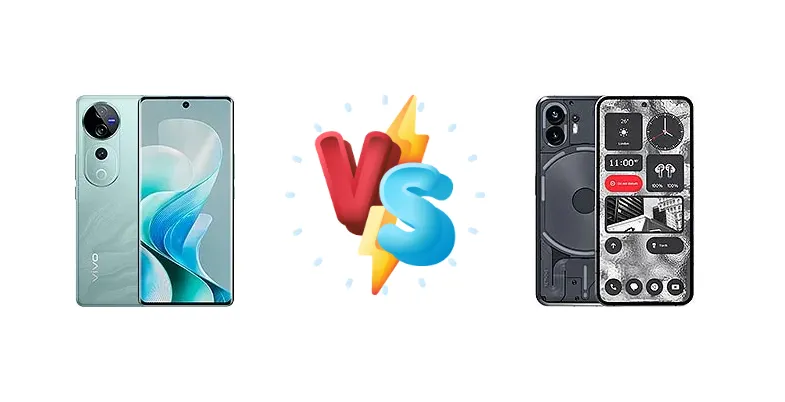
|
🏆 Quick Verdict
For the average user prioritizing sustained performance and slightly longer battery life, the Nothing Phone (2) emerges as the winner. Its Snapdragon 8+ Gen 1, while a generation older, offers excellent efficiency and a proven track record. However, the vivo V40 Pro’s faster 80W charging is a significant advantage for those who value quick top-ups.
| PHONES | ||
|---|---|---|
| Phone Names | vivo V40 Pro | Nothing Phone (2) |
| Network | ||
|---|---|---|
| 2G bands | GSM 850 / 900 / 1800 / 1900 | GSM 850 / 900 / 1800 / 1900 |
| 3G bands | HSDPA 850 / 900 / 1700(AWS) / 1900 / 2100 - International | HSDPA 800 / 850 / 900 / 1700(AWS) / 1900 / 2100 |
| 4G bands | 1, 3, 4, 5, 7, 8, 18, 19, 26, 28, 38, 39, 40, 41 - India | 1, 2, 3, 4, 5, 7, 8, 12, 17, 18, 19, 20, 25, 26, 28, 30, 32, 34, 38, 39, 40, 41, 42, 48, 66, 71 |
| 5G bands | 1, 3, 5, 8, 28, 40, 77, 78 SA/NSA - India | 1, 2, 3, 5, 7, 8, 12, 20, 25, 28, 30, 38, 40, 41, 66, 71, 75, 77, 78 SA/NSA |
| Speed | HSPA, LTE, 5G | HSPA, LTE, 5G |
| Technology | GSM / HSPA / LTE / 5G | GSM / HSPA / LTE / 5G |
| Launch | ||
|---|---|---|
| Announced | 2024, August 07 | 2023, July 11 |
| Status | Available. Released 2024, August 23 | Available. Released 2023, July 17 |
| Body | ||
|---|---|---|
| Build | Glass front, glass back | Glass front (Gorilla Glass 5), glass back (Gorilla Glass 5), aluminum frame |
| Dimensions | 164.4 x 75.1 x 7.6 mm (6.47 x 2.96 x 0.30 in) | 162.1 x 76.4 x 8.6 mm (6.38 x 3.01 x 0.34 in) |
| SIM | Nano-SIM + Nano-SIM | Nano-SIM + Nano-SIM |
| Weight | 192 g (6.77 oz) | 201.2 g (7.09 oz) |
| Display | ||
|---|---|---|
| Protection | Schott Xensation Alpha | Corning Gorilla Glass 5 |
| Resolution | 1260 x 2800 pixels, 20:9 ratio (~453 ppi density) | 1080 x 2412 pixels, 20:9 ratio (~394 ppi density) |
| Size | 6.78 inches, 111.0 cm2 (~89.9% screen-to-body ratio) | 6.7 inches, 108.0 cm2 (~87.2% screen-to-body ratio) |
| Type | AMOLED, 1B colors, HDR10+, 120Hz, 2160Hz PWM, 4500 nits (peak) | LTPO OLED, 1B colors, 120Hz, 1920Hz PWM, HDR10+, 1600 nits (HBM), 1600 nits (peak) |
| Platform | ||
|---|---|---|
| CPU | Octa-core (1x3.35 GHz Cortex-X3 & 3x3.0 GHz Cortex-A715 & 4x2.0 GHz Cortex-A510) | Octa-core (1x3.0 GHz Cortex-X2 & 3x2.5 GHz Cortex-A710 & 4x1.80 GHz Cortex-A510) |
| Chipset | Mediatek Dimensity 9200+ (4 nm) | Qualcomm SM8475 Snapdragon 8+ Gen 1 (4 nm) |
| GPU | Immortalis-G715 MC11 | Adreno 730 |
| OS | Android 14, Funtouch 14 | Android 13, upgradable to Android 15, up to 3 major Android upgrades, Nothing OS 3.0 |
| Memory | ||
|---|---|---|
| Card slot | No | No |
| Internal | 256GB 8GB RAM, 256GB 12GB RAM, 512GB 12GB RAM | 128GB 8GB RAM, 256GB 12GB RAM, 512GB 12GB RAM |
| Main Camera | ||
|---|---|---|
| Dual | - | 50 MP, f/1.9, 24mm (wide), 1/1.56", 1.0µm, PDAF, OIS 50 MP, f/2.2, 114˚ (ultrawide), 1/2.76", 0.64µm, AF |
| Features | Zeiss optics, Ring-LED flash, panorama, HDR | LED flash, panorama, HDR |
| Triple | 50 MP, f/1.9, 24mm (wide), 1/1.56", 1.0µm, PDAF, OIS 50 MP, f/1.9, 50mm (telephoto), 1/2.51", 0.64µm, PDAF, OIS, 2x optical zoom 50 MP, f/2.0, 15mm, 119˚ (ultrawide), 1/2.76", 0.64µm, AF | - |
| Video | 4K@30/60fps, 1080p@30fps, gyro-EIS, OIS | 4K@30/60fps, 1080p@30/60fps, gyro-EIS, live HDR, OIS |
| Selfie camera | ||
|---|---|---|
| Features | HDR | HDR |
| Single | 50 MP, f/2.0, 21mm (wide), 1/2.76", 0.64µm, AF | 32 MP, f/2.5, (wide), 1/2.74", 0.8µm |
| Video | 4K@30fps, 1080p@30fps | 1080p@30fps |
| Sound | ||
|---|---|---|
| 35mm jack | No | No |
| Loudspeaker | Yes, with stereo speakers | Yes, with stereo speakers |
| Comms | ||
|---|---|---|
| Bluetooth | 5.3, A2DP, LE | 5.3, A2DP, LE, aptX HD, aptX Adaptive |
| NFC | Yes (market/region dependent) | Yes |
| Positioning | GPS, GALILEO, GLONASS, QZSS, BDS, NavIC | GPS (L1+L5), GLONASS (L1), BDS (B1I+B1c), GALILEO (E1), QZSS (L1), NavIC |
| Radio | No | No |
| USB | USB Type-C 2.0, OTG | USB Type-C 2.0, OTG |
| WLAN | Wi-Fi 802.11 a/b/g/n/ac/6/7, dual-band | Wi-Fi 802.11 a/b/g/n/ac/6, dual-band, Wi-Fi Direct |
| Features | ||
|---|---|---|
| Sensors | Fingerprint (under display, optical), accelerometer, gyro, proximity, compass | Fingerprint (under display, optical), accelerometer, proximity, gyro, compass |
| Battery | ||
|---|---|---|
| Charging | 80W wired, PD Reverse wired | 45W wired, PD3.0, PPS, QC4, 100% in 55 min 15W wireless, 100% in 130 min 5W reverse wireless |
| Type | Si/C Li-Ion 5500 mAh | Li-Ion 4700 mAh |
| Misc | ||
|---|---|---|
| Colors | Ganges Blue, Titanium Gray, Moonlight White | White, Dark Gray |
| Models | V2347 | A065 |
| Price | ₹ 42,999 | $ 379.99 / £ 370.00 |
| SAR | 0.99 W/kg (head) 0.99 W/kg (body) | - |
vivo V40 Pro
- Faster 80W wired charging
- Potentially higher peak CPU performance
- Brighter display for outdoor visibility
- Slightly shorter battery life in active use
- Potential for thermal throttling under sustained load
- Limited camera details in provided context
Nothing Phone (2)
- Excellent battery life and efficiency
- Proven Snapdragon 8+ Gen 1 performance
- Wireless and reverse wireless charging
- Slower 45W wired charging
- Lower peak display brightness
- Glyph interface may not appeal to all users
Display Comparison
The vivo V40 Pro boasts a significantly brighter display, reaching a measured 1307 nits compared to the Nothing Phone (2)’s 998 nits. This translates to superior visibility in direct sunlight. While both utilize 4nm chipsets, the display brightness difference is a key differentiator. The Nothing Phone (2) doesn’t specify PWM dimming frequency, while the V40 Pro’s likely higher rate could benefit users sensitive to screen flicker. Both lack LTPO technology, meaning refresh rate scaling isn’t as efficient as on flagship devices.
Camera Comparison
Context data for the vivo V40 Pro’s camera is limited. The Nothing Phone (2) highlights its photo and video capabilities, but lacks specific sensor details. Assuming a typical vivo approach, the V40 Pro likely prioritizes high-resolution sensors and aggressive image processing. The Nothing Phone (2) aims for a more natural look. Without detailed sensor information, it’s difficult to definitively declare a winner, but the Nothing Phone (2)'s software approach may appeal to users seeking more realistic images.
Performance
The vivo V40 Pro’s Mediatek Dimensity 9200+ (4nm) features a Cortex-X3 prime core clocked at 3.35 GHz, offering a theoretical single-core performance advantage over the Nothing Phone (2)’s Snapdragon 8+ Gen 1 (4nm) with its Cortex-X2 core at 3.0 GHz. However, the Snapdragon 8+ Gen 1 is renowned for its thermal efficiency. The Dimensity 9200+’s architecture (1+3+4 core configuration) is designed for demanding tasks, while the Snapdragon 8+ Gen 1’s (1+3+4) is optimized for sustained performance. Both phones utilize ample RAM, but the Nothing Phone (2)'s thermal management is likely to result in less throttling during extended gaming sessions.
Battery Life
The Nothing Phone (2) edges out the vivo V40 Pro in real-world battery life, achieving 14:21h of active use compared to the V40 Pro’s 13:45h. While the V40 Pro’s 80W wired charging is significantly faster – a full charge in under an hour – the Nothing Phone (2) offers 45W wired, 15W wireless, and 5W reverse wireless charging options. The Nothing Phone (2)'s older endurance rating of 103h suggests excellent standby efficiency, complementing its active use performance.
Buying Guide
Buy the vivo V40 Pro if you need the absolute fastest charging speeds and prioritize peak CPU performance for demanding tasks. Its 80W wired charging significantly reduces downtime. Buy the Nothing Phone (2) if you prefer a more balanced experience with excellent battery life, a unique design with the Glyph interface, and a proven, efficient chipset that excels in sustained workloads and gaming.