
vivo V40 Lite vs Honor X9b: A Deep Dive into the Snapdragon 6 Gen 1 Experience
| Phones Images | |||||
|---|---|---|---|---|---|
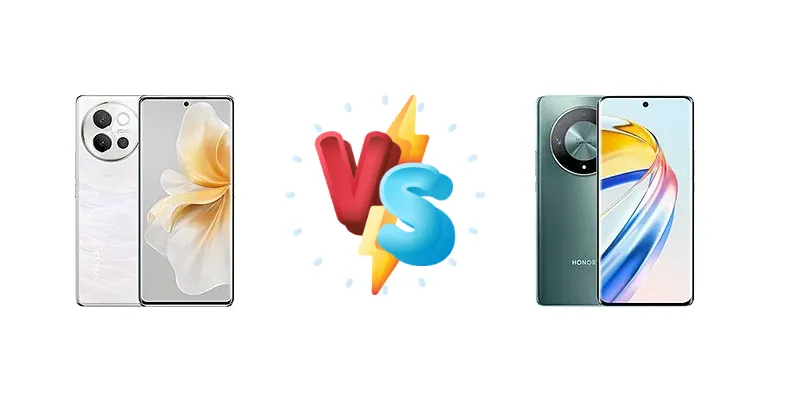
|
🏆 Quick Verdict
For the average user prioritizing faster charging and potential software customization, the vivo V40 Lite emerges as the slightly better choice. Its 44W charging significantly reduces top-up times compared to the Honor X9b’s 35W, a tangible benefit for daily use. However, Honor’s MagicOS may appeal to those seeking a distinct UI.
| PHONES | ||
|---|---|---|
| Phone Names | vivo V40 Lite | Honor X9b |
| Network | ||
|---|---|---|
| 2G bands | GSM 850 / 900 / 1800 / 1900 | GSM 850 / 900 / 1800 / 1900 |
| 3G bands | HSDPA 850 / 900 / 1700(AWS) / 1900 / 2100 | HSDPA 850 / 900 / 1900 / 2100 |
| 4G bands | 1, 2, 3, 4, 5, 7, 8, 12, 13, 17, 18, 19, 20, 26, 28, 32, 38, 39, 40, 41, 66 | 1, 2, 3, 4, 5, 7, 8, 20, 28, 32, 38, 40, 41 |
| 5G bands | 1, 2, 3, 5, 7, 8, 20, 26, 28, 66, 75, 38, 40, 41, 77, 78 SA/NSA | 1, 3, 7, 8, 20, 28, 38, 40, 41, 77, 78 SA/NSA |
| Speed | HSPA, LTE, 5G | HSPA, LTE, 5G |
| Technology | GSM / HSPA / LTE / 5G | GSM / HSPA / LTE / 5G |
| Launch | ||
|---|---|---|
| Announced | 2024, July 14 | 2023, October 18 |
| Status | Available. Released 2024, July 14 | Available. Released 2023, October |
| Body | ||
|---|---|---|
| Build | Glass front, plastic frame, glass back or plastic back | - |
| Dimensions | 164.4 x 74.8 x 7.7 mm (6.47 x 2.94 x 0.30 in) | 163.6 x 75.5 x 8 mm (6.44 x 2.97 x 0.31 in) |
| SIM | Nano-SIM + Nano-SIM | Nano-SIM + Nano-SIM |
| Weight | 179 g or 188 g (6.31 oz) | 185 g (6.53 oz) |
| Display | ||
|---|---|---|
| Resolution | 1080 x 2400 pixels, 20:9 ratio (~388 ppi density) | 1220 x 2652 pixels, 19.5:9 ratio (~431 ppi density) |
| Size | 6.78 inches, 111.0 cm2 (~90.3% screen-to-body ratio) | 6.78 inches, 112.6 cm2 (~91.2% screen-to-body ratio) |
| Type | AMOLED, 1B colors, 120Hz, 1300 nits (peak) | AMOLED, 1B colors, 120Hz, 1200 nits (peak) |
| Platform | ||
|---|---|---|
| CPU | Octa-core (4x2.2 GHz Cortex-A78 & 4x1.8 GHz Cortex-A55) | Octa-core (4x2.2 GHz Cortex-A78 & 4x1.8 GHz Cortex-A55) |
| Chipset | Qualcomm SM6450 Snapdragon 6 Gen 1 (4 nm) | Qualcomm SM6450 Snapdragon 6 Gen 1 (4 nm) |
| GPU | Adreno 710 | Adreno 710 |
| OS | Android 14, Funtouch 14 | Android 13, Magic OS 7.2 |
| Memory | ||
|---|---|---|
| Card slot | microSDXC (uses shared SIM slot) | No |
| Internal | 256GB 8GB RAM | 256GB 8GB RAM, 256GB 12GB RAM, 512GB 8GB RAM, 512GB 12GB RAM |
| Main Camera | ||
|---|---|---|
| Features | Ring-LED flash, panorama, HDR | LED flash, panorama, HDR |
| Triple | 50 MP, f/1.8, 26mm (wide), 1/1.95", 0.8µm, PDAF 8 MP, f/2.2, 120˚ (ultrawide), 1/4.0", 1.12µm 2 MP (macro) | 108 MP, f/1.8, (wide), 1/1.67", PDAF 5 MP, f/2.2, (ultrawide) 2 MP (macro) |
| Video | 4K@30fps, 1080p@30fps | 4K@30fps, 1080p@30fps |
| Selfie camera | ||
|---|---|---|
| Single | 32 MP, f/2.0, 24mm (wide) | 16 MP, f/2.5, (wide) |
| Video | 1080p@30fps | 1080p@30fps |
| Sound | ||
|---|---|---|
| 35mm jack | No | No |
| Loudspeaker | Yes | Yes |
| Comms | ||
|---|---|---|
| Bluetooth | 5.1, A2DP, LE | 5.1, A2DP, LE |
| Infrared port | - | Yes |
| NFC | Yes (market/region dependent) | Yes (market/region dependent) |
| Positioning | GPS, GLONASS, GALILEO, BDS, QZSS | GPS, GLONASS, GALILEO, BDS |
| Radio | No | No |
| USB | USB Type-C 2.0, OTG | USB Type-C 2.0, OTG |
| WLAN | Wi-Fi 802.11 a/b/g/n/ac, dual-band | Wi-Fi 802.11 a/b/g/n/ac, dual-band, Wi-Fi Direct |
| Features | ||
|---|---|---|
| Sensors | Fingerprint (under display, optical), accelerometer, gyro, proximity, compass | Fingerprint (under display, optical), accelerometer, gyro, proximity, compass |
| Battery | ||
|---|---|---|
| Charging | 44W wired, PD Reverse wired | 35W wired Reverse wired |
| Type | Li-Ion 5500 mAh | Li-Po 5800 mAh |
| Misc | ||
|---|---|---|
| Colors | Classy Brown, Dreamy White | Sunrise Orange, Midnight Black, Emerald Green |
| Models | - | ALI-NX1 |
| Price | $ 127.08 | About 970 EUR |
| SAR EU | 0.99 W/kg (head) 1.18 W/kg (body) | - |
vivo V40 Lite
- Faster 44W charging with PD support
- Reverse wired charging capability
- Potentially more software customization options
- Software experience can vary by region
- Camera performance likely similar to Honor X9b
Honor X9b
- Potentially cleaner software experience (MagicOS)
- Sleek design aesthetic (typical of Honor)
- Reverse wired charging capability
- Slower 35W charging
- Performance identical to vivo V40 Lite
Display Comparison
Both devices are likely to feature similar LCD panels, given their price bracket. While specific display specs (resolution, refresh rate) are missing, the focus here is on charging. Display quality will likely be adequate for everyday use, but neither is expected to compete with flagship OLED panels. Bezels are likely comparable, and color accuracy will depend on software calibration.
Camera Comparison
Without detailed camera specifications, it’s difficult to make a definitive judgment. Both phones likely employ a multi-camera setup, but the quality will heavily depend on the main sensor and image processing algorithms. The presence of a 2MP macro camera on either device is largely inconsequential; its utility is limited by its low resolution. Expect adequate performance in well-lit conditions, but low-light photography will likely be a weak point for both.
Performance
The core of both phones is the Qualcomm SM6450 Snapdragon 6 Gen 1 (4nm). This chipset features an octa-core CPU configuration – 4x2.2 GHz Cortex-A78 and 4x1.8 GHz Cortex-A55. Performance will be virtually identical in CPU-bound tasks. The 4nm process node ensures reasonable thermal efficiency, minimizing throttling during sustained workloads. However, RAM configuration (LPDDR4x vs LPDDR5) is unknown, which could introduce a minor performance difference. The GPU performance will also be identical, suitable for moderate gaming at medium settings.
Battery Life
The battery capacity is not specified, but both phones will likely house a battery in the 5000mAh range, typical for this segment. The key differentiator is charging speed. The vivo V40 Lite’s 44W wired charging with PD support offers a significant advantage over the Honor X9b’s 35W charging. This translates to a faster 0-100% charge time, potentially shaving off 30-60 minutes. Both support reverse wired charging, allowing them to act as power banks for other devices, a useful feature for travelers or those with multiple gadgets.
Buying Guide
Buy the vivo V40 Lite if you need rapid charging and appreciate the flexibility of reverse wired charging for accessories. It’s ideal for users who frequently find themselves needing a quick power boost. Buy the Honor X9b if you prefer a potentially cleaner software experience (depending on regional variations of MagicOS) and prioritize a brand known for its design aesthetic. It suits users who value a polished user interface and are less concerned with charging speed.