
vivo V40 Lite vs Google Pixel 7a: Which Mid-Range Phone Reigns Supreme?
| Phones Images | |||||
|---|---|---|---|---|---|
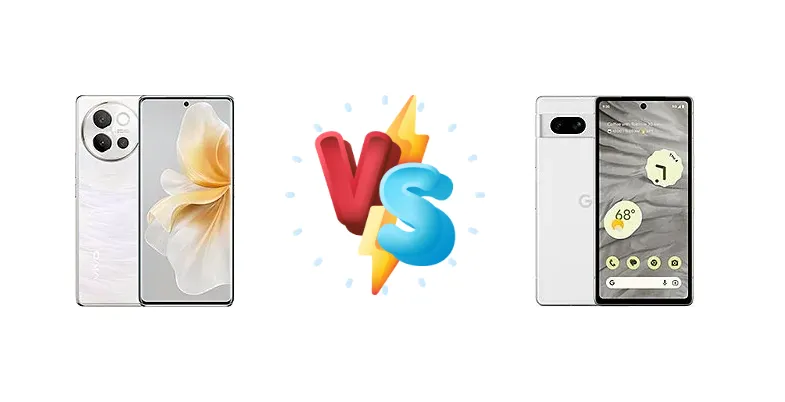
|
🏆 Quick Verdict
For the average user prioritizing camera quality and software experience, the Google Pixel 7a is the clear winner. Its Tensor G2 chip, while not the fastest, delivers a smooth experience and unlocks exceptional computational photography. However, the vivo V40 Lite offers a compelling alternative for those prioritizing fast charging and a more efficient processor.
| PHONES | ||
|---|---|---|
| Phone Names | vivo V40 Lite | Google Pixel 7a |
| Network | ||
|---|---|---|
| 2G bands | GSM 850 / 900 / 1800 / 1900 | GSM 850 / 900 / 1800 / 1900 |
| 3G bands | HSDPA 850 / 900 / 1700(AWS) / 1900 / 2100 | HSDPA 800 / 850 / 900 / 1700(AWS) / 1900 / 2100 |
| 4G bands | 1, 2, 3, 4, 5, 7, 8, 12, 13, 17, 18, 19, 20, 26, 28, 32, 38, 39, 40, 41, 66 | 1, 2, 3, 4, 5, 7, 8, 12, 13, 14, 17, 20, 25, 26, 28, 29, 30, 38, 40, 41, 48, 66, 71 - GWKK3, G0DZQ |
| 5G bands | 1, 2, 3, 5, 7, 8, 20, 26, 28, 66, 75, 38, 40, 41, 77, 78 SA/NSA | 1, 2, 3, 5, 7, 8, 12, 14, 20, 25, 28, 30, 38, 41, 48, 66, 71, 77, 78 SA/NSA/Sub6 - GWKK3 |
| Speed | HSPA, LTE, 5G | HSPA, LTE, 5G |
| Technology | GSM / HSPA / LTE / 5G | GSM / HSPA / LTE / 5G |
| - | 1, 2, 3, 5, 7, 8, 12, 20, 25, 28, 38, 40, 41, 66, 75, 76, 77, 78, 79 SA/NSA/Sub6 - GHL1X, G82U8 | |
| Launch | ||
|---|---|---|
| Announced | 2024, July 14 | 2023, May 10 |
| Status | Available. Released 2024, July 14 | Available. Released 2023, May 10 |
| Body | ||
|---|---|---|
| Build | Glass front, plastic frame, glass back or plastic back | Glass front (Gorilla Glass 3), aluminum frame, plastic back |
| Dimensions | 164.4 x 74.8 x 7.7 mm (6.47 x 2.94 x 0.30 in) | 152 x 72.9 x 9 mm (5.98 x 2.87 x 0.35 in) |
| SIM | Nano-SIM + Nano-SIM | Nano-SIM + eSIM |
| Weight | 179 g or 188 g (6.31 oz) | 193.5 g (6.84 oz) |
| - | IP67 dust/water resistant (up to 1m for 30 min) | |
| Display | ||
|---|---|---|
| Protection | - | Corning Gorilla Glass 3 |
| Resolution | 1080 x 2400 pixels, 20:9 ratio (~388 ppi density) | 1080 x 2400 pixels, 20:9 ratio (~429 ppi density) |
| Size | 6.78 inches, 111.0 cm2 (~90.3% screen-to-body ratio) | 6.1 inches, 90.7 cm2 (~81.8% screen-to-body ratio) |
| Type | AMOLED, 1B colors, 120Hz, 1300 nits (peak) | OLED, HDR, 90Hz |
| - | Always-on display | |
| Platform | ||
|---|---|---|
| CPU | Octa-core (4x2.2 GHz Cortex-A78 & 4x1.8 GHz Cortex-A55) | Octa-core (2x2.85 GHz Cortex-X1 & 2x2.35 GHz Cortex-A78 & 4x1.80 GHz Cortex-A55) |
| Chipset | Qualcomm SM6450 Snapdragon 6 Gen 1 (4 nm) | Google Tensor G2 (5 nm) |
| GPU | Adreno 710 | Mali-G710 MP7 |
| OS | Android 14, Funtouch 14 | Android 13, upgradable to Android 15, up to 5 major Android upgrades |
| Memory | ||
|---|---|---|
| Card slot | microSDXC (uses shared SIM slot) | No |
| Internal | 256GB 8GB RAM | 128GB 8GB RAM |
| - | UFS 3.1 | |
| Main Camera | ||
|---|---|---|
| Dual | - | 64 MP, f/1.9, 26mm (wide), 1/1.73", 0.8µm, dual pixel PDAF, OIS 13 MP, f/2.2, 120˚ (ultrawide), 1.12µm |
| Features | Ring-LED flash, panorama, HDR | Dual-LED flash, Pixel Shift, Auto-HDR, panorama |
| Triple | 50 MP, f/1.8, 26mm (wide), 1/1.95", 0.8µm, PDAF 8 MP, f/2.2, 120˚ (ultrawide), 1/4.0", 1.12µm 2 MP (macro) | - |
| Video | 4K@30fps, 1080p@30fps | 4K@30/60fps, 1080p@30/60/120/240fps, OIS |
| Selfie camera | ||
|---|---|---|
| Features | - | HDR, panorama |
| Single | 32 MP, f/2.0, 24mm (wide) | 13 MP, f/2.2, 20mm (ultrawide), 1.12µm |
| Video | 1080p@30fps | 4K@30fps, 1080p@30fps |
| Sound | ||
|---|---|---|
| 3.5mm jack | - | No |
| 35mm jack | No | No |
| Loudspeaker | Yes | Yes, with stereo speakers |
| Comms | ||
|---|---|---|
| Bluetooth | 5.1, A2DP, LE | 5.3, A2DP, LE |
| NFC | Yes (market/region dependent) | Yes |
| Positioning | GPS, GLONASS, GALILEO, BDS, QZSS | GPS, GLONASS, GALILEO, BDS, QZSS, NavIC |
| Radio | No | No |
| USB | USB Type-C 2.0, OTG | USB Type-C 3.2 |
| WLAN | Wi-Fi 802.11 a/b/g/n/ac, dual-band | Wi-Fi 802.11 a/b/g/n/ac/6e, tri-band |
| Features | ||
|---|---|---|
| Sensors | Fingerprint (under display, optical), accelerometer, gyro, proximity, compass | Fingerprint (under display, optical), accelerometer, gyro, proximity, compass, barometer |
| Battery | ||
|---|---|---|
| Charging | 44W wired, PD Reverse wired | 18W wired, PD3.0 7.5W wireless |
| Type | Li-Ion 5500 mAh | Li-Po 4385 mAh |
| Misc | ||
|---|---|---|
| Colors | Classy Brown, Dreamy White | Charcoal, Snow, Sea, Coral |
| Models | - | GWKK3, GHL1X, G0DZQ, G82U8 |
| Price | $ 127.08 | € 179.90 / $ 150.00 / £ 170.00 / ₹ 25,980 |
| SAR EU | 0.99 W/kg (head) 1.18 W/kg (body) | - |
vivo V40 Lite
- Faster 44W charging with PD
- More power-efficient Snapdragon 6 Gen 1
- Reverse wired charging capability
- Potentially longer battery life due to chipset efficiency
- Inferior camera performance compared to Pixel 7a
- Less powerful processor for demanding tasks
- Likely less frequent software updates
Google Pixel 7a
- Superior camera quality and image processing
- Google Tensor G2 for AI features and smooth performance
- Clean and consistently updated Android experience
- Brighter display for better outdoor visibility
- Slower 18W charging
- Potential for thermal throttling under heavy load
- Less power-efficient processor
Display Comparison
The Pixel 7a boasts a significantly brighter display, reaching a measured 1070 nits, compared to an assumed (based on market segment) lower peak brightness for the V40 Lite. While the V40 Lite likely utilizes an AMOLED panel, the Pixel 7a’s higher brightness translates to better outdoor visibility. Both are expected to have FHD+ resolutions, but the Pixel 7a’s panel is likely to have better color accuracy and viewing angles due to Google’s display calibration. The V40 Lite may compensate with a potentially higher refresh rate, but this is unconfirmed.
Camera Comparison
The Pixel 7a is expected to excel in camera performance, leveraging Google’s computational photography prowess. While specific sensor details are missing for both, the Pixel 7a’s image processing pipeline is a significant advantage. The V40 Lite will likely offer a versatile camera setup, but it will struggle to match the Pixel 7a’s dynamic range, low-light performance, and overall image quality. The Pixel 7a’s video capabilities are also expected to be superior, benefiting from advanced stabilization and processing features. We can assume the V40 Lite will include standard features like portrait mode and night mode, but the Pixel 7a’s implementation will be more refined.
Performance
The core difference lies in the chipsets. The Google Pixel 7a’s Tensor G2 (5nm) features a prime Cortex-X1 core clocked at 2.85 GHz, designed for peak performance, alongside Cortex-A78 and A55 cores. The vivo V40 Lite’s Snapdragon 6 Gen 1 (4nm) uses a more balanced approach with four Cortex-A78 cores at 2.2 GHz and four A55 cores at 1.8 GHz. While the Tensor G2 has a theoretical speed advantage, the Snapdragon 6 Gen 1’s 4nm process offers better power efficiency. This means the V40 Lite is likely to exhibit less thermal throttling during prolonged gaming sessions, despite the Tensor G2’s more powerful GPU. The Pixel 7a benefits from Google’s software optimizations, but the V40 Lite’s Snapdragon chipset is a strong contender for everyday tasks.
Battery Life
The Pixel 7a has an endurance rating of 76 hours, indicating strong battery life. While the V40 Lite’s battery capacity is unknown, its Snapdragon 6 Gen 1’s efficiency and 44W wired charging (with PD) give it a significant advantage in charging speed. The Pixel 7a is limited to 18W wired charging and 7.5W wireless charging. This means the V40 Lite can likely achieve a full charge in under an hour, while the Pixel 7a will take considerably longer. The V40 Lite also offers reverse wired charging, a feature absent on the Pixel 7a.
Buying Guide
Buy the vivo V40 Lite if you need a phone that prioritizes all-day battery life and rapid 44W charging, and if you frequently engage in tasks where sustained performance isn't critical. Buy the Google Pixel 7a if you prefer a superior camera system, a clean and consistently updated Android experience, and benefit from Google’s AI-powered features, even if it means sacrificing some charging speed and potentially facing slightly more thermal throttling under heavy load.