
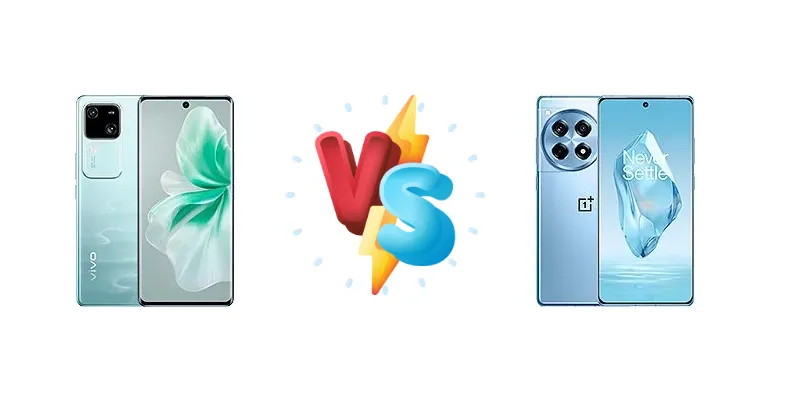
vivo V30 vs OnePlus 12R: A Deep Dive into Mid-Range Power
| Phones Images | |||||
|---|---|---|---|---|---|
|
🏆 Quick Verdict
For the average user prioritizing sustained performance and faster charging, the OnePlus 12R emerges as the winner. Its Snapdragon 8 Gen 2 chipset provides a significant performance advantage, and the 100W charging drastically reduces downtime. However, the vivo V30 offers a brighter display and respectable battery life, making it a viable alternative for those less demanding on processing power.
| PHONES | ||
|---|---|---|
| Phone Names | vivo V30 | OnePlus 12R |
| Network | ||
|---|---|---|
| 2G bands | GSM 850 / 900 / 1800 / 1900 | GSM 850 / 900 / 1800 / 1900 |
| 3G bands | HSDPA 850 / 900 / 1700(AWS) / 1900 / 2100 | HSDPA 850 / 900 / 1700(AWS) / 1900 / 2100 |
| 4G bands | 1, 2, 3, 4, 5, 7, 8, 12, 13, 17, 18, 19, 20, 26, 28, 38, 40, 41, 66 | 1, 2, 3, 4, 5, 7, 8, 12, 17, 18, 19, 20, 26, 28, 32, 38, 39, 40, 41, 66 |
| 5G bands | 1, 2, 3, 5, 7, 8, 20, 26, 28, 38, 40, 41, 66, 77, 78 SA/NSA | 1, 2, 3, 5, 7, 8, 12, 20, 28, 38, 40, 41, 66, 77, 78 SA/NSA |
| Speed | HSPA, LTE, 5G | HSPA, LTE, 5G |
| Technology | GSM / HSPA / LTE / 5G | GSM / CDMA / HSPA / LTE / 5G |
| Launch | ||
|---|---|---|
| Announced | 2024, February 04 | 2024, January 23 |
| Status | Available. Released 2024, March 04 | Available. Released 2024, February 06 |
| Body | ||
|---|---|---|
| Build | Glass front, plastic frame, glass back | Glass front (Gorilla Glass Victus 2), aluminum frame, glass back |
| Dimensions | 164.4 x 75.1 x 7.5 mm (6.47 x 2.96 x 0.30 in) | 163.3 x 75.3 x 8.8 mm (6.43 x 2.96 x 0.35 in) |
| SIM | · Nano-SIM· Nano-SIM + Nano-SIM | · Nano-SIM + Nano-SIM + eSIM (max 2 at a time)· Nano-SIM + Nano-SIM |
| Weight | 186 g (6.56 oz) | 207 g (7.30 oz) |
| Display | ||
|---|---|---|
| Protection | Schott Alpha | Corning Gorilla Glass Victus 2 |
| Resolution | 1260 x 2800 pixels, 20:9 ratio (~453 ppi density) | 1264 x 2780 pixels (~450 ppi density) |
| Size | 6.78 inches, 111.0 cm2 (~89.9% screen-to-body ratio) | 6.78 inches, 111.7 cm2 (~90.9% screen-to-body ratio) |
| Type | AMOLED, 1B colors, HDR10+, 120Hz, 1200 nits (HBM), 2800 nits (peak) | LTPO4 AMOLED, 1B colors, 120Hz, HDR10+, Dolby Vision, 1600 nits (HBM), 4500 nits (peak) |
| Platform | ||
|---|---|---|
| CPU | Octa-core (1x2.63 GHz Cortex-A715 & 3x2.4 GHz Cortex-A715 & 4x1.8 GHz Cortex-A510) | Octa-core (1x3.2 GHz Cortex-X3 & 2x2.8 GHz Cortex-A715 & 2x2.8 GHz Cortex-A710 & 3x2.0 GHz Cortex-A510) |
| Chipset | Qualcomm SM7550-AB Snapdragon 7 Gen 3 (4 nm) | Qualcomm SM8550-AB Snapdragon 8 Gen 2 (4 nm) |
| GPU | Adreno 720 | Adreno 740 |
| OS | Android 14, up to 2 major Android upgrades, Funtouch 14 | Android 14, up to 3 major Android upgrades, OxygenOS 15 |
| Memory | ||
|---|---|---|
| Card slot | No | No |
| Internal | 128GB 8GB RAM, 256GB 8GB RAM, 256GB 12GB RAM, 512GB 12GB RAM | 128GB 8GB RAM, 256GB 8GB RAM, 256GB 12GB RAM, 256GB 16GB RAM |
| Main Camera | ||
|---|---|---|
| Features | Ring-LED flash, panorama, HDR | Laser AF, color spectrum sensor, LED flash, HDR, panorama |
| Triple | 50 MP, f/1.9, 23mm (wide), 1/1.55", 1.0µm, PDAF, OIS 50 MP, f/2.0, 15mm, 119˚ (ultrawide), 1/2.76", 0.64µm, AF 2 MP, f/2.4 (market/region dependent) | 50 MP, f/1.8, 24mm (wide), 1/1.56", 1.0µm, multi-directional PDAF, OIS 8 MP, f/2.2, 16mm, 112˚ (ultrawide), 1/4.0", 1.12µm 2 MP (macro) |
| Video | 4K@30fps, 1080p@30fps, gyro-EIS | 4K@30/60fps, 1080p@30/60/120/240fps, gyro-EIS, OIS |
| Selfie camera | ||
|---|---|---|
| Features | Dual-LED flash, HDR | HDR, panorama |
| Single | 50 MP, f/2.0, 21mm (wide), 1/2.76", 0.64µm, AF | 16 MP, f/2.4, 26mm (wide), 1/3", 1.0µm |
| Video | 4K@30fps, 1080p@30fps | 1080p@30fps, gyro-EIS |
| Sound | ||
|---|---|---|
| 35mm jack | No | No |
| Loudspeaker | Yes | Yes, with stereo speakers |
| Comms | ||
|---|---|---|
| Bluetooth | 5.4, A2DP, LE, aptX HD, aptX Adaptive, aptX Lossless | 5.3, A2DP, LE, aptX HD |
| Infrared port | - | Yes |
| NFC | Yes (market/region dependent) | Yes |
| Positioning | GPS, GALILEO, GLONASS, QZSS, BDS | GPS, GALILEO, GLONASS, BDS, QZSS |
| Radio | No | No |
| USB | USB Type-C 2.0, OTG | USB Type-C 2.0 |
| WLAN | Wi-Fi 802.11 a/b/g/n/ac/6, dual-band, Wi-Fi Direct | Wi-Fi 802.11 a/b/g/n/ac/6/7, dual-band |
| Features | ||
|---|---|---|
| Sensors | Fingerprint (under display, optical), accelerometer, gyro, proximity, compass | Fingerprint (under display, optical), accelerometer, gyro, proximity, compass |
| Battery | ||
|---|---|---|
| Charging | 80W wired, PD, 100% in 48 min Reverse wired | 100W wired, 100% in 26 min |
| Type | Li-Ion 5000 mAh | Li-Ion 5500 mAh |
| Misc | ||
|---|---|---|
| Colors | Bloom White, Waving Aqua, Lush Green, Noble Black | Iron Gray, Cool Blue, Electric Violet, Sunset Dune |
| Models | V2318 | CPH2609, CPH2585, CPH2611 |
| Price | About 690 EUR | € 410.84 / $ 399.95 / £ 649.00 |
| SAR | - | 1.19 W/kg (head) 0.82 W/kg (body) |
vivo V30
- Brighter display for better outdoor visibility
- Slightly longer battery life in active use
- Potentially more refined software experience (vivo's Funtouch OS)
- Less powerful Snapdragon 7 Gen 3 chipset
- Slower 80W charging compared to the 12R
OnePlus 12R
- Flagship-level Snapdragon 8 Gen 2 performance
- Significantly faster 100W charging
- Superior ISP for potentially better image processing
- Slightly dimmer display
- Potentially less optimized software (OxygenOS can be feature-rich but sometimes buggy)
Display Comparison
The vivo V30 boasts a brighter display, reaching a measured peak brightness of 1253 nits, compared to the OnePlus 12R’s 1181 nits. This difference is noticeable in direct sunlight, giving the V30 an edge in outdoor visibility. While both utilize standard OLED panels, the V30’s higher peak brightness translates to more vivid HDR content. Both phones likely employ similar pixel densities, resulting in comparable sharpness, but the V30’s brightness is a clear advantage.
Camera Comparison
Without detailed camera specs, a direct comparison is limited. However, the chipset difference indirectly impacts camera processing. The Snapdragon 8 Gen 2’s superior ISP (Image Signal Processor) in the OnePlus 12R allows for faster image processing, potentially resulting in better low-light performance and more detailed photos. While both phones likely feature multi-camera systems, the 12R’s processing power gives it an advantage in computational photography. We can assume both phones will have capable main sensors, but the 12R’s ISP will likely extract more detail and dynamic range.
Performance
The core difference lies in the chipsets. The OnePlus 12R’s Snapdragon 8 Gen 2 (SM8550-AB) is a significant step up from the vivo V30’s Snapdragon 7 Gen 3 (SM7550-AB). The 8 Gen 2 features a Cortex-X3 prime core clocked at 3.2 GHz, alongside faster Cortex-A715 and A710 performance cores, offering substantially greater CPU and GPU performance. The V30’s CPU configuration (1x2.63 GHz Cortex-A715, 3x2.4 GHz Cortex-A715, 4x1.8 GHz Cortex-A510) is geared towards efficiency, while the 12R prioritizes raw power. This translates to smoother gaming, faster app loading times, and better multitasking on the OnePlus 12R.
Battery Life
The vivo V30 achieves an active use battery score of 15:01h, slightly exceeding the OnePlus 12R’s 14:32h. However, this advantage is offset by the 12R’s significantly faster 100W charging, achieving a full charge in just 26 minutes, compared to the V30’s 48 minutes with its 80W charging. The 12R’s faster charging is a game-changer for users who frequently need to top up their battery. While the V30 offers slightly longer runtime, the 12R’s charging speed minimizes downtime.
Buying Guide
Buy the vivo V30 if you value a brighter, more vibrant display for media consumption and prioritize a slimmer, more aesthetically focused design. It’s ideal for everyday users who don’t heavily game or require extreme multitasking capabilities. Buy the OnePlus 12R if you demand top-tier performance for gaming, demanding applications, and future-proofing. Its faster charging and more powerful chipset make it the better choice for power users and those who want a phone that will remain responsive for years to come.