
Xiaomi 14T Pro vs vivo V30 Pro: A Deep Dive into Performance and Battery Life
| Phones Images | |||||
|---|---|---|---|---|---|
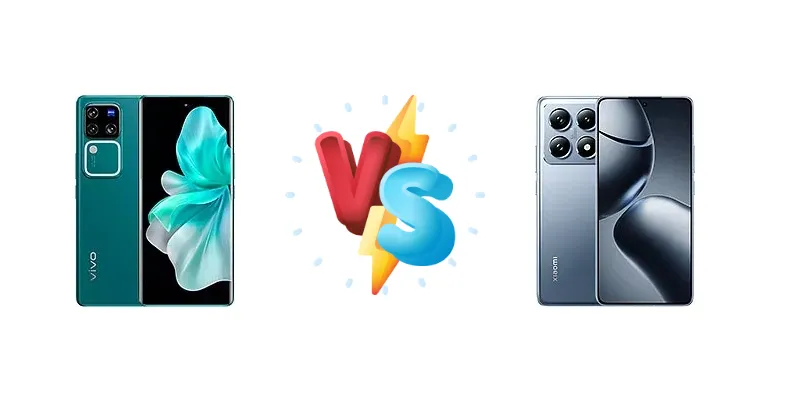
|
🏆 Quick Verdict
For users prioritizing raw speed and the convenience of incredibly fast charging, the Xiaomi 14T Pro is the clear winner. However, the vivo V30 Pro delivers superior battery endurance and a slightly brighter display, making it ideal for power users who value longevity over peak performance.
| PHONES | ||
|---|---|---|
| Phone Names | vivo V30 Pro | Xiaomi 14T Pro |
| Network | ||
|---|---|---|
| 2G bands | GSM 850 / 900 / 1800 / 1900 | GSM 850 / 900 / 1800 / 1900 |
| 3G bands | HSDPA 850 / 900 / 1700(AWS) / 1900 / 2100 | HSDPA 800 / 850 / 900 / 1700(AWS) / 1900 / 2100 |
| 4G bands | 1, 2, 3, 4, 5, 7, 8, 12, 17, 18, 19, 20, 26, 28, 38, 39, 40, 41 | 1, 2, 3, 4, 5, 7, 8, 12, 13, 17, 18, 19, 20, 25, 26, 28, 32, 38, 39, 40, 41, 42, 48, 66 |
| 5G bands | 1, 3, 5, 7, 8, 20, 28, 38, 40, 41, 77, 78 SA/NSA | 1, 2, 3, 5, 7, 8, 12, 20, 25, 26, 28, 38, 40, 41, 48, 66, 75, 77, 78 SA/NSA |
| Speed | HSPA, LTE, 5G | HSPA, LTE, 5G |
| Technology | GSM / CDMA / HSPA / LTE / 5G | GSM / HSPA / LTE / 5G |
| Launch | ||
|---|---|---|
| Announced | 2024, February 28 | 2024, September 26 |
| Status | Available. Released 2024, March 07 | Available. Released 2024, September 26 |
| Body | ||
|---|---|---|
| Build | Glass front (Schott α), glass back, plastic frame | Glass front (Gorilla Glass 5), aluminum frame, glass back (Panda X) |
| Dimensions | 164.4 x 75.1 x 7.5 mm (6.47 x 2.96 x 0.30 in) | 160.4 x 75.1 x 8.4 mm (6.31 x 2.96 x 0.33 in) |
| SIM | Nano-SIM + Nano-SIM | · Nano-SIM + eSIM· eSIM + eSIM· Nano-SIM + Nano-SIM |
| Weight | 188 g (6.63 oz) | 209 g (7.37 oz) |
| Display | ||
|---|---|---|
| Protection | Schott α glass | Corning Gorilla Glass 5 |
| Resolution | 1260 x 2800 pixels, 20:9 ratio (~453 ppi density) | 1220 x 2712 pixels, 20:9 ratio (~446 ppi density) |
| Size | 6.78 inches, 111.0 cm2 (~89.9% screen-to-body ratio) | 6.67 inches, 107.4 cm2 (~89.1% screen-to-body ratio) |
| Type | AMOLED, 1B colors, HDR10+, 120Hz, 2800 nits (peak) | AMOLED, 68B colors, 144Hz, 3840Hz PWM, Dolby Vision, HDR10+, 1600 nits (HBM), 4000 nits (peak) |
| Platform | ||
|---|---|---|
| CPU | Octa-core (1x3.1 GHz Cortex-A78 & 3x3.0 GHz Cortex-A78 & 4x2.0 GHz Cortex-A55) | Octa-core (1x3.4 GHz Cortex-X4 & 3x2.85 GHz Cortex-X4 & 4x2.0 GHz Cortex-A720) |
| Chipset | Mediatek Dimensity 8200 (4 nm) | Mediatek Dimensity 9300+ (4 nm) |
| GPU | Mali-G610 MC6 | Immortalis-G720 MC12 |
| OS | Android 14, up to 2 major Android upgrades, Funtouch 14 | Android 14, HyperOS |
| Memory | ||
|---|---|---|
| Card slot | No | No |
| Internal | 256GB 8GB RAM, 256GB 12GB RAM, 512GB 12GB RAM | 256GB 12GB RAM, 512GB 12GB RAM, 512GB 16GB RAM, 1TB 12GB RAM |
| Main Camera | ||
|---|---|---|
| Features | Zeiss optics, Zeiss T* lens coating, Ring-LED flash, panorama, HDR | Leica lens, Ultra HDR, LED flash, HDR, panorama |
| Triple | 50 MP, f/1.9, 23mm (wide), 1/1.49", 1.0µm, PDAF, OIS 50 MP, f/1.9, 50mm (telephoto), 1/2.51", 0.64µm, PDAF, 2x optical zoom 50 MP, f/2.0, 15mm, 119˚ (ultrawide), 1/2.76", 0.64µm, AF | 50 MP, f/1.6, 23mm (wide), 1/1.31", 1.2µm, PDAF, OIS 50 MP, f/2.0, 60mm (telephoto), 1/2.88", 0.61µm, PDAF, 2.6x optical zoom 12 MP, f/2.2, 15mm (ultrawide), 1/3.06", 1.12µm |
| Video | 4K@30fps, 1080p@30fps | 8K@24/30fps, 4K@24/30/60fps, 1080p@30/60/120/240/960fps, gyro-EIS, 10-bit Rec. 2020, HDR10+ |
| Selfie camera | ||
|---|---|---|
| Features | Dual-LED flash, HDR | HDR |
| Single | 50 MP, f/2.0, 20mm (wide), 1/2.76", 0.64µm, AF | 32 MP, f/2.0, 25mm (wide), 1/3.44", 0.64µm |
| Video | 4K@30fps, 1080p@30fps | 4K@30fps, 1080p@30/60fps, HDR10+ |
| Sound | ||
|---|---|---|
| 35mm jack | No | No |
| Loudspeaker | Yes | Yes, with stereo speakers |
| Comms | ||
|---|---|---|
| Bluetooth | 5.3, A2DP, LE, aptX HD | 5.4, A2DP, LE, LHDC |
| Infrared port | - | Yes |
| NFC | Yes | Yes (market/region dependent) |
| Positioning | GPS (L1+L5), GLONASS, BDS (B1I+B1c+B2a), GALILEO (E1+E5a), QZSS (L1+L5), NavIC (L5) | GPS (L1+L5), BDS (B1I+B1C+B2a+B2b), GALILEO (E1+E5a+E5b), QZSS (L1+L5), NavIC (L5), GLONASS |
| Radio | No | No |
| USB | USB Type-C 2.0, OTG | USB Type-C 2.0, OTG |
| WLAN | Wi-Fi 802.11 a/b/g/n/ac/6, dual-band, Wi-Fi Direct | Wi-Fi 802.11 a/b/g/n/ac/6e/7, dual-band, Wi-Fi Direct |
| Features | ||
|---|---|---|
| Sensors | Fingerprint (under display, optical), accelerometer, proximity, gyro, compass | Fingerprint (under display, optical), accelerometer, gyro, proximity, compass |
| Battery | ||
|---|---|---|
| Charging | 80W wired, PD, 100% in 43 min Reverse wired | 120W wired, PD3.0, QC4, 100% in 19 min 50W wireless, 100% in 45 min |
| Type | Li-Ion 5000 mAh | Li-Po 5000 mAh |
| Misc | ||
|---|---|---|
| Colors | Bloom White, Waving Aqua, Lush Green, Noble Black | Titan Gray, Titan Blue, Titan Black |
| Models | V2319 | 2407FPN8EG |
| Price | About 450 EUR | $ 550.00 / £ 498.00 / € 539.99 |
| SAR EU | - | 0.99 W/kg (head) 1.00 W/kg (body) |
vivo V30 Pro
- Superior battery life (13:25h active use)
- Slightly brighter display (1197 nits)
- Balanced performance for everyday tasks
- Slower charging speed (80W wired)
- Less powerful chipset compared to the Xiaomi
Xiaomi 14T Pro
- Blazing-fast 120W wired charging (0-100% in 19 min)
- More powerful Dimensity 9300+ chipset
- 50W wireless charging support
- Shorter battery life (12:32h active use)
- Slightly dimmer display (1228 nits)
Display Comparison
Both the Xiaomi 14T Pro and vivo V30 Pro feature vibrant displays, but subtle differences exist. The Xiaomi 14T Pro reaches a peak brightness of 1228 nits, slightly dimmer than the vivo V30 Pro’s 1197 nits, though this difference is unlikely to be noticeable in most real-world scenarios. While both utilize 4nm chipsets, display power draw will vary. Neither specification details refresh rate or panel technology (LTPO), so we must assume standard AMOLED panels. The Xiaomi’s slightly lower peak brightness is offset by potentially more aggressive color calibration, a common Xiaomi trait.
Camera Comparison
Without detailed camera specifications, a direct comparison is limited. However, the chipset’s ISP capabilities play a role. The Dimensity 9300+ in the Xiaomi 14T Pro likely offers more advanced image processing features and potentially better low-light performance due to its superior processing power. We can assume both phones will feature multi-camera systems, but the sensor sizes and lens apertures are unknown. The absence of information regarding OIS (Optical Image Stabilization) makes it impossible to assess video stabilization capabilities. It's safe to assume both will include standard wide, ultrawide, and potentially macro lenses, but the quality will depend heavily on the sensor implementation.
Performance
The performance gap is the most significant differentiator. The Xiaomi 14T Pro’s Mediatek Dimensity 9300+ chipset, featuring a 1x3.4 GHz Cortex-X4 prime core and 3x2.85 GHz Cortex-X4 performance cores, represents a substantial leap over the vivo V30 Pro’s Dimensity 8200 (1x3.1 GHz Cortex-A78, 3x3.0 GHz Cortex-A78, 4x2.0 GHz Cortex-A55). The Cortex-X4 architecture in the 9300+ offers significantly improved single-core performance, crucial for responsive UI and demanding applications. While both use a 4nm process, the architectural improvements in the 9300+ translate to a noticeable performance advantage. The Xiaomi also benefits from potentially faster LPDDR5x RAM, though this isn't specified. The vivo's Dimensity 8200 remains a capable performer, but will show its limitations in graphically intensive tasks.
Battery Life
The vivo V30 Pro edges out the Xiaomi 14T Pro in battery endurance, achieving an active use score of 13:25h compared to the Xiaomi’s 12:32h. This suggests the Dimensity 8200 is more power-efficient, or the vivo has better software optimization. However, the Xiaomi 14T Pro compensates with its groundbreaking 120W wired charging, reaching 100% in just 19 minutes – a significant advantage over the vivo’s 80W charging (43 minutes). The Xiaomi also adds 50W wireless charging, a feature absent on the vivo. The faster charging speed effectively mitigates the slightly smaller battery capacity for users who prioritize quick top-ups.
Buying Guide
Buy the vivo V30 Pro if you need all-day battery life and a consistently bright display for outdoor use. It’s the better choice for travelers, content consumers, and those who dislike frequent charging. Buy the Xiaomi 14T Pro if you demand the fastest possible performance for gaming and demanding applications, and if you value the ability to top up your battery from 0 to 100% in under 20 minutes.