
Vivo V30 Pro vs Samsung Galaxy S24+: Which Android Flagship Reigns Supreme?
| Phones Images | |||||
|---|---|---|---|---|---|
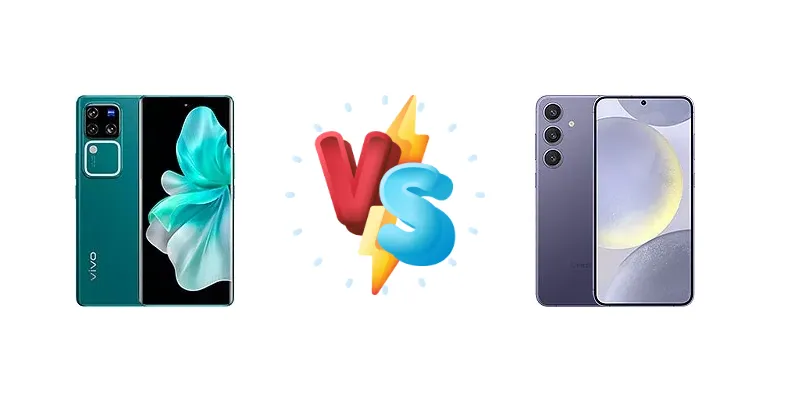
|
🏆 Quick Verdict
For most users, the Samsung Galaxy S24+ is the superior choice. While the Vivo V30 Pro offers impressive 80W charging and a bright display, the S24+'s significantly more powerful Snapdragon 8 Gen 3 (or Exynos 2400 depending on region) chipset and slightly longer battery life provide a smoother, more future-proof experience.
| PHONES | ||
|---|---|---|
| Phone Names | vivo V30 Pro | Samsung Galaxy S24+ |
| Network | ||
|---|---|---|
| 2G bands | GSM 850 / 900 / 1800 / 1900 | GSM 850 / 900 / 1800 / 1900 |
| 3G bands | HSDPA 850 / 900 / 1700(AWS) / 1900 / 2100 | HSDPA 850 / 900 / 1700(AWS) / 1900 / 2100 |
| 4G bands | 1, 2, 3, 4, 5, 7, 8, 12, 17, 18, 19, 20, 26, 28, 38, 39, 40, 41 | 1, 2, 3, 4, 5, 7, 8, 12, 13, 17, 18, 19, 20, 25, 26, 28, 32, 38, 39, 40, 41, 66 - International |
| 5G bands | 1, 3, 5, 7, 8, 20, 28, 38, 40, 41, 77, 78 SA/NSA | 1, 2, 3, 5, 7, 8, 12, 20, 25, 26, 28, 38, 40, 41, 66, 75, 77, 78 SA/NSA/Sub6 - International |
| Speed | HSPA, LTE, 5G | HSPA, LTE (up to 7CA), 5G |
| Technology | GSM / CDMA / HSPA / LTE / 5G | GSM / CDMA / HSPA / EVDO / LTE / 5G |
| Launch | ||
|---|---|---|
| Announced | 2024, February 28 | 2024, January 17 |
| Status | Available. Released 2024, March 07 | Available. Released 2024, January 24 |
| Body | ||
|---|---|---|
| Build | Glass front (Schott α), glass back, plastic frame | Glass front (Gorilla Glass Victus 2), glass back (Gorilla Glass Victus 2), aluminum frame |
| Dimensions | 164.4 x 75.1 x 7.5 mm (6.47 x 2.96 x 0.30 in) | 158.5 x 75.9 x 7.7 mm (6.24 x 2.99 x 0.30 in) |
| SIM | Nano-SIM + Nano-SIM | · Nano-SIM + Nano-SIM + eSIM + eSIM (max 2 at a time) - INT· Nano-SIM + eSIM + eSIM (max 2 at a time) - USA· Nano-SIM + Nano-SIM - CN |
| Weight | 188 g (6.63 oz) | 196 g or 197 g (6.91 oz) |
| Display | ||
|---|---|---|
| Protection | Schott α glass | Corning Gorilla Glass Victus 2 |
| Resolution | 1260 x 2800 pixels, 20:9 ratio (~453 ppi density) | 1440 x 3120 pixels, 19.5:9 ratio (~513 ppi density) |
| Size | 6.78 inches, 111.0 cm2 (~89.9% screen-to-body ratio) | 6.7 inches, 110.2 cm2 (~91.6% screen-to-body ratio) |
| Type | AMOLED, 1B colors, HDR10+, 120Hz, 2800 nits (peak) | Dynamic LTPO AMOLED 2X, 120Hz, HDR10+, 2600 nits (peak) |
| Platform | ||
|---|---|---|
| CPU | Octa-core (1x3.1 GHz Cortex-A78 & 3x3.0 GHz Cortex-A78 & 4x2.0 GHz Cortex-A55) | 8-core (1x3.39GHz Cortex-X4 & 3x3.1GHz Cortex-A720 & 2x2.9GHz Cortex-A720 & 2x2.2GHz Cortex-A520)10-core (1x3.2GHz Cortex-X4 & 2x2.9GHz Cortex-A720 & 3x2.6GHz Cortex-A720 & 4x1.95GHz Cortex-A520) |
| Chipset | Mediatek Dimensity 8200 (4 nm) | Qualcomm SM8650-AC Snapdragon 8 Gen 3 (4 nm) - USA/Canada/ChinaExynos 2400 (4 nm) - International |
| GPU | Mali-G610 MC6 | Adreno 750 (1 GHz) - USA/Canada/ChinaXclipse 940 - International |
| OS | Android 14, up to 2 major Android upgrades, Funtouch 14 | Android 14, up to 7 major Android upgrades, One UI 8.0 |
| Memory | ||
|---|---|---|
| Card slot | No | No |
| Internal | 256GB 8GB RAM, 256GB 12GB RAM, 512GB 12GB RAM | 256GB 12GB RAM, 512GB 12GB RAM |
| Main Camera | ||
|---|---|---|
| Features | Zeiss optics, Zeiss T* lens coating, Ring-LED flash, panorama, HDR | LED flash, auto-HDR, panorama |
| Triple | 50 MP, f/1.9, 23mm (wide), 1/1.49", 1.0µm, PDAF, OIS 50 MP, f/1.9, 50mm (telephoto), 1/2.51", 0.64µm, PDAF, 2x optical zoom 50 MP, f/2.0, 15mm, 119˚ (ultrawide), 1/2.76", 0.64µm, AF | 50 MP, f/1.8, 24mm (wide), 1/1.56", 1.0µm, dual pixel PDAF, OIS 10 MP, f/2.4, 67mm (telephoto), 1/3.94", 1.0µm, PDAF, OIS, 3x optical zoom 12 MP, f/2.2, 13mm, 120˚ (ultrawide), 1/2.55" 1.4µm, Super Steady video |
| Video | 4K@30fps, 1080p@30fps | 8K@24/30fps, 4K@30/60fps, 1080p@30/60/120/240fps, HDR10+, stereo sound rec., gyro-EIS |
| Selfie camera | ||
|---|---|---|
| Features | Dual-LED flash, HDR | HDR, HDR10+ |
| Single | 50 MP, f/2.0, 20mm (wide), 1/2.76", 0.64µm, AF | 12 MP, f/2.2, 26mm (wide), 1/3.2", 1.12µm, dual pixel PDAF |
| Video | 4K@30fps, 1080p@30fps | 4K@30/60fps, 1080p@30fps |
| Sound | ||
|---|---|---|
| 35mm jack | No | No |
| Loudspeaker | Yes | Yes, with stereo speakers |
| Comms | ||
|---|---|---|
| Bluetooth | 5.3, A2DP, LE, aptX HD | 5.3, A2DP, LE |
| NFC | Yes | Yes |
| Positioning | GPS (L1+L5), GLONASS, BDS (B1I+B1c+B2a), GALILEO (E1+E5a), QZSS (L1+L5), NavIC (L5) | GPS, GLONASS, BDS, GALILEO, QZSS |
| Radio | No | No |
| USB | USB Type-C 2.0, OTG | USB Type-C 3.2, DisplayPort 1.2, OTG |
| WLAN | Wi-Fi 802.11 a/b/g/n/ac/6, dual-band, Wi-Fi Direct | Wi-Fi 802.11 a/b/g/n/ac/6e, tri-band, Wi-Fi Direct |
| Features | ||
|---|---|---|
| Sensors | Fingerprint (under display, optical), accelerometer, proximity, gyro, compass | Fingerprint (under display, ultrasonic), accelerometer, gyro, proximity, compass, barometer |
| Battery | ||
|---|---|---|
| Charging | 80W wired, PD, 100% in 43 min Reverse wired | 45W wired, PD3.0, 65% in 30 min 15W wireless (Qi) 4.5W reverse wireless |
| Type | Li-Ion 5000 mAh | Li-Ion 4900 mAh |
| Misc | ||
|---|---|---|
| Colors | Bloom White, Waving Aqua, Lush Green, Noble Black | Onyx Black, Marble Grey, Cobalt Violet, Amber Yellow, Jade Green, Sandstone Orange, Sapphire Blue |
| Models | V2319 | SM-S926B, SM-S926B/DS, SM-S926U, SM-S926U1, SM-S926W, SM-S926N, SM-S9260, SM-S926E, SM-S926E/DS |
| Price | About 450 EUR | $ 429.50 / € 549.00 / £ 445.98 |
| SAR | - | 1.16 W/kg (head) 0.84 W/kg (body) |
| SAR EU | - | 0.74 W/kg (head) 1.25 W/kg (body) |
vivo V30 Pro
- Incredibly fast 80W wired charging
- Competitive active use battery life (13:25h)
- Bright and vibrant display (1197 nits)
- Potentially more affordable price point
- Less powerful chipset (Dimensity 8200)
- Limited camera details in provided specs
Samsung Galaxy S24+
- Significantly more powerful chipset (Snapdragon 8 Gen 3/Exynos 2400)
- Brighter display (1452 nits)
- Samsung’s established software ecosystem
- Likely superior camera performance
- Slower wired charging (45W)
- Slightly shorter active use battery life (12:30h)
Display Comparison
Both phones feature 4nm chipsets, but their displays differ noticeably. The Samsung Galaxy S24+ boasts a peak brightness of 1452 nits, significantly exceeding the Vivo V30 Pro’s 1197 nits. This translates to better visibility in direct sunlight. While both likely utilize AMOLED panels, Samsung’s implementation often includes LTPO technology for adaptive refresh rates, potentially improving battery efficiency. The S24+’s higher brightness and likely LTPO implementation give it an edge for outdoor use and power management.
Camera Comparison
Context data is limited regarding camera specifics, but we can infer some differences. Samsung typically prioritizes versatile camera systems with strong image processing. The S24+ likely features a larger main sensor and more sophisticated computational photography algorithms than the V30 Pro. While the V30 Pro may offer competitive image quality in ideal conditions, the S24+ is expected to excel in low-light scenarios and provide more consistent results across various shooting conditions. The absence of detail on the V30 Pro’s camera system suggests it may not be a primary selling point.
Performance
The performance gap is the most significant differentiator. The Samsung Galaxy S24+ utilizes the Qualcomm Snapdragon 8 Gen 3 (in USA/Canada/China) or the Exynos 2400 (International), both built on a 4nm process. The Snapdragon 8 Gen 3’s Cortex-X4 prime core, clocked at 3.39GHz, and advanced GPU architecture provide a substantial performance uplift over the Vivo V30 Pro’s MediaTek Dimensity 8200. The Dimensity 8200, while capable, features older Cortex-A78 cores and a less powerful GPU. This difference will be most apparent in demanding games and resource-intensive applications. The S24+'s RAM configuration (likely LPDDR5x) also contributes to faster multitasking.
Battery Life
The Vivo V30 Pro achieves 13:25h of active use, while the Samsung Galaxy S24+ manages 12:30h. This suggests the V30 Pro has slightly better battery endurance despite a potentially smaller capacity. However, the S24+ compensates with significantly faster charging – 45W wired, reaching 65% in 30 minutes – compared to the V30 Pro’s 80W, which takes 43 minutes for a full charge. The V30 Pro also offers reverse wired charging, a feature present but less emphasized on the S24+ (4.5W reverse wireless). The V30 Pro’s faster charging is a key advantage, but the S24+’s overall efficiency and software optimization contribute to a competitive real-world experience.
Buying Guide
Buy the Vivo V30 Pro if you prioritize incredibly fast charging – its 80W wired charging is a standout feature – and are looking for a stylish device with a vibrant display at a lower price. Buy the Samsung Galaxy S24+ if you demand the best possible performance for demanding tasks like gaming and video editing, value Samsung’s software features and ecosystem, and want a phone with a proven track record of software updates.