
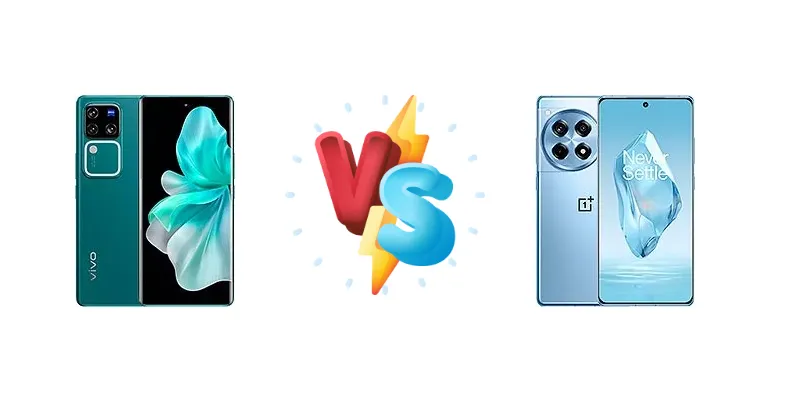
OnePlus 12R vs vivo V30 Pro: A Deep Dive into Performance and Value
| Phones Images | |||||
|---|---|---|---|---|---|
|
🏆 Quick Verdict
For most users, the OnePlus 12R emerges as the stronger choice. Its Snapdragon 8 Gen 2 chipset provides a noticeable performance edge, coupled with faster 100W charging and slightly better battery life. While the vivo V30 Pro offers a respectable experience, the 12R’s raw power and efficiency are hard to ignore.
| PHONES | ||
|---|---|---|
| Phone Names | vivo V30 Pro | OnePlus 12R |
| Network | ||
|---|---|---|
| 2G bands | GSM 850 / 900 / 1800 / 1900 | GSM 850 / 900 / 1800 / 1900 |
| 3G bands | HSDPA 850 / 900 / 1700(AWS) / 1900 / 2100 | HSDPA 850 / 900 / 1700(AWS) / 1900 / 2100 |
| 4G bands | 1, 2, 3, 4, 5, 7, 8, 12, 17, 18, 19, 20, 26, 28, 38, 39, 40, 41 | 1, 2, 3, 4, 5, 7, 8, 12, 17, 18, 19, 20, 26, 28, 32, 38, 39, 40, 41, 66 |
| 5G bands | 1, 3, 5, 7, 8, 20, 28, 38, 40, 41, 77, 78 SA/NSA | 1, 2, 3, 5, 7, 8, 12, 20, 28, 38, 40, 41, 66, 77, 78 SA/NSA |
| Speed | HSPA, LTE, 5G | HSPA, LTE, 5G |
| Technology | GSM / CDMA / HSPA / LTE / 5G | GSM / CDMA / HSPA / LTE / 5G |
| Launch | ||
|---|---|---|
| Announced | 2024, February 28 | 2024, January 23 |
| Status | Available. Released 2024, March 07 | Available. Released 2024, February 06 |
| Body | ||
|---|---|---|
| Build | Glass front (Schott α), glass back, plastic frame | Glass front (Gorilla Glass Victus 2), aluminum frame, glass back |
| Dimensions | 164.4 x 75.1 x 7.5 mm (6.47 x 2.96 x 0.30 in) | 163.3 x 75.3 x 8.8 mm (6.43 x 2.96 x 0.35 in) |
| SIM | Nano-SIM + Nano-SIM | · Nano-SIM + Nano-SIM + eSIM (max 2 at a time)· Nano-SIM + Nano-SIM |
| Weight | 188 g (6.63 oz) | 207 g (7.30 oz) |
| Display | ||
|---|---|---|
| Protection | Schott α glass | Corning Gorilla Glass Victus 2 |
| Resolution | 1260 x 2800 pixels, 20:9 ratio (~453 ppi density) | 1264 x 2780 pixels (~450 ppi density) |
| Size | 6.78 inches, 111.0 cm2 (~89.9% screen-to-body ratio) | 6.78 inches, 111.7 cm2 (~90.9% screen-to-body ratio) |
| Type | AMOLED, 1B colors, HDR10+, 120Hz, 2800 nits (peak) | LTPO4 AMOLED, 1B colors, 120Hz, HDR10+, Dolby Vision, 1600 nits (HBM), 4500 nits (peak) |
| Platform | ||
|---|---|---|
| CPU | Octa-core (1x3.1 GHz Cortex-A78 & 3x3.0 GHz Cortex-A78 & 4x2.0 GHz Cortex-A55) | Octa-core (1x3.2 GHz Cortex-X3 & 2x2.8 GHz Cortex-A715 & 2x2.8 GHz Cortex-A710 & 3x2.0 GHz Cortex-A510) |
| Chipset | Mediatek Dimensity 8200 (4 nm) | Qualcomm SM8550-AB Snapdragon 8 Gen 2 (4 nm) |
| GPU | Mali-G610 MC6 | Adreno 740 |
| OS | Android 14, up to 2 major Android upgrades, Funtouch 14 | Android 14, up to 3 major Android upgrades, OxygenOS 15 |
| Memory | ||
|---|---|---|
| Card slot | No | No |
| Internal | 256GB 8GB RAM, 256GB 12GB RAM, 512GB 12GB RAM | 128GB 8GB RAM, 256GB 8GB RAM, 256GB 12GB RAM, 256GB 16GB RAM |
| Main Camera | ||
|---|---|---|
| Features | Zeiss optics, Zeiss T* lens coating, Ring-LED flash, panorama, HDR | Laser AF, color spectrum sensor, LED flash, HDR, panorama |
| Triple | 50 MP, f/1.9, 23mm (wide), 1/1.49", 1.0µm, PDAF, OIS 50 MP, f/1.9, 50mm (telephoto), 1/2.51", 0.64µm, PDAF, 2x optical zoom 50 MP, f/2.0, 15mm, 119˚ (ultrawide), 1/2.76", 0.64µm, AF | 50 MP, f/1.8, 24mm (wide), 1/1.56", 1.0µm, multi-directional PDAF, OIS 8 MP, f/2.2, 16mm, 112˚ (ultrawide), 1/4.0", 1.12µm 2 MP (macro) |
| Video | 4K@30fps, 1080p@30fps | 4K@30/60fps, 1080p@30/60/120/240fps, gyro-EIS, OIS |
| Selfie camera | ||
|---|---|---|
| Features | Dual-LED flash, HDR | HDR, panorama |
| Single | 50 MP, f/2.0, 20mm (wide), 1/2.76", 0.64µm, AF | 16 MP, f/2.4, 26mm (wide), 1/3", 1.0µm |
| Video | 4K@30fps, 1080p@30fps | 1080p@30fps, gyro-EIS |
| Sound | ||
|---|---|---|
| 35mm jack | No | No |
| Loudspeaker | Yes | Yes, with stereo speakers |
| Comms | ||
|---|---|---|
| Bluetooth | 5.3, A2DP, LE, aptX HD | 5.3, A2DP, LE, aptX HD |
| Infrared port | - | Yes |
| NFC | Yes | Yes |
| Positioning | GPS (L1+L5), GLONASS, BDS (B1I+B1c+B2a), GALILEO (E1+E5a), QZSS (L1+L5), NavIC (L5) | GPS, GALILEO, GLONASS, BDS, QZSS |
| Radio | No | No |
| USB | USB Type-C 2.0, OTG | USB Type-C 2.0 |
| WLAN | Wi-Fi 802.11 a/b/g/n/ac/6, dual-band, Wi-Fi Direct | Wi-Fi 802.11 a/b/g/n/ac/6/7, dual-band |
| Features | ||
|---|---|---|
| Sensors | Fingerprint (under display, optical), accelerometer, proximity, gyro, compass | Fingerprint (under display, optical), accelerometer, gyro, proximity, compass |
| Battery | ||
|---|---|---|
| Charging | 80W wired, PD, 100% in 43 min Reverse wired | 100W wired, 100% in 26 min |
| Type | Li-Ion 5000 mAh | Li-Ion 5500 mAh |
| Misc | ||
|---|---|---|
| Colors | Bloom White, Waving Aqua, Lush Green, Noble Black | Iron Gray, Cool Blue, Electric Violet, Sunset Dune |
| Models | V2319 | CPH2609, CPH2585, CPH2611 |
| Price | About 450 EUR | € 410.84 / $ 399.95 / £ 649.00 |
| SAR | - | 1.19 W/kg (head) 0.82 W/kg (body) |
vivo V30 Pro
- Superior performance with Snapdragon 8 Gen 2
- Faster 100W charging
- Slightly better battery life in real-world use
- OxygenOS may not appeal to all users
- Design is more utilitarian than the V30 Pro
OnePlus 12R
- Sleek and stylish design
- Potentially better portrait camera processing
- Funtouch OS offers unique features
- Dimensity 8200 is outperformed by Snapdragon 8 Gen 2
- Slower 80W charging
Display Comparison
Both the OnePlus 12R and vivo V30 Pro feature excellent displays, with measured peak brightness figures of 1181 nits and 1197 nits respectively. The difference is negligible in real-world use. While neither manufacturer explicitly details PWM dimming rates, both are likely to employ high-frequency PWM to minimize flicker. The 12R’s display is likely to benefit from OnePlus’s established color calibration expertise, though both displays should offer vibrant and accurate colors. Bezels appear comparable based on available imagery, suggesting a similar immersive viewing experience.
Camera Comparison
Without detailed camera specs, a direct comparison is limited. However, the market positioning suggests the OnePlus 12R will likely prioritize overall image quality and versatility, potentially featuring a larger main sensor. The vivo V30 Pro, known for its portrait capabilities, may emphasize software-driven enhancements and beauty modes. The Dimensity 8200’s ISP is capable, but the Snapdragon 8 Gen 2’s ISP offers more advanced features and processing capabilities. The presence of OIS on the main sensor of both devices is expected, but sensor size and aperture will be key differentiators. We can safely assume both phones will include a standard ultrawide and macro lens, though the utility of a 2MP macro lens is questionable on both devices.
Performance
The core difference lies in the chipsets. The OnePlus 12R’s Snapdragon 8 Gen 2 (SM8550-AB) boasts a prime Cortex-X3 core clocked at 3.2 GHz, alongside two Cortex-A715 cores at 2.8 GHz and two Cortex-A710 cores at 2.8 GHz, complemented by three Cortex-A510 efficiency cores. This configuration, built on a 4nm process, offers a significant advantage over the vivo V30 Pro’s Dimensity 8200. The Dimensity 8200 utilizes a single 3.1 GHz Cortex-A78 core, three 3.0 GHz Cortex-A78 cores, and four 2.0 GHz Cortex-A55 cores, also on a 4nm node. The Snapdragon 8 Gen 2’s architectural improvements, particularly the Cortex-X3, translate to superior single-core and multi-core performance, crucial for demanding tasks and gaming. The 12R will exhibit less thermal throttling under sustained load.
Battery Life
The OnePlus 12R delivers a slightly longer active use battery score of 14:32h compared to the vivo V30 Pro’s 13:25h. This difference, while not massive, is likely attributable to the Snapdragon 8 Gen 2’s superior power efficiency. Crucially, the 12R supports 100W SuperVOOC charging, achieving a full charge in just 26 minutes, while the V30 Pro’s 80W charging takes 43 minutes. This faster charging speed significantly reduces downtime and provides a more convenient user experience. The 12R’s efficiency offsets the slightly smaller battery capacity.
Buying Guide
Buy the vivo V30 Pro if you prioritize a sleek design and are heavily invested in the vivo ecosystem, valuing its software features and camera processing style. Buy the OnePlus 12R if you demand maximum performance for gaming and demanding applications, coupled with faster charging speeds and a more streamlined Android experience. The 12R is the clear choice for power users.