
Honor Magic6 Pro vs vivo V30 Pro: A Deep Dive into Flagship Performance and Features
| Phones Images | |||||
|---|---|---|---|---|---|
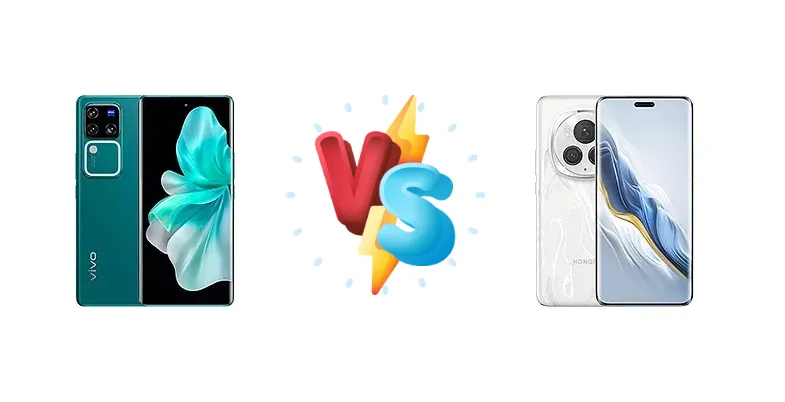
|
🏆 Quick Verdict
For the average user prioritizing peak performance and a brighter display, the Honor Magic6 Pro emerges as the winner. Its Snapdragon 8 Gen 3 chipset and significantly brighter 1578 nit display offer a noticeable advantage. However, the vivo V30 Pro remains a strong contender for those valuing a more streamlined experience and potentially better thermal management.
| PHONES | ||
|---|---|---|
| Phone Names | vivo V30 Pro | Honor Magic6 Pro |
| Network | ||
|---|---|---|
| 2G bands | GSM 850 / 900 / 1800 / 1900 | GSM 850 / 900 / 1800 / 1900 |
| 3G bands | HSDPA 850 / 900 / 1700(AWS) / 1900 / 2100 | HSDPA 800 / 850 / 900 / 1700(AWS) / 1900 / 2100 |
| 4G bands | 1, 2, 3, 4, 5, 7, 8, 12, 17, 18, 19, 20, 26, 28, 38, 39, 40, 41 | LTE |
| 5G bands | 1, 3, 5, 7, 8, 20, 28, 38, 40, 41, 77, 78 SA/NSA | SA/NSA |
| Speed | HSPA, LTE, 5G | HSPA, LTE, 5G |
| Technology | GSM / CDMA / HSPA / LTE / 5G | GSM / CDMA / HSPA / CDMA2000 / LTE / 5G |
| Launch | ||
|---|---|---|
| Announced | 2024, February 28 | 2024, January 11 |
| Status | Available. Released 2024, March 07 | Available. Released 2024, January 18 |
| Body | ||
|---|---|---|
| Build | Glass front (Schott α), glass back, plastic frame | Glass front (NanoCrystal Shield), glass back or silicone polymer back (eco leather) |
| Dimensions | 164.4 x 75.1 x 7.5 mm (6.47 x 2.96 x 0.30 in) | 162.5 x 75.8 x 8.9 mm (6.40 x 2.98 x 0.35 in) |
| SIM | Nano-SIM + Nano-SIM | · Nano-SIM + eSIM· Nano-SIM + Nano-SIM |
| Weight | 188 g (6.63 oz) | 225 g or 229 g (7.94 oz) |
| Display | ||
|---|---|---|
| Protection | Schott α glass | NanoCrystal Shield |
| Resolution | 1260 x 2800 pixels, 20:9 ratio (~453 ppi density) | 1280 x 2800 pixels, 19.5:9 ratio (~453 ppi density) |
| Size | 6.78 inches, 111.0 cm2 (~89.9% screen-to-body ratio) | 6.8 inches, 112.8 cm2 (~91.6% screen-to-body ratio) |
| Type | AMOLED, 1B colors, HDR10+, 120Hz, 2800 nits (peak) | LTPO OLED, 1B colors, 120Hz, Dolby Vision, HDR, 1600 nits (HBM), 5000 nits (peak) |
| Platform | ||
|---|---|---|
| CPU | Octa-core (1x3.1 GHz Cortex-A78 & 3x3.0 GHz Cortex-A78 & 4x2.0 GHz Cortex-A55) | Octa-core (1x3.3 GHz Cortex-X4 & 3x3.2 GHz Cortex-A720 & 2x3.0 GHz Cortex-A720 & 2x2.3 GHz Cortex-A520) |
| Chipset | Mediatek Dimensity 8200 (4 nm) | Qualcomm SM8650-AB Snapdragon 8 Gen 3 (4 nm) |
| GPU | Mali-G610 MC6 | Adreno 750 |
| OS | Android 14, up to 2 major Android upgrades, Funtouch 14 | Android 14, up to 4 major Android upgrades, MagicOS 8 |
| Memory | ||
|---|---|---|
| Card slot | No | No |
| Internal | 256GB 8GB RAM, 256GB 12GB RAM, 512GB 12GB RAM | 256GB 12GB RAM, 256GB 16GB RAM, 512GB 12GB RAM, 512GB 16GB RAM, 1TB 16GB RAM |
| Main Camera | ||
|---|---|---|
| Features | Zeiss optics, Zeiss T* lens coating, Ring-LED flash, panorama, HDR | Laser AF, color spectrum sensor, LED flash, HDR, panorama |
| Triple | 50 MP, f/1.9, 23mm (wide), 1/1.49", 1.0µm, PDAF, OIS 50 MP, f/1.9, 50mm (telephoto), 1/2.51", 0.64µm, PDAF, 2x optical zoom 50 MP, f/2.0, 15mm, 119˚ (ultrawide), 1/2.76", 0.64µm, AF | 50 MP, f/1.4-2.0, 23mm (wide), 1/1.3", 1.2µm, PDAF, OIS 180 MP, f/2.6, (periscope telephoto), 1/1.49", 0.56µm, PDAF, OIS, 2.5x optical zoom 50 MP, f/2.0, 13mm, 122˚ (ultrawide), 1/2.88", 0.61µm, AF |
| Video | 4K@30fps, 1080p@30fps | 4K@24/30/60fps, 1080p@30/60/120/240fps, gyro-EIS, OIS, HDR, 10-bit video |
| Selfie camera | ||
|---|---|---|
| Features | Dual-LED flash, HDR | - |
| Single | 50 MP, f/2.0, 20mm (wide), 1/2.76", 0.64µm, AF | 50 MP, f/2.0, 22mm (wide), 1/2.93", 0.6µm, AF TOF 3D, (depth/biometrics sensor) |
| Video | 4K@30fps, 1080p@30fps | 4K@30fps, 1080p@30/60fps, gyro-EIS |
| Sound | ||
|---|---|---|
| 35mm jack | No | No |
| Loudspeaker | Yes | Yes, with stereo speakers |
| Comms | ||
|---|---|---|
| Bluetooth | 5.3, A2DP, LE, aptX HD | 5.3, A2DP, LE, aptX HD |
| Infrared port | - | Yes |
| NFC | Yes | Yes |
| Positioning | GPS (L1+L5), GLONASS, BDS (B1I+B1c+B2a), GALILEO (E1+E5a), QZSS (L1+L5), NavIC (L5) | GPS (L1+L5), GLONASS, BDS (B1I+B1c+B2a), GALILEO (E1+E5a) |
| Radio | No | No |
| USB | USB Type-C 2.0, OTG | USB Type-C 3.2, DisplayPort 1.2, OTG |
| WLAN | Wi-Fi 802.11 a/b/g/n/ac/6, dual-band, Wi-Fi Direct | Wi-Fi 802.11 a/b/g/n/ac/6/7, dual-band, Wi-Fi Direct |
| Features | ||
|---|---|---|
| Sensors | Fingerprint (under display, optical), accelerometer, proximity, gyro, compass | Fingerprint (under display, optical), Face ID, accelerometer, gyro, proximity, compass |
| Battery | ||
|---|---|---|
| Charging | 80W wired, PD, 100% in 43 min Reverse wired | 80W wired 66W wireless Reverse wireless 5W reverse wired |
| Type | Li-Ion 5000 mAh | Si/C Li-Ion 5600 mAh |
| Misc | ||
|---|---|---|
| Colors | Bloom White, Waving Aqua, Lush Green, Noble Black | Black, Green, Blue, Purple, White |
| Models | V2319 | BVL-AN16, BVL-N49 |
| Price | About 450 EUR | € 455.54 / $ 899.00 / £ 598.99 |
vivo V30 Pro
- Potentially better thermal management due to less powerful chipset
- Stylish design and build quality
- Fast 80W wired charging
- Less powerful chipset compared to Snapdragon 8 Gen 3
- Dimmer display, less visible in sunlight
- Lacks wireless charging
Honor Magic6 Pro
- Significantly brighter display for outdoor use
- Top-tier performance with Snapdragon 8 Gen 3
- 66W wireless charging and 5W reverse wireless charging
- May run hotter under sustained load
- Potentially higher price point
- Software experience may vary
Display Comparison
The Honor Magic6 Pro boasts a significantly brighter display, reaching a measured 1578 nits compared to the vivo V30 Pro’s 1197 nits. This difference translates to vastly improved visibility in direct sunlight. While both utilize 4nm chipsets, the display’s power draw will impact overall efficiency. We lack panel technology details (LTPO, PWM frequency) but the brightness gap is a clear win for the Magic6 Pro, benefiting users who frequently consume content outdoors or in brightly lit environments. The V30 Pro’s display, while still excellent, will appear comparatively dimmer.
Camera Comparison
Without detailed camera specs, a direct comparison is limited. However, the chipset difference indirectly impacts camera processing. The Snapdragon 8 Gen 3’s ISP (Image Signal Processor) is more advanced, enabling faster image processing and potentially better low-light performance. We can assume the Magic6 Pro will offer more sophisticated computational photography features. The absence of information on sensor sizes and OIS makes a definitive statement impossible, but the processing power advantage leans towards the Honor device. Ignoring the likely present but functionally limited 2MP macro cameras on both devices, the overall imaging experience will likely be superior on the Magic6 Pro.
Performance
The core difference lies in the chipsets: the Honor Magic6 Pro features the Qualcomm Snapdragon 8 Gen 3, while the vivo V30 Pro utilizes the MediaTek Dimensity 8200. The Snapdragon 8 Gen 3’s Cortex-X4 prime core (3.3 GHz) and newer Cortex-A720 performance cores represent a substantial architectural leap over the Dimensity 8200’s Cortex-A78 cores (3.1 GHz). This translates to faster application loading, smoother multitasking, and superior gaming performance. While both are 4nm chips, the Snapdragon 8 Gen 3’s architecture is more efficient, though it may run hotter under sustained load. The Magic6 Pro’s superior GPU will also deliver a better graphics experience.
Battery Life
The Honor Magic6 Pro edges out the vivo V30 Pro in active use battery life, achieving 14:06h versus 13:25h. This suggests better power efficiency despite the more powerful chipset, potentially due to software optimizations. Both support 80W wired charging, reaching 100% in approximately 43 minutes for the V30 Pro. However, the Magic6 Pro adds 66W wireless charging and 5W reverse wired charging, offering greater versatility. The slightly longer battery life combined with wireless charging gives the Magic6 Pro a clear advantage for users who prioritize convenience.
Buying Guide
Buy the vivo V30 Pro if you need a stylish phone with a good all-around experience, prioritizing a balance between performance and battery life, and appreciate a potentially cooler running device during extended use. Buy the Honor Magic6 Pro if you prefer a flagship with uncompromising performance, a stunningly bright display for outdoor visibility, and the convenience of fast wireless charging, even if it means potentially higher temperatures under sustained load.