
vivo V30 Pro vs iPhone 15 Pro Max: A Head-to-Head Flagship Battle
| Phones Images | |||||
|---|---|---|---|---|---|
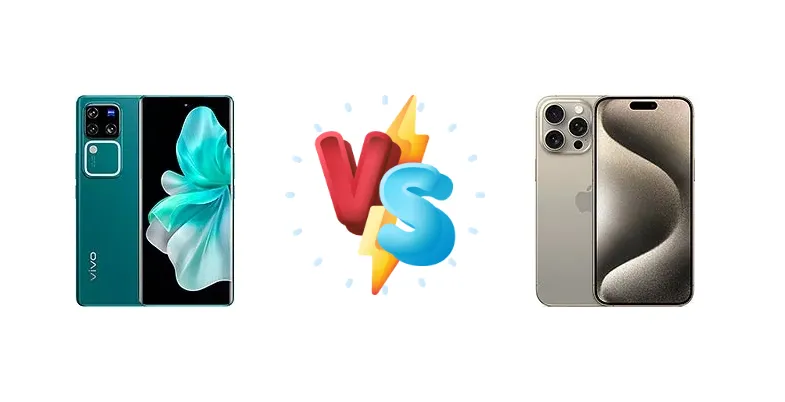
|
🏆 Quick Verdict
For the average user prioritizing raw power, long-term software support, and a seamless ecosystem, the iPhone 15 Pro Max is the clear winner. However, the vivo V30 Pro offers a stunning display and incredibly fast 80W charging at a significantly lower price point, making it a strong choice for those seeking value and speed.
| PHONES | ||
|---|---|---|
| Phone Names | vivo V30 Pro | Apple iPhone 15 Pro Max |
| Network | ||
|---|---|---|
| 2G bands | GSM 850 / 900 / 1800 / 1900 | GSM 850 / 900 / 1800 / 1900 |
| 3G bands | HSDPA 850 / 900 / 1700(AWS) / 1900 / 2100 | HSDPA 850 / 900 / 1700(AWS) / 1900 / 2100 |
| 4G bands | 1, 2, 3, 4, 5, 7, 8, 12, 17, 18, 19, 20, 26, 28, 38, 39, 40, 41 | 1, 2, 3, 4, 5, 7, 8, 12, 13, 17, 18, 19, 20, 25, 26, 28, 30, 32, 34, 38, 39, 40, 41, 42, 46, 48, 53, 66 - A3106 |
| 5G bands | 1, 3, 5, 7, 8, 20, 28, 38, 40, 41, 77, 78 SA/NSA | 1, 2, 3, 5, 7, 8, 12, 20, 25, 26, 28, 30, 38, 40, 41, 48, 53, 66, 70, 77, 78, 79 SA/NSA/Sub6 - A3106 |
| Speed | HSPA, LTE, 5G | HSPA, LTE, 5G, EV-DO Rev.A 3.1 Mbps |
| Technology | GSM / CDMA / HSPA / LTE / 5G | GSM / CDMA / HSPA / EVDO / LTE / 5G |
| Launch | ||
|---|---|---|
| Announced | 2024, February 28 | 2023, September 12 |
| Status | Available. Released 2024, March 07 | Available. Released 2023, September 22 |
| Body | ||
|---|---|---|
| Build | Glass front (Schott α), glass back, plastic frame | Glass front, glass back, titanium frame (grade 5) |
| Dimensions | 164.4 x 75.1 x 7.5 mm (6.47 x 2.96 x 0.30 in) | 159.9 x 76.7 x 8.3 mm (6.30 x 3.02 x 0.33 in) |
| SIM | Nano-SIM + Nano-SIM | · Nano-SIM + eSIM + eSIM (max 2 at a time; International)· eSIM + eSIM (8 or more, max 2 at a time; USA)· Nano-SIM + Nano-SIM (China) |
| Weight | 188 g (6.63 oz) | 221 g (7.80 oz) |
| Display | ||
|---|---|---|
| Protection | Schott α glass | Ceramic Shield glass |
| Resolution | 1260 x 2800 pixels, 20:9 ratio (~453 ppi density) | 1290 x 2796 pixels, 19.5:9 ratio (~460 ppi density) |
| Size | 6.78 inches, 111.0 cm2 (~89.9% screen-to-body ratio) | 6.7 inches, 110.2 cm2 (~89.8% screen-to-body ratio) |
| Type | AMOLED, 1B colors, HDR10+, 120Hz, 2800 nits (peak) | LTPO Super Retina XDR OLED, 120Hz, HDR10, Dolby Vision, 1000 nits (typ), 2000 nits (HBM) |
| Platform | ||
|---|---|---|
| CPU | Octa-core (1x3.1 GHz Cortex-A78 & 3x3.0 GHz Cortex-A78 & 4x2.0 GHz Cortex-A55) | Hexa-core (2x3.78 GHz + 4x2.11 GHz) |
| Chipset | Mediatek Dimensity 8200 (4 nm) | Apple A17 Pro (3 nm) |
| GPU | Mali-G610 MC6 | Apple GPU (6-core graphics) |
| OS | Android 14, up to 2 major Android upgrades, Funtouch 14 | iOS 17, upgradable to iOS 26.1 |
| Memory | ||
|---|---|---|
| Card slot | No | No |
| Internal | 256GB 8GB RAM, 256GB 12GB RAM, 512GB 12GB RAM | 256GB 8GB RAM, 512GB 8GB RAM, 1TB 8GB RAM |
| Main Camera | ||
|---|---|---|
| Features | Zeiss optics, Zeiss T* lens coating, Ring-LED flash, panorama, HDR | Dual-LED dual-tone flash, HDR (photo/panorama) |
| Triple | 50 MP, f/1.9, 23mm (wide), 1/1.49", 1.0µm, PDAF, OIS 50 MP, f/1.9, 50mm (telephoto), 1/2.51", 0.64µm, PDAF, 2x optical zoom 50 MP, f/2.0, 15mm, 119˚ (ultrawide), 1/2.76", 0.64µm, AF | 48 MP, f/1.8, 24mm (wide), 1/1.28", 1.22µm, dual pixel PDAF, sensor-shift OIS 12 MP, f/2.8, 120mm (periscope telephoto), 1/3.06", 1.12µm, dual pixel PDAF, 3D sensor‑shift OIS, 5x optical zoom 12 MP, f/2.2, 13mm, 120˚ (ultrawide), 1/2.55", 1.4µm, dual pixel PDAF TOF 3D LiDAR scanner (depth) |
| Video | 4K@30fps, 1080p@30fps | 4K@24/25/30/60fps, 1080p@25/30/60/120/240fps, 10-bit HDR, Dolby Vision HDR (up to 60fps), ProRes, 3D (spatial) video, stereo sound rec. |
| Selfie camera | ||
|---|---|---|
| Features | Dual-LED flash, HDR | HDR, Dolby Vision HDR |
| Single | 50 MP, f/2.0, 20mm (wide), 1/2.76", 0.64µm, AF | 12 MP, f/1.9, 23mm (wide), 1/3.6", 1.0µm, PDAF, OIS SL 3D, (depth/biometrics sensor) |
| Video | 4K@30fps, 1080p@30fps | 4K@24/25/30/60fps, 1080p@25/30/60/120fps, gyro-EIS |
| Sound | ||
|---|---|---|
| 35mm jack | No | No |
| Loudspeaker | Yes | Yes, with stereo speakers |
| Comms | ||
|---|---|---|
| Bluetooth | 5.3, A2DP, LE, aptX HD | 5.3, A2DP, LE |
| NFC | Yes | Yes |
| Positioning | GPS (L1+L5), GLONASS, BDS (B1I+B1c+B2a), GALILEO (E1+E5a), QZSS (L1+L5), NavIC (L5) | GPS (L1+L5), GLONASS, GALILEO, BDS, QZSS, NavIC |
| Radio | No | No |
| USB | USB Type-C 2.0, OTG | USB Type-C 3.2 Gen 2, DisplayPort |
| WLAN | Wi-Fi 802.11 a/b/g/n/ac/6, dual-band, Wi-Fi Direct | Wi-Fi 802.11 a/b/g/n/ac/6e, tri-band, hotspot |
| Features | ||
|---|---|---|
| Sensors | Fingerprint (under display, optical), accelerometer, proximity, gyro, compass | Face ID, accelerometer, gyro, proximity, compass, barometer |
| Battery | ||
|---|---|---|
| Charging | 80W wired, PD, 100% in 43 min Reverse wired | Wired, PD2.0, 50% in 30 min 15W wireless (MagSafe) 15W wireless (Qi2) - requires iOS 17.2 update 4.5W reverse wired |
| Type | Li-Ion 5000 mAh | Li-Ion 4441 mAh |
| Misc | ||
|---|---|---|
| Colors | Bloom White, Waving Aqua, Lush Green, Noble Black | Black Titanium, White Titanium, Blue Titanium, Natural Titanium |
| Models | V2319 | A2849, A3105, A3106, A3108, iPhone16,2 |
| Price | About 450 EUR | € 758.79 / $ 579.87 / £ 628.29 |
| SAR | - | 1.07 W/kg (head) 1.11 W/kg (body) |
| SAR EU | - | 0.98 W/kg (head) 0.98 W/kg (body) |
vivo V30 Pro
- 80W fast charging significantly reduces charging time.
- Vibrant and bright display offers excellent viewing experience.
- Potentially more affordable price point.
- Dimensity 8200 chipset is less powerful than the A17 Pro.
- Battery life is shorter than the iPhone 15 Pro Max.
Apple iPhone 15 Pro Max
- A17 Pro chipset delivers industry-leading performance.
- Exceptional camera system with advanced image processing.
- Longer battery life and efficient power management.
- Significantly higher price tag.
- Slower wired charging compared to the vivo V30 Pro.
Display Comparison
The iPhone 15 Pro Max boasts a significantly brighter display, reaching 1787 nits compared to the vivo V30 Pro’s 1197 nits. This translates to superior visibility in direct sunlight. While both likely employ OLED technology, the iPhone’s higher peak brightness and potentially superior color calibration (though not specified) provide a more immersive viewing experience. The absence of refresh rate data for the V30 Pro means we can't assess motion clarity, a key advantage of the iPhone's ProMotion technology. The iPhone's display is also likely to benefit from tighter integration with Apple's image processing pipeline.
Camera Comparison
The provided data lacks detailed camera specifications for both devices, making a direct comparison challenging. However, the iPhone 15 Pro Max is known for its exceptional computational photography and video recording capabilities. Apple’s image processing pipeline is renowned for its natural-looking results and dynamic range. While the V30 Pro likely features a capable camera system, it’s unlikely to match the iPhone’s overall image quality and video stabilization. The absence of sensor size information for the V30 Pro makes it difficult to assess its low-light performance. We can assume the iPhone benefits from larger sensors and more advanced image processing algorithms.
Performance
The core difference lies in the chipsets: Apple’s A17 Pro (3nm) versus MediaTek’s Dimensity 8200 (4nm). The A17 Pro’s 3nm process offers superior transistor density and power efficiency, resulting in higher sustained performance and reduced thermal throttling. While the Dimensity 8200 is a capable performer with its octa-core configuration (1x3.1 GHz Cortex-A78, 3x3.0 GHz Cortex-A78, 4x2.0 GHz Cortex-A55), the A17 Pro’s hexa-core design (2x3.78 GHz + 4x2.11 GHz) is architecturally more advanced. The iPhone’s advantage extends to GPU performance and optimized software integration, making it the preferred choice for gamers and power users. The V30 Pro will handle everyday tasks smoothly, but will likely struggle with graphically intensive applications compared to the iPhone.
Battery Life
The iPhone 15 Pro Max demonstrates superior battery endurance with an active use score of 16:01h, compared to the vivo V30 Pro’s 13:25h. While the V30 Pro compensates with significantly faster 80W wired charging (100% in 43 minutes), the iPhone’s efficiency and larger battery capacity provide longer runtimes between charges. The iPhone also offers 15W wireless charging (MagSafe and Qi2), while the V30 Pro includes reverse wired charging, a feature absent on the iPhone. The iPhone’s older endurance rating of 118h provides a baseline for comparison, but active use testing is more representative of real-world scenarios.
Buying Guide
Buy the vivo V30 Pro if you need blazing-fast charging, a vibrant and bright display for media consumption, and a feature-rich Android experience without the premium price tag. Buy the Apple iPhone 15 Pro Max if you prioritize top-tier performance for demanding tasks like video editing, a mature and reliable operating system, and integration with the Apple ecosystem, and are willing to pay a premium for it.