
vivo V30 Lite vs Google Pixel 7a: A Deep Dive into Mid-Range Champions
| Phones Images | |||||
|---|---|---|---|---|---|
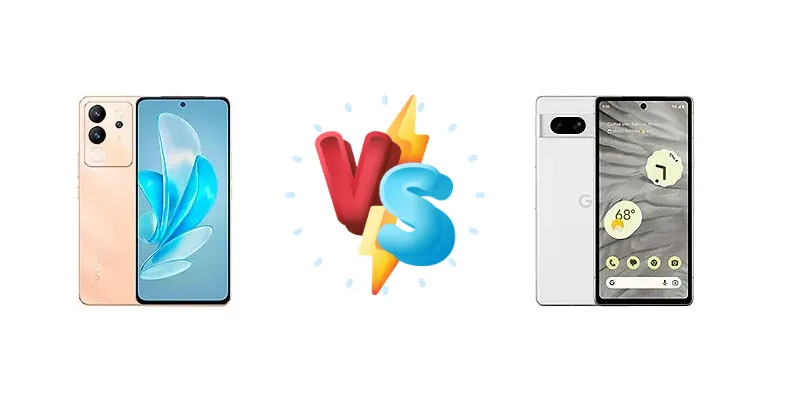
|
🏆 Quick Verdict
For the average user prioritizing camera quality and software experience, the Google Pixel 7a is the clear winner. Its Tensor G2 chip, while not a raw performance leader, provides a smoother, more intelligent experience, and its camera consistently delivers excellent results. However, the vivo V30 Lite offers a compelling value proposition for those prioritizing fast charging and 5G connectivity on a tighter budget.
| PHONES | ||
|---|---|---|
| Phone Names | vivo V30 Lite | Google Pixel 7a |
| Network | ||
|---|---|---|
| 2G bands | GSM 850 / 900 / 1800 / 1900 | GSM 850 / 900 / 1800 / 1900 |
| 3G bands | HSDPA 850 / 900 / 1700(AWS) / 1900 / 2100 | HSDPA 800 / 850 / 900 / 1700(AWS) / 1900 / 2100 |
| 4G bands | 1, 2, 3, 4, 5, 7, 8, 12, 13, 17, 18, 19, 20, 26, 28, 38, 40, 41, 66 | 1, 2, 3, 4, 5, 7, 8, 12, 13, 14, 17, 20, 25, 26, 28, 29, 30, 38, 40, 41, 48, 66, 71 - GWKK3, G0DZQ |
| 5G bands | 1, 2, 3, 5, 7, 8, 20, 26, 28, 38, 40, 41, 66, 77, 78 SA/NSA | 1, 2, 3, 5, 7, 8, 12, 14, 20, 25, 28, 30, 38, 41, 48, 66, 71, 77, 78 SA/NSA/Sub6 - GWKK3 |
| Speed | HSPA, LTE, 5G | HSPA, LTE, 5G |
| Technology | GSM / HSPA / LTE / 5G | GSM / HSPA / LTE / 5G |
| - | 1, 2, 3, 5, 7, 8, 12, 20, 25, 28, 38, 40, 41, 66, 75, 76, 77, 78, 79 SA/NSA/Sub6 - GHL1X, G82U8 | |
| Launch | ||
|---|---|---|
| Announced | 2023, December 29 | 2023, May 10 |
| Status | Available. Released 2023, December 29 | Available. Released 2023, May 10 |
| Body | ||
|---|---|---|
| Build | Glass front, plastic frame, glass back | Glass front (Gorilla Glass 3), aluminum frame, plastic back |
| Dimensions | 162.4 x 74.9 x 7.7 mm (6.39 x 2.95 x 0.30 in) | 152 x 72.9 x 9 mm (5.98 x 2.87 x 0.35 in) |
| SIM | Nano-SIM | Nano-SIM + eSIM |
| Weight | 190 g (6.70 oz) | 193.5 g (6.84 oz) |
| - | IP67 dust/water resistant (up to 1m for 30 min) | |
| Display | ||
|---|---|---|
| Protection | - | Corning Gorilla Glass 3 |
| Resolution | 1080 x 2400 pixels, 20:9 ratio (~395 ppi density) | 1080 x 2400 pixels, 20:9 ratio (~429 ppi density) |
| Size | 6.67 inches, 107.4 cm2 (~88.3% screen-to-body ratio) | 6.1 inches, 90.7 cm2 (~81.8% screen-to-body ratio) |
| Type | AMOLED, 120Hz, 1150 nits (peak) | OLED, HDR, 90Hz |
| - | Always-on display | |
| Platform | ||
|---|---|---|
| CPU | Octa-core (2x2.2 GHz Kryo 660 Gold & 6x1.8 GHz Kryo 660 Silver) | Octa-core (2x2.85 GHz Cortex-X1 & 2x2.35 GHz Cortex-A78 & 4x1.80 GHz Cortex-A55) |
| Chipset | Qualcomm SM6375 Snapdragon 695 5G (6 nm) | Google Tensor G2 (5 nm) |
| GPU | Adreno 619 | Mali-G710 MP7 |
| OS | Android 13, Funtouch 13 | Android 13, upgradable to Android 15, up to 5 major Android upgrades |
| Memory | ||
|---|---|---|
| Card slot | No | No |
| Internal | 256GB 8GB RAM, 256GB 12GB RAM | 128GB 8GB RAM |
| - | UFS 3.1 | |
| Main Camera | ||
|---|---|---|
| Dual | - | 64 MP, f/1.9, 26mm (wide), 1/1.73", 0.8µm, dual pixel PDAF, OIS 13 MP, f/2.2, 120˚ (ultrawide), 1.12µm |
| Features | Ring-LED flash, panorama, HDR | Dual-LED flash, Pixel Shift, Auto-HDR, panorama |
| Triple | 64 MP, f/1.8, (wide), PDAF, OIS 8 MP, f/2.2, (ultrawide) Auxiliary lens | - |
| Video | 1080p@30fps | 4K@30/60fps, 1080p@30/60/120/240fps, OIS |
| Selfie camera | ||
|---|---|---|
| Features | - | HDR, panorama |
| Single | 50 MP, f/2.0, 22mm (wide), AF | 13 MP, f/2.2, 20mm (ultrawide), 1.12µm |
| Video | 1080p@30fps | 4K@30fps, 1080p@30fps |
| Sound | ||
|---|---|---|
| 3.5mm jack | - | No |
| 35mm jack | No | No |
| Loudspeaker | Yes | Yes, with stereo speakers |
| Comms | ||
|---|---|---|
| Bluetooth | 5.1, A2DP, LE | 5.3, A2DP, LE |
| NFC | Yes | Yes |
| Positioning | GPS, GLONASS, GALILEO, BDS, QZSS | GPS, GLONASS, GALILEO, BDS, QZSS, NavIC |
| Radio | No | No |
| USB | USB Type-C 2.0, OTG | USB Type-C 3.2 |
| WLAN | Wi-Fi 802.11 a/b/g/n/ac, dual-band | Wi-Fi 802.11 a/b/g/n/ac/6e, tri-band |
| Features | ||
|---|---|---|
| Sensors | Fingerprint (under display, optical), accelerometer, gyro, proximity, compass | Fingerprint (under display, optical), accelerometer, gyro, proximity, compass, barometer |
| Battery | ||
|---|---|---|
| Charging | 44W wired | 18W wired, PD3.0 7.5W wireless |
| Type | Li-Ion 4800 mAh | Li-Po 4385 mAh |
| Misc | ||
|---|---|---|
| Colors | Forest Black, Rose Gold | Charcoal, Snow, Sea, Coral |
| Models | V2314 | GWKK3, GHL1X, G0DZQ, G82U8 |
| Price | About 480 EUR | € 179.90 / $ 150.00 / £ 170.00 / ₹ 25,980 |
vivo V30 Lite
- 44W Fast Charging: Significantly faster charging speeds.
- 5G Connectivity: Provides access to next-generation networks.
- Competitive Price: Offers good value for money.
- Less Powerful Chipset: Snapdragon 695 lags behind the Tensor G2 in performance.
- Camera Quality: Likely inferior to the Pixel 7a's camera.
Google Pixel 7a
- Superior Camera: Google's computational photography is a standout feature.
- Powerful Chipset: Tensor G2 offers a smoother and more responsive experience.
- Software Support: Guaranteed updates and a clean Android experience.
- Slower Charging: 18W charging is significantly slower than the V30 Lite.
- Higher Price: More expensive than the vivo V30 Lite.
Display Comparison
The Pixel 7a boasts a significantly brighter display, reaching a measured peak of 1070 nits, compared to an unspecified brightness for the V30 Lite. This translates to better visibility outdoors under direct sunlight. While the V30 Lite’s panel technology isn’t specified, the Pixel 7a’s OLED panel offers superior contrast and color accuracy. The Pixel 7a’s smaller bezels also contribute to a more immersive viewing experience. The absence of LTPO on either device suggests neither offers adaptive refresh rates for power saving.
Camera Comparison
The Pixel 7a’s camera system is a major strength. While specific sensor details are missing for both, Google’s computational photography prowess elevates the Pixel 7a’s image quality significantly. The Tensor G2’s image signal processor (ISP) excels at noise reduction, dynamic range optimization, and detail preservation. The V30 Lite likely relies more on hardware limitations and less on software processing. The Pixel 7a’s video capabilities are also expected to be superior, benefiting from the Tensor G2’s advanced video encoding and stabilization features. We can assume the V30 Lite will include a standard set of camera modes, but will likely lack the Pixel 7a’s Magic Eraser and Photo Unblur features.
Performance
The core difference lies in the chipsets. The Google Pixel 7a’s Tensor G2 (5nm) is architecturally more advanced than the vivo V30 Lite’s Snapdragon 695 5G (6nm). The Tensor G2 features a tri-cluster configuration with Cortex-X1 performance cores clocked at 2.85 GHz, offering a substantial performance advantage in demanding tasks and AI processing. The Snapdragon 695, while capable, is geared towards efficiency and 5G connectivity, with its Kryo 660 Gold cores peaking at 2.2 GHz. This difference is reflected in real-world usage; the Pixel 7a will handle multitasking and graphically intensive games more smoothly. The Pixel 7a also benefits from potentially faster RAM speeds (likely LPDDR5x) compared to the V30 Lite, further enhancing performance.
Battery Life
The Pixel 7a has an endurance rating of 76 hours, indicating strong battery life despite its 18W charging. The vivo V30 Lite counters with a significantly faster 44W wired charging, allowing for a much quicker 0-100% charge. While the V30 Lite’s battery capacity is unknown, the faster charging speed is a significant advantage for users who prioritize convenience. The Pixel 7a supports PD3.0 and 7.5W wireless charging, offering additional flexibility, but the charging speed remains considerably slower than the V30 Lite’s wired charging.
Buying Guide
Buy the vivo V30 Lite if you need a reliable 5G phone with exceptionally fast 44W charging and prioritize affordability above all else. It’s ideal for users who primarily browse, use social media, and occasionally game. Buy the Google Pixel 7a if you prefer a superior camera experience, a cleaner software interface with guaranteed updates, and benefit from Google’s AI-powered features, even if it means sacrificing some charging speed and paying a premium.