
vivo V30 Lite (ME) vs. V30e: A Deep Dive into Performance and Value
| Phones Images | |||||
|---|---|---|---|---|---|
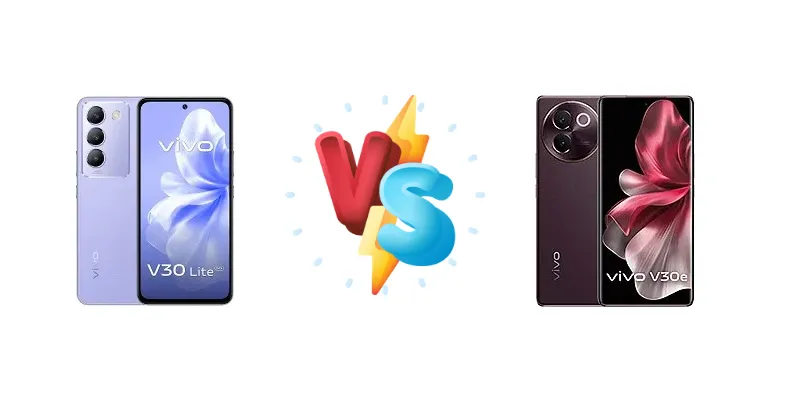
|
🏆 Quick Verdict
For the average user prioritizing everyday tasks and fast charging, the vivo V30 Lite (ME) emerges as the stronger choice. Its 80W charging significantly reduces downtime, and the Snapdragon 4 Gen 2 provides sufficient power for smooth operation, despite being slightly less powerful than the Snapdragon 6 Gen 1.
| PHONES | ||
|---|---|---|
| Phone Names | vivo V30 Lite (ME) | vivo V30e |
| Network | ||
|---|---|---|
| 2G bands | GSM 850 / 900 / 1800 / 1900 | GSM 850 / 900 / 1800 / 1900 |
| 3G bands | HSDPA 850 / 900 / 1700(AWS) / 1900 / 2100 | HSDPA 850 / 900 / 1700(AWS) / 1900 / 2100 - Malaysia |
| 4G bands | 1, 2, 3, 4, 5, 7, 8, 18, 19, 20, 26, 28 | 1, 2, 3, 4, 5, 7, 8, 18, 19, 20, 26, 28, 38, 39, 40, 41 - Malaysia |
| 5G bands | 1, 3, 5, 7, 8, 20, 28, 38, 40, 41, 77, 78 SA/NSA | 1, 3, 5, 7, 8, 20, 28, 38, 40, 41, 77, 78 SA/NSA - Malaysia |
| Speed | HSPA, LTE, 5G | HSPA, LTE, 5G |
| Technology | GSM / HSPA / LTE / 5G | GSM / HSPA / LTE / 5G |
| Launch | ||
|---|---|---|
| Announced | 2024, February 26 | 2024, May 02 |
| Status | Available. Released 2024, February 26 | Available. Released 2024, May 09 |
| Body | ||
|---|---|---|
| Build | Glass front, plastic or silicone polymer (eco leather) back | Glass front, plastic frame, glass back or plastic back |
| Dimensions | 162.4 x 74.9 x 7.8 mm (6.39 x 2.95 x 0.31 in) | 164.4 x 74.8 x 7.7 mm (6.47 x 2.94 x 0.30 in) |
| SIM | Nano-SIM + Nano-SIM | Nano-SIM + Nano-SIM |
| Weight | 185.5 g or 191 g (6.56 oz) | 179 g or 188 g (6.31 oz) |
| Display | ||
|---|---|---|
| Protection | - | Schott Xensation |
| Resolution | 1080 x 2400 pixels, 20:9 ratio (~395 ppi density) | 1080 x 2400 pixels, 20:9 ratio (~388 ppi density) |
| Size | 6.67 inches, 107.4 cm2 (~88.3% screen-to-body ratio) | 6.78 inches, 111.0 cm2 (~90.3% screen-to-body ratio) |
| Type | AMOLED, 1B colors, 120Hz, 1800 nits (peak) | AMOLED, 1B colors, 120Hz, 1300 nits (peak) |
| Platform | ||
|---|---|---|
| CPU | Octa-core (2x2.2 GHz Cortex-A78 & 6x1.95 GHz Cortex-A55) | Octa-core (4x2.2 GHz Cortex-A78 & 4x1.8 GHz Cortex-A55) |
| Chipset | Qualcomm SM4450 Snapdragon 4 Gen 2 (4 nm) | Qualcomm SM6450 Snapdragon 6 Gen 1 (4 nm) |
| GPU | Adreno 613 | Adreno 710 |
| OS | Android 14, Funtouch 14 | Android 14, Funtouch 14 |
| Memory | ||
|---|---|---|
| Card slot | microSDXC (uses shared SIM slot) | microSDXC (uses shared SIM slot) |
| Internal | 256GB 12GB RAM | 128GB 8GB RAM, 256GB 8GB RAM, 256GB 12GB RAM |
| Main Camera | ||
|---|---|---|
| Dual | 50 MP, f/1.8, (wide), PDAF 8 MP, f/2.2, 106° (ultrawide) | 50 MP, f/1.8, 26mm (wide), 1/1.95", 0.8µm, PDAF, OIS (India only) 8 MP, f/2.2, 120˚ (ultrawide), 1/4.0", 1.12µm |
| Features | LED flash, panorama, HDR | Ring-LED flash, panorama, HDR |
| Video | 1080p@30fps | 4K@30fps, 1080p@30fps |
| Selfie camera | ||
|---|---|---|
| Single | 8 MP, f/2.0, (wide) | 50 MP, f/2.5, 25mm (wide), AF - India 32 MP, f/2.0, 24mm (wide) - Malaysia |
| Video | 1080p@30fps | 4K@30fps (India only), 1080p@30fps |
| Sound | ||
|---|---|---|
| 35mm jack | No | No |
| Loudspeaker | Yes, with stereo speakers | Yes |
| Comms | ||
|---|---|---|
| Bluetooth | 5.0, A2DP, LE | 5.1, A2DP, LE |
| NFC | Yes | Yes (market/region dependent) |
| Positioning | GPS, GLONASS, GALILEO, BDS, QZSS | GPS, GLONASS, GALILEO, BDS, QZSS, NavIC |
| Radio | Unspecified | No |
| USB | USB Type-C 2.0, OTG | USB Type-C 2.0, OTG |
| WLAN | Wi-Fi 802.11 a/b/g/n/ac, dual-band | Wi-Fi 802.11 a/b/g/n/ac, dual-band |
| Features | ||
|---|---|---|
| Sensors | Fingerprint (under display, optical), accelerometer, gyro, proximity, compass | Fingerprint (under display, optical), accelerometer, gyro, proximity, compass |
| Battery | ||
|---|---|---|
| Charging | 80W wired, 80% in 30 min Reverse wired | 44W wired, PD Reverse wired |
| Type | 5000 mAh | Li-Ion 5500 mAh |
| Misc | ||
|---|---|---|
| Colors | Leather Purple, Leather Orange, Crystal Black | Velvet Red (Coco Brown), Silk Blue, Sky Mirror |
| Models | - | V2339 |
| Price | About 280 EUR | ₹ 23,999 |
vivo V30 Lite (ME)
- Significantly faster 80W charging
- Potentially better thermal efficiency due to newer architecture
- Competitive performance for everyday tasks
- Slightly less powerful CPU compared to the V30e
- Camera performance is unknown without further specs
vivo V30e
- More powerful CPU core configuration
- Power Delivery (PD) support for charging
- Potentially better sustained performance due to thermal headroom
- Slower 44W charging
- May experience more thermal throttling under sustained load
Display Comparison
Both devices are expected to feature similar LCD panels, typical for this price segment. However, detailed display specs like resolution, peak brightness, and color gamut coverage are not provided. The focus here is on the internal hardware, not display prowess. Expect standard viewing experiences, prioritizing functionality over visual fidelity.
Camera Comparison
Without detailed camera specifications, a direct comparison is difficult. Both phones likely feature a multi-camera setup, but the quality will depend heavily on sensor size, lens aperture, and image processing algorithms. It's reasonable to assume both will include a primary sensor, an ultrawide, and potentially a macro lens. The absence of OIS information suggests neither phone will excel in low-light photography without significant software intervention. Focusing on the processor, the Snapdragon 6 Gen 1 in the V30e *may* offer slightly faster image processing speeds, but this is speculative.
Performance
The core difference lies in the chipsets. The vivo V30 Lite (ME) utilizes the Qualcomm SM4450 Snapdragon 4 Gen 2 (4nm), featuring an octa-core CPU with 2x2.2 GHz Cortex-A78 and 6x1.95 GHz Cortex-A55 cores. The V30e steps up to the Qualcomm SM6450 Snapdragon 6 Gen 1 (4nm), with a slightly different CPU configuration: 4x2.2 GHz Cortex-A78 and 4x1.8 GHz Cortex-A55. While both are 4nm chips offering good efficiency, the Snapdragon 6 Gen 1's higher core count at the prime performance tier *should* translate to better multi-tasking and slightly improved performance in CPU-intensive tasks. However, the Snapdragon 4 Gen 2 benefits from newer architecture, potentially closing the gap. Neither chipset is geared towards high-end gaming, but both should handle popular titles at medium settings.
Battery Life
The V30 Lite (ME) boasts 80W wired charging, capable of reaching 80% charge in just 30 minutes. This is a significant advantage over the V30e's 44W wired charging, which, while supporting Power Delivery (PD), will take considerably longer to fully charge. While battery capacity isn't specified, the faster charging of the V30 Lite (ME) mitigates the impact of a potentially smaller battery, offering more convenient top-ups throughout the day.
Buying Guide
Buy the vivo V30 Lite (ME) if you need consistently fast charging and prioritize a responsive experience for social media, streaming, and everyday communication. Buy the vivo V30e if you prefer a slightly more powerful processor for demanding applications and don't mind a slower charging speed, potentially benefiting from longer sustained performance due to the Snapdragon 6 Gen 1's thermal characteristics.