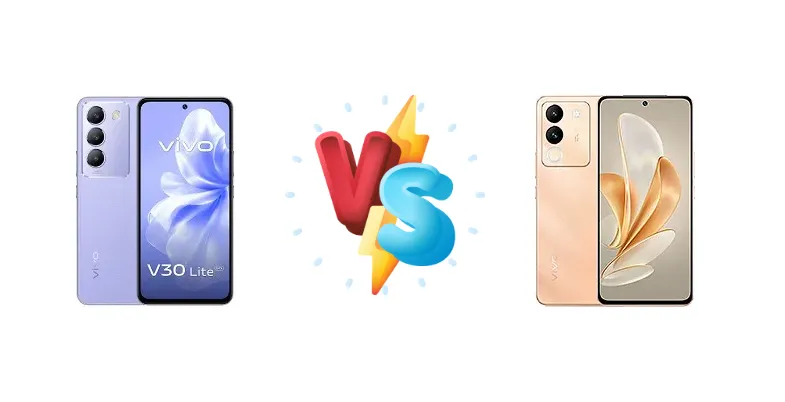
vivo's V-series consistently delivers compelling mid-range options, but the V30 Lite (ME) and V29e present a fascinating choice. The V30 Lite (ME) represents a newer generation with a focus on efficiency, while the V29e leverages the established Snapdragon 695 5G. This comparison dissects their key differences to determine which device best suits your needs.
🏆 Quick Verdict
For most users, the vivo V30 Lite (ME) emerges as the stronger contender. Its newer Snapdragon 4 Gen 2 chipset, built on a more efficient 4nm process, offers a noticeable performance advantage and improved thermal management, despite the V29e's 5G connectivity. The significantly faster 80W charging further solidifies its position.
| Network |
|---|
| 2G bands | GSM 850 / 900 / 1800 / 1900 | GSM 850 / 900 / 1800 / 1900 |
| 3G bands | HSDPA 850 / 900 / 1700(AWS) / 1900 / 2100 | HSDPA 850 / 900 / 1700(AWS) / 1900 / 2100 |
| 4G bands | 1, 2, 3, 4, 5, 7, 8, 18, 19, 20, 26, 28 | 1, 2, 3, 4, 5, 7, 8, 18, 19, 20, 26, 28, 38, 39, 40, 41 |
| 5G bands | 1, 3, 5, 7, 8, 20, 28, 38, 40, 41, 77, 78 SA/NSA | 1, 3, 5, 7, 8, 28, 38, 40, 41, 77, 78 SA/NSA |
| Speed | HSPA, LTE, 5G | HSPA, LTE, 5G |
| Technology | GSM / HSPA / LTE / 5G | GSM / HSPA / LTE / 5G |
| Launch |
|---|
| Announced | 2024, February 26 | 2023, October 23 |
| Status | Available. Released 2024, February 26 | Available. Released 2023, October 23 |
| Body |
|---|
| Build | Glass front, plastic or silicone polymer (eco leather) back | Glass front, plastic frame, glass back |
| Dimensions | 162.4 x 74.9 x 7.8 mm (6.39 x 2.95 x 0.31 in) | 162.4 x 74.9 x 7.7 mm (6.39 x 2.95 x 0.30 in) |
| SIM | Nano-SIM + Nano-SIM | Nano-SIM + Nano-SIM |
| Weight | 185.5 g or 191 g (6.56 oz) | 190 g (6.70 oz) |
| Display |
|---|
| Resolution | 1080 x 2400 pixels, 20:9 ratio (~395 ppi density) | 1080 x 2400 pixels, 20:9 ratio (~395 ppi density) |
| Size | 6.67 inches, 107.4 cm2 (~88.3% screen-to-body ratio) | 6.67 inches, 107.4 cm2 (~88.3% screen-to-body ratio) |
| Type | AMOLED, 1B colors, 120Hz, 1800 nits (peak) | AMOLED, 120Hz, 1150 nits (peak) |
| Platform |
|---|
| CPU | Octa-core (2x2.2 GHz Cortex-A78 & 6x1.95 GHz Cortex-A55) | Octa-core (2x2.2 GHz Kryo 660 Gold & 6x1.8 GHz Kryo 660 Silver) |
| Chipset | Qualcomm SM4450 Snapdragon 4 Gen 2 (4 nm) | Qualcomm SM6375 Snapdragon 695 5G (6 nm) |
| GPU | Adreno 613 | Adreno 619 |
| OS | Android 14, Funtouch 14 | Android 13, Funtouch 13 |
| Memory |
|---|
| Card slot | microSDXC (uses shared SIM slot) | No |
| Internal | 256GB 12GB RAM | 256GB 8GB RAM, 256GB 12GB RAM |
| Main Camera |
|---|
| Dual | 50 MP, f/1.8, (wide), PDAF
8 MP, f/2.2, 106° (ultrawide) | 64 MP, f/1.8, (wide), PDAF, OIS
8 MP, f/2.2, (ultrawide) |
| Features | LED flash, panorama, HDR | Ring-LED flash, panorama, HDR |
| Video | 1080p@30fps | 1080p@30fps |
| Selfie camera |
|---|
| Single | 8 MP, f/2.0, (wide) | 50 MP, f/2.0, 22mm (wide), AF |
| Video | 1080p@30fps | 1080p@30fps |
| Sound |
|---|
| 35mm jack | No | No |
| Loudspeaker | Yes, with stereo speakers | Yes |
| Comms |
|---|
| Bluetooth | 5.0, A2DP, LE | 5.1, A2DP, LE |
| NFC | Yes | No |
| Positioning | GPS, GLONASS, GALILEO, BDS, QZSS | GPS, GLONASS, GALILEO, BDS, QZSS |
| Radio | Unspecified | No |
| USB | USB Type-C 2.0, OTG | USB Type-C 2.0, OTG |
| WLAN | Wi-Fi 802.11 a/b/g/n/ac, dual-band | Wi-Fi 802.11 a/b/g/n/ac, dual-band |
| Features |
|---|
| Sensors | Fingerprint (under display, optical), accelerometer, gyro, proximity, compass | Fingerprint (under display, optical), accelerometer, gyro, proximity, compass |
| Battery |
|---|
| Charging | 80W wired, 80% in 30 min
Reverse wired | 44W wired |
| Type | 5000 mAh | Li-Ion 4800 mAh |
| Misc |
|---|
| Colors | Leather Purple, Leather Orange, Crystal Black | Forest Black, Rose Gold, Ice Creek Blue |
| Models | - | V2317 |
| Price | About 280 EUR | About 320 EUR |
vivo V30 Lite (ME)
- Faster 80W charging
- More efficient Snapdragon 4 Gen 2 (4nm)
- Potentially better image processing
- Reverse wired charging
- Lacks 5G connectivity
- Display specs unknown
vivo V29e
- 5G connectivity
- Established Snapdragon 695 platform
- Generally available
- Potentially lower price
- Slower 44W charging
- Less efficient Snapdragon 695 (6nm)
- Older chipset architecture
Display Comparison
Neither device's display specifications are provided, so a direct comparison is limited. However, given the V30 Lite (ME)'s positioning as a newer model, it's reasonable to expect a slightly improved panel in terms of color accuracy and peak brightness. The absence of LTPO technology on either device suggests standard refresh rate panels, likely 60Hz or 90Hz. Bezels are likely comparable, typical of this price segment.
Camera Comparison
Without detailed camera specs, a definitive comparison is difficult. However, the chipset plays a role in image signal processing (ISP) capabilities. The newer Snapdragon 4 Gen 2 in the V30 Lite (ME) likely benefits from improvements in Qualcomm’s ISP, potentially leading to better image quality, especially in low-light conditions. The absence of information regarding sensor sizes and OIS makes it impossible to declare a clear winner, but the V30 Lite (ME)'s more advanced chipset gives it a slight edge in potential image processing prowess.
Performance
The core difference lies in the chipsets. The vivo V30 Lite (ME) utilizes the Qualcomm Snapdragon 4 Gen 2 (4nm), featuring an octa-core CPU with 2x2.2 GHz Cortex-A78 and 6x1.95 GHz Cortex-A55 cores. This 4nm fabrication process is a significant advantage over the V29e’s Snapdragon 695 5G (6nm). The 6nm process, while still efficient, is less so than 4nm, meaning the V30 Lite (ME) will likely exhibit better thermal performance under sustained load. While both CPUs have 2x2.2 GHz performance cores (Kryo 660 Gold in the V29e), the Cortex-A78 cores in the V30 Lite (ME) generally offer a slight architectural advantage. The V29e's 5G modem is its key advantage, but the V30 Lite (ME) compensates with a more modern and efficient CPU.
Battery Life
The V30 Lite (ME) boasts a significant advantage in charging speed with 80W wired charging, capable of reaching 80% charge in just 30 minutes. The V29e is limited to 44W wired charging, resulting in a considerably slower charging experience. While battery capacity isn't specified for either device, the V30 Lite (ME)'s more efficient chipset and faster charging mitigate the impact of a potentially smaller battery. The 80W charging is a game-changer for users who prioritize quick top-ups.
Buying Guide
Buy the vivo V30 Lite (ME) if you prioritize efficient performance for everyday tasks, fast charging, and a modern chipset. It's ideal for users who frequently multitask, enjoy mobile gaming casually, and value quick top-ups. Buy the vivo V29e if 5G connectivity is absolutely essential and you're willing to trade some processing power and charging speed for it. It's a reasonable choice for users primarily focused on streaming and basic social media.
Frequently Asked Questions
❓ Will the Snapdragon 4 Gen 2 in the V30 Lite (ME) handle demanding games like PUBG Mobile?
While not a flagship chipset, the Snapdragon 4 Gen 2 is capable of running PUBG Mobile at medium settings with stable frame rates. However, users seeking consistently high frame rates at maximum settings may experience some limitations. The 4nm process helps mitigate thermal throttling during extended gaming sessions.
❓ Does the V29e's 5G connectivity actually make a noticeable difference in everyday use?
The benefit of 5G on the V29e depends heavily on your location and network availability. If you live in an area with robust 5G coverage, you'll experience faster download and upload speeds. However, in areas with limited 5G, the difference compared to 4G LTE will be minimal. The V30 Lite (ME) still supports 4G LTE, which remains widely available.
❓ How long will it take to fully charge the V30 Lite (ME) from 0% with the 80W charger?
vivo claims the V30 Lite (ME) can reach 80% charge in 30 minutes with the 80W charger. A full 0-100% charge is likely to take around 45-50 minutes, making it significantly faster than the V29e's 44W charging.
❓ Is the Snapdragon 695 in the V29e still a relevant chipset in 2024?
The Snapdragon 695 remains a capable chipset for everyday tasks and light gaming. However, it's starting to show its age compared to newer offerings like the Snapdragon 4 Gen 2. The 6nm process is less efficient, and the CPU architecture is older, resulting in lower overall performance and potentially more thermal throttling.