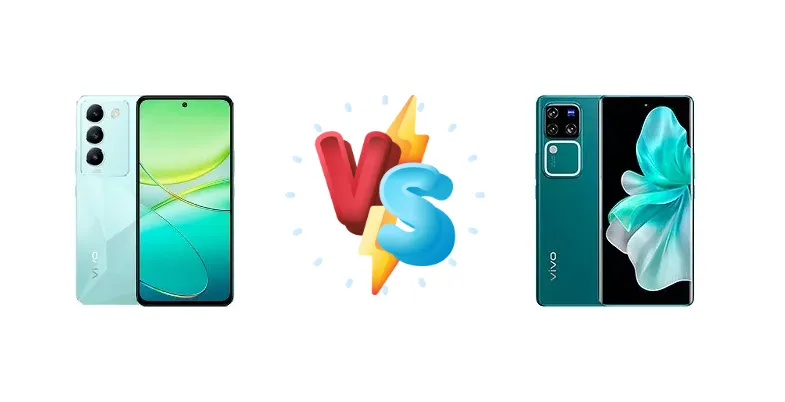
Vivo's V30 series presents a clear segmentation: the V30 Lite 4G focuses on affordability, while the V30 Pro aims for a more premium experience. This comparison dissects the core differences – from processing power to display quality and charging speeds – to determine which device best suits your needs and budget.
🏆 Quick Verdict
For most users, the Vivo V30 Pro is the superior choice. Its Mediatek Dimensity 8200 chipset delivers significantly faster performance and better thermal management than the Snapdragon 685 in the V30 Lite, justifying the price difference. While the Lite offers 80W charging, the Pro's longer battery life and overall refinement make it the winner.
| Network |
|---|
| 2G bands | GSM 850 / 900 / 1800 / 1900 | GSM 850 / 900 / 1800 / 1900 |
| 3G bands | HSDPA 850 / 900 / 1700(AWS) / 1900 / 2100 | HSDPA 850 / 900 / 1700(AWS) / 1900 / 2100 |
| 4G bands | 1, 3, 5, 7, 8, 20, 28 | 1, 2, 3, 4, 5, 7, 8, 12, 17, 18, 19, 20, 26, 28, 38, 39, 40, 41 |
| 5G bands | - | 1, 3, 5, 7, 8, 20, 28, 38, 40, 41, 77, 78 SA/NSA |
| Speed | HSPA, LTE | HSPA, LTE, 5G |
| Technology | GSM / HSPA / LTE | GSM / CDMA / HSPA / LTE / 5G |
| Launch |
|---|
| Announced | 2024, April 04 | 2024, February 28 |
| Status | Available. Released 2024, April 04 | Available. Released 2024, March 07 |
| Body |
|---|
| Build | - | Glass front (Schott α), glass back, plastic frame |
| Dimensions | 163.2 x 75.8 x 7.8 mm (6.43 x 2.98 x 0.31 in) | 164.4 x 75.1 x 7.5 mm (6.47 x 2.96 x 0.30 in) |
| SIM | Nano-SIM + Nano-SIM | Nano-SIM + Nano-SIM |
| Weight | 186 g or 188 g (6.56 oz) | 188 g (6.63 oz) |
| Display |
|---|
| Protection | Asahi Glass AGC DT-Star2 Plus | Schott α glass |
| Resolution | 1080 x 2400 pixels, 20:9 ratio (~395 ppi density) | 1260 x 2800 pixels, 20:9 ratio (~453 ppi density) |
| Size | 6.67 inches, 107.4 cm2 (~86.8% screen-to-body ratio) | 6.78 inches, 111.0 cm2 (~89.9% screen-to-body ratio) |
| Type | AMOLED, 1B colors, 120Hz, 1200 nits (peak) | AMOLED, 1B colors, HDR10+, 120Hz, 2800 nits (peak) |
| Platform |
|---|
| CPU | Octa-core (4x2.8 GHz Cortex-A73 & 4x1.9 GHz Cortex-A53) | Octa-core (1x3.1 GHz Cortex-A78 & 3x3.0 GHz Cortex-A78 & 4x2.0 GHz Cortex-A55) |
| Chipset | Qualcomm SM6225 Snapdragon 685 (6 nm) | Mediatek Dimensity 8200 (4 nm) |
| GPU | Adreno 610 | Mali-G610 MC6 |
| OS | Android 14, Funtouch 14 | Android 14, up to 2 major Android upgrades, Funtouch 14 |
| Memory |
|---|
| Card slot | microSDXC (uses shared SIM slot) | No |
| Internal | 128GB 8GB RAM, 256GB 8GB RAM | 256GB 8GB RAM, 256GB 12GB RAM, 512GB 12GB RAM |
| Main Camera |
|---|
| Dual | 50 MP, f/1.8, (wide), PDAF
Auxiliary lens | - |
| Features | LED flash, panorama, HDR | Zeiss optics, Zeiss T* lens coating, Ring-LED flash, panorama, HDR |
| Triple | - | 50 MP, f/1.9, 23mm (wide), 1/1.49", 1.0µm, PDAF, OIS
50 MP, f/1.9, 50mm (telephoto), 1/2.51", 0.64µm, PDAF, 2x optical zoom
50 MP, f/2.0, 15mm, 119˚ (ultrawide), 1/2.76", 0.64µm, AF |
| Video | 1080p@30fps | 4K@30fps, 1080p@30fps |
| Selfie camera |
|---|
| Features | - | Dual-LED flash, HDR |
| Single | 8 MP, f/2.0, (wide) | 50 MP, f/2.0, 20mm (wide), 1/2.76", 0.64µm, AF |
| Video | 1080p@30fps | 4K@30fps, 1080p@30fps |
| Sound |
|---|
| 35mm jack | No | No |
| Loudspeaker | Yes, with stereo speakers | Yes |
| Comms |
|---|
| Bluetooth | 5.0, A2DP, LE | 5.3, A2DP, LE, aptX HD |
| NFC | No | Yes |
| Positioning | GPS, GLONASS, GALILEO, BDS, QZSS | GPS (L1+L5), GLONASS, BDS (B1I+B1c+B2a), GALILEO (E1+E5a), QZSS (L1+L5), NavIC (L5) |
| Radio | No | No |
| USB | USB Type-C 2.0, OTG | USB Type-C 2.0, OTG |
| WLAN | Wi-Fi 802.11 a/b/g/n/ac, dual-band | Wi-Fi 802.11 a/b/g/n/ac/6, dual-band, Wi-Fi Direct |
| Features |
|---|
| Sensors | Fingerprint (under display, optical), accelerometer, gyro, proximity, compass | Fingerprint (under display, optical), accelerometer, proximity, gyro, compass |
| Battery |
|---|
| Charging | 80W wired, 80% in 30 min
Reverse wired | 80W wired, PD, 100% in 43 min
Reverse wired |
| Type | 5000 mAh | Li-Ion 5000 mAh |
| Misc |
|---|
| Colors | Crystal Green, Crystal Black | Bloom White, Waving Aqua, Lush Green, Noble Black |
| Models | - | V2319 |
| Price | About 280 EUR | About 450 EUR |
vivo V30 Lite 4G
- More affordable price point
- Fast 80W charging (to 80%)
- Sufficient for basic smartphone tasks
- Significantly weaker processor
- Likely lower display quality
- Potentially limited gaming performance
vivo V30 Pro
- Powerful Dimensity 8200 chipset
- Brighter and potentially higher-quality display
- Longer battery life (13:25h active use)
- Higher price tag
- Slightly slower full charge time (43 minutes)
Display Comparison
The Vivo V30 Pro boasts a significantly brighter display, reaching a measured peak of 1197 nits, compared to an unspecified brightness for the V30 Lite. This higher peak brightness translates to better visibility outdoors under direct sunlight. While both likely utilize AMOLED panels (based on Vivo's typical implementation), the Pro's superior brightness and potential for higher color accuracy make it the clear winner for media consumption and content creation. We expect the Pro to also have a higher refresh rate, though this is not specified in the data.
Camera Comparison
While detailed camera specs are missing, the chipset difference hints at a significant advantage for the V30 Pro. The Dimensity 8200’s more powerful ISP (Image Signal Processor) will enable superior image processing, resulting in better dynamic range, noise reduction, and overall image quality. The V30 Lite will likely rely on software processing to compensate for its less capable chipset, potentially leading to slower processing times and less detail in challenging lighting conditions. We can assume the Pro will have a more advanced camera system overall, though sensor sizes and OIS presence remain unknown.
Performance
The performance gap between these two devices is substantial. The Vivo V30 Pro’s Mediatek Dimensity 8200, built on a 4nm process, is a significant upgrade over the V30 Lite’s Qualcomm Snapdragon 685 (6nm). The Dimensity 8200 features a more modern CPU architecture – a 1x3.1 GHz Cortex-A78 core alongside 3x3.0 GHz Cortex-A78 cores and 4x2.0 GHz Cortex-A55 cores – compared to the V30 Lite’s 4x2.8 GHz Cortex-A73 and 4x1.9 GHz Cortex-A53 configuration. This translates to faster app loading times, smoother multitasking, and a more responsive user experience. The 4nm process also contributes to better thermal efficiency, reducing the likelihood of performance throttling during extended gaming sessions.
Battery Life
The Vivo V30 Pro demonstrates a clear advantage in battery endurance, achieving an active use score of 13 hours and 25 minutes. While both phones support 80W wired charging, the Pro takes 43 minutes to reach 100%, while the Lite achieves 80% in 30 minutes. This suggests the Pro has a larger battery capacity, contributing to its longer runtime. The faster full charge time on the Lite is offset by the Pro’s superior overall battery life and efficiency.
Buying Guide
Buy the vivo V30 Lite 4G if you prioritize a lower upfront cost and are a casual user primarily focused on everyday tasks like calling, texting, and social media. Buy the vivo V30 Pro if you demand smoother multitasking, enjoy mobile gaming, value a brighter and more vibrant display, and appreciate faster overall performance for demanding applications.
Frequently Asked Questions
❓ Does the Dimensity 8200 in the V30 Pro get hot during prolonged gaming sessions?
The Dimensity 8200 is built on a 4nm process, which is more efficient than the 6nm Snapdragon 685 in the V30 Lite. This improved efficiency translates to better thermal management, reducing the likelihood of significant throttling during extended gaming. While some heat is inevitable, the V30 Pro is better equipped to maintain consistent performance over longer periods.
❓ Is the 80W charging on the V30 Lite fast enough for daily use?
The 80W charging on the V30 Lite is indeed fast, reaching 80% charge in just 30 minutes. However, the V30 Pro, despite taking 43 minutes for a full charge, benefits from a larger battery capacity and longer overall runtime, making it a more practical choice for users who prioritize all-day battery life.
❓ What kind of gaming performance can I expect from the V30 Pro?
The Dimensity 8200 is a capable chipset for gaming. You can expect to play most popular titles at high settings with smooth frame rates. While it's not a flagship-level gaming chip, it provides a significantly better gaming experience than the Snapdragon 685 in the V30 Lite.