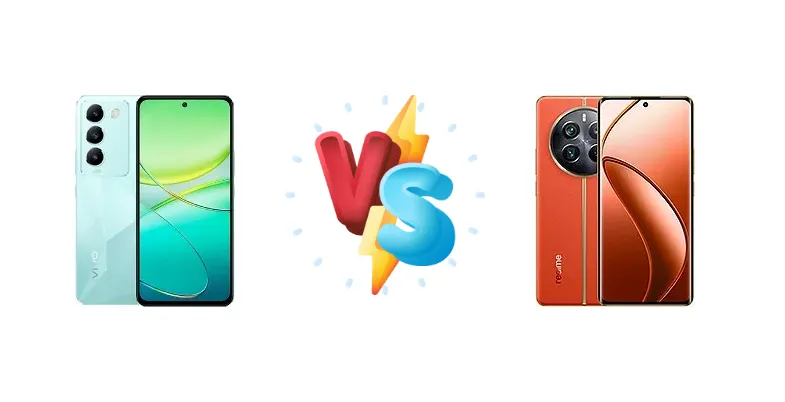
The mid-range smartphone market is fiercely competitive, and the vivo V30 Lite 4G and Realme 12 Pro+ represent compelling options for budget-conscious buyers. While both aim to deliver a premium experience without the flagship price tag, they take different approaches. The V30 Lite focuses on rapid charging and a streamlined experience, while the 12 Pro+ prioritizes a more powerful chipset and extended battery life. This comparison dives deep into the specifics to determine which device best suits your needs.
🏆 Quick Verdict
For the average user prioritizing sustained performance and battery longevity, the Realme 12 Pro+ emerges as the stronger contender. Its Snapdragon 7s Gen 2 chipset and impressive 13:24h active use battery life offer a smoother, more capable experience than the vivo V30 Lite 4G's Snapdragon 685.
| Network |
|---|
| 2G bands | GSM 850 / 900 / 1800 / 1900 | GSM 850 / 900 / 1800 / 1900 |
| 3G bands | HSDPA 850 / 900 / 1700(AWS) / 1900 / 2100 | HSDPA 850 / 900 / 2100 |
| 4G bands | 1, 3, 5, 7, 8, 20, 28 | 1, 3, 5, 8, 28, 40, 41 |
| 5G bands | - | 1, 3, 5, 8, 28, 40, 41, 77, 78 SA/NSA |
| Speed | HSPA, LTE | HSPA, LTE, 5G |
| Technology | GSM / HSPA / LTE | GSM / HSPA / LTE / 5G |
| Launch |
|---|
| Announced | 2024, April 04 | 2024, January 29 |
| Status | Available. Released 2024, April 04 | Available. Released 2024, January 29 |
| Body |
|---|
| Dimensions | 163.2 x 75.8 x 7.8 mm (6.43 x 2.98 x 0.31 in) | 161.5 x 74 x 8.8 mm (6.36 x 2.91 x 0.35 in) |
| SIM | Nano-SIM + Nano-SIM | Nano-SIM + Nano-SIM |
| Weight | 186 g or 188 g (6.56 oz) | 196 g (6.91 oz) |
| Display |
|---|
| Protection | Asahi Glass AGC DT-Star2 Plus | - |
| Resolution | 1080 x 2400 pixels, 20:9 ratio (~395 ppi density) | 1080 x 2412 pixels, 20:9 ratio (~394 ppi density) |
| Size | 6.67 inches, 107.4 cm2 (~86.8% screen-to-body ratio) | 6.7 inches, 108.0 cm2 (~90.4% screen-to-body ratio) |
| Type | AMOLED, 1B colors, 120Hz, 1200 nits (peak) | AMOLED, 1B colors, 120Hz, 800 nits (HBM), 950 nits (peak) |
| Platform |
|---|
| CPU | Octa-core (4x2.8 GHz Cortex-A73 & 4x1.9 GHz Cortex-A53) | Octa-core (4x2.40 GHz Cortex-A78 & 4x1.95 GHz Cortex-A55) |
| Chipset | Qualcomm SM6225 Snapdragon 685 (6 nm) | Qualcomm SM7435-AB Snapdragon 7s Gen 2 (4 nm) |
| GPU | Adreno 610 | Adreno 710 |
| OS | Android 14, Funtouch 14 | Android 14, Realme UI 5.0 |
| Memory |
|---|
| Card slot | microSDXC (uses shared SIM slot) | No |
| Internal | 128GB 8GB RAM, 256GB 8GB RAM | 128GB 8GB RAM, 256GB 8GB RAM, 256GB 12GB RAM, 512GB 12GB RAM |
| Main Camera |
|---|
| Dual | 50 MP, f/1.8, (wide), PDAF
Auxiliary lens | - |
| Features | LED flash, panorama, HDR | LED flash, HDR, panorama |
| Triple | - | 50 MP, f/1.8, 24mm (wide), 1/1.56", 1.0µm, multi-directional PDAF, OIS
64 MP, f/2.8, 71mm, (periscope telephoto), 1/2.0", 0.7µm, PDAF, OIS, 3x optical zoom
8 MP, f/2.2, 16mm, 112˚ (ultrawide), 1/4.0", 1.12µm |
| Video | 1080p@30fps | 4K@30fps, 1080p@30/60/120fps, gyro-EIS |
| Selfie camera |
|---|
| Single | 8 MP, f/2.0, (wide) | 32 MP, f/2.4, 22mm (wide) |
| Video | 1080p@30fps | 1080p@30fps |
| Sound |
|---|
| 35mm jack | No | No |
| Loudspeaker | Yes, with stereo speakers | Yes, with stereo speakers |
| Comms |
|---|
| Bluetooth | 5.0, A2DP, LE | 5.2, A2DP, LE |
| NFC | No | Yes (market/region dependent) |
| Positioning | GPS, GLONASS, GALILEO, BDS, QZSS | GPS, GLONASS, GALILEO, BDS, QZSS |
| Radio | No | No |
| USB | USB Type-C 2.0, OTG | USB Type-C 2.0 |
| WLAN | Wi-Fi 802.11 a/b/g/n/ac, dual-band | Wi-Fi 802.11 a/b/g/n/ac/6, dual-band |
| Features |
|---|
| Sensors | Fingerprint (under display, optical), accelerometer, gyro, proximity, compass | Fingerprint (under display, optical), accelerometer, gyro, proximity, compass |
| Battery |
|---|
| Charging | 80W wired, 80% in 30 min
Reverse wired | 67W wired, 50% in 19 min |
| Type | 5000 mAh | 5000 mAh |
| Misc |
|---|
| Colors | Crystal Green, Crystal Black | Submarine Blue, Navigator Beige, Explorer Red |
| Models | - | RMX3840, RMX3841 |
| Price | About 280 EUR | $ 465.00 / £ 299.00 / € 344.26 / ₹ 28,400 |
vivo V30 Lite 4G
- 80W SuperCharge delivers incredibly fast initial charging.
- Potentially lighter and more compact design (speculation based on brand trends).
- Reverse wired charging for accessory top-ups.
- Snapdragon 685 chipset is less powerful than the 7s Gen 2.
- Likely shorter battery life compared to the Realme 12 Pro+.
Realme 12 Pro+
- Snapdragon 7s Gen 2 offers significantly better performance.
- Excellent battery life with 13:24h of active use.
- Brighter display for improved outdoor visibility.
- 67W charging is slower than the V30 Lite's 80W.
- May be slightly larger and heavier than the V30 Lite.
Display Comparison
The Realme 12 Pro+ boasts a brighter display, reaching a measured peak brightness of 802 nits, which translates to better visibility outdoors. While the V30 Lite’s display specifications are not provided, Realme’s higher brightness is a clear advantage. Both devices likely utilize AMOLED panels, common in this price bracket, but the Realme’s brightness suggests a potentially superior viewing experience in direct sunlight. The absence of refresh rate data for the V30 Lite makes a direct comparison difficult, but the Realme 12 Pro+ likely offers a smoother experience if it includes a high refresh rate panel.
Camera Comparison
Without detailed camera specifications for both devices, a direct comparison is limited. However, the Realme 12 Pro+ is known for its 50MP main camera with OIS, suggesting a focus on image stabilization and low-light performance. The V30 Lite’s camera capabilities are less clear, but its positioning suggests a more budget-oriented approach. The absence of information regarding sensor sizes and lens apertures makes a definitive judgment difficult, but the Realme’s OIS is a significant advantage for capturing sharp, blur-free photos and videos.
Performance
The core difference lies in the chipsets. The Realme 12 Pro+ is equipped with the Qualcomm Snapdragon 7s Gen 2 (4nm), featuring four Cortex-A78 cores clocked at 2.40 GHz. This represents a significant step up from the vivo V30 Lite’s Snapdragon 685 (6nm) and its Cortex-A73 cores clocked at 2.8 GHz. While the V30 Lite’s cores have a slightly higher clock speed, the 7s Gen 2’s newer architecture and 4nm process node deliver superior efficiency and sustained performance. This translates to faster app loading times, smoother multitasking, and a more enjoyable gaming experience on the Realme 12 Pro+. The 4nm process also contributes to better thermal management, reducing the likelihood of throttling during extended use.
Battery Life
The Realme 12 Pro+ shines in battery life, achieving an impressive 13:24h of active use. While the V30 Lite’s battery capacity is unknown, the Realme’s endurance is a major selling point. The charging speeds are also noteworthy: the V30 Lite supports 80W wired charging, claiming 80% charge in 30 minutes, while the 12 Pro+ offers 67W wired charging, reaching 50% in 19 minutes. Although the V30 Lite charges faster initially, the Realme’s larger battery and efficient chipset provide longer overall usage time. The inclusion of reverse wired charging on the V30 Lite is a useful addition for topping up accessories.
Buying Guide
Buy the vivo V30 Lite 4G if you absolutely prioritize the fastest possible charging speeds and a lighter, more manageable device. Its 80W charging is a standout feature. Buy the Realme 12 Pro+ if you value a more powerful processor for gaming and demanding apps, coupled with significantly longer battery life for all-day use. The 7s Gen 2 provides a noticeable performance uplift.
Frequently Asked Questions
❓ Will the Snapdragon 685 in the vivo V30 Lite 4G struggle with demanding games like Genshin Impact?
Yes, the Snapdragon 685 is a capable chipset for everyday tasks, but it will likely struggle with graphically intensive games like Genshin Impact. Expect lower frame rates and the need to reduce graphics settings significantly. The Realme 12 Pro+'s Snapdragon 7s Gen 2 is much better suited for gaming.
❓ How much faster is the 80W charging on the vivo V30 Lite 4G compared to the 67W charging on the Realme 12 Pro+ in real-world use?
While the V30 Lite charges faster initially (80% in 30 minutes), the difference in overall charge time to 100% isn't massive. The Realme 12 Pro+'s larger battery and efficient chipset mean you'll spend less time plugged in overall, despite the slightly slower charging speed. The convenience of a full charge lasting significantly longer outweighs the initial charging speed advantage.
❓ Does the Realme 12 Pro+ get noticeably warm during extended gaming sessions?
The Snapdragon 7s Gen 2's 4nm process node is designed for improved thermal efficiency. While some warmth is expected during prolonged gaming, the Realme 12 Pro+ is less likely to experience significant throttling compared to devices with less efficient chipsets. The larger battery also acts as a heat sink, helping to dissipate heat.