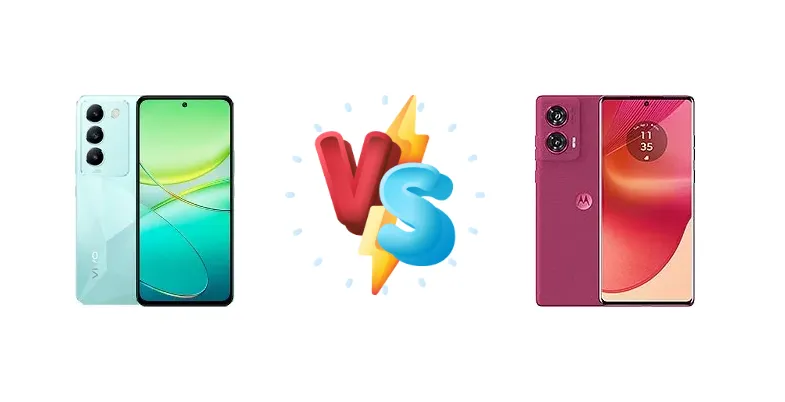
The mid-range smartphone market is fiercely competitive, and the vivo V30 Lite 4G and Motorola Edge 50 Fusion represent compelling options for budget-conscious buyers. While both aim to deliver a balanced experience, they take different approaches to chipset selection and feature prioritization. This comparison dissects their key specifications to determine which device offers the best value for your money.
🏆 Quick Verdict
For most users, the Motorola Edge 50 Fusion emerges as the stronger contender. Its Snapdragon 7s Gen 2 chipset (international variant) provides a significant performance uplift over the vivo V30 Lite’s Snapdragon 685, translating to smoother multitasking and gaming. While the vivo boasts faster 80W charging, the Fusion’s superior processing power and excellent 12:40h active use battery life make it the more well-rounded choice.
| Network |
|---|
| 2G bands | GSM 850 / 900 / 1800 / 1900 | GSM 850 / 900 / 1800 / 1900 |
| 3G bands | HSDPA 850 / 900 / 1700(AWS) / 1900 / 2100 | HSDPA 850 / 900 / 1900 / 2100 |
| 4G bands | 1, 3, 5, 7, 8, 20, 28 | 1, 2, 3, 5, 7, 8, 18, 19, 20, 26, 28, 32, 38, 40, 41, 42, 71 - International |
| 5G bands | - | 1, 3, 5, 7, 8, 20, 26, 28, 38, 40, 41, 77, 78 SA/NSA |
| Speed | HSPA, LTE | HSPA, LTE, 5G |
| Technology | GSM / HSPA / LTE | GSM / HSPA / LTE / 5G |
| Launch |
|---|
| Announced | 2024, April 04 | 2024, April 16 |
| Status | Available. Released 2024, April 04 | Available. Released 2024, May 15 |
| Body |
|---|
| Build | - | Glass front, silicone polymer back (eco leather), plastic frame |
| Dimensions | 163.2 x 75.8 x 7.8 mm (6.43 x 2.98 x 0.31 in) | 161.9 x 73.1 x 7.9 mm (6.37 x 2.88 x 0.31 in) |
| SIM | Nano-SIM + Nano-SIM | · Nano-SIM + eSIM· Nano-SIM + Nano-SIM |
| Weight | 186 g or 188 g (6.56 oz) | 174.9 g (6.17 oz) |
| Display |
|---|
| Protection | Asahi Glass AGC DT-Star2 Plus | Corning Gorilla Glass 5 |
| Resolution | 1080 x 2400 pixels, 20:9 ratio (~395 ppi density) | 1080 x 2400 pixels, 20:9 ratio (~393 ppi density) |
| Size | 6.67 inches, 107.4 cm2 (~86.8% screen-to-body ratio) | 6.7 inches, 108.4 cm2 (~91.6% screen-to-body ratio) |
| Type | AMOLED, 1B colors, 120Hz, 1200 nits (peak) | P-OLED, 1B colors, 120Hz (LATAM), 144Hz (INT), 1600 nits (peak) |
| Platform |
|---|
| CPU | Octa-core (4x2.8 GHz Cortex-A73 & 4x1.9 GHz Cortex-A53) | Octa-core (4x2.40 GHz Cortex-A78 & 4x1.95 GHz Cortex-A55) - InternationalOcta-core (4x2.2 GHz Cortex-A78 & 4x1.8 GHz Cortex-A55) - LATAM |
| Chipset | Qualcomm SM6225 Snapdragon 685 (6 nm) | Qualcomm SM7435-AB Snapdragon 7s Gen 2 (4 nm) - InternationalQualcomm SM6450 Snapdragon 6 Gen 1 (4 nm) - LATAM |
| GPU | Adreno 610 | Adreno 710 |
| OS | Android 14, Funtouch 14 | Android 14, upgradable to Android 15, up to 3 major Android upgrades |
| Memory |
|---|
| Card slot | microSDXC (uses shared SIM slot) | No |
| Internal | 128GB 8GB RAM, 256GB 8GB RAM | 128GB 8GB RAM, 256GB 8GB RAM, 256GB 12GB RAM, 512GB 8GB RAM, 512GB 12GB RAM |
| Main Camera |
|---|
| Dual | 50 MP, f/1.8, (wide), PDAF
Auxiliary lens | 50 MP, f/1.9, (wide), 1/1.56", 1.0µm, multi-directional PDAF, OIS
13 MP, f/2.2, 120˚ (ultrawide), 1/3.0", 1.12µm, AF |
| Features | LED flash, panorama, HDR | LED flash, HDR, panorama |
| Video | 1080p@30fps | 4K@30fps, 1080p@30/60/120fps, gyro-EIS |
| Selfie camera |
|---|
| Features | - | HDR |
| Single | 8 MP, f/2.0, (wide) | 32 MP, f/2.5, (wide), 1/3.14", 0.7µm |
| Video | 1080p@30fps | 4K@30fps, 1080p@30fps |
| Sound |
|---|
| 35mm jack | No | No |
| Loudspeaker | Yes, with stereo speakers | Yes, with stereo speakers |
| Comms |
|---|
| Bluetooth | 5.0, A2DP, LE | 5.2, A2DP, LE |
| NFC | No | Yes |
| Positioning | GPS, GLONASS, GALILEO, BDS, QZSS | GPS, GLONASS, GALILEO |
| Radio | No | No |
| USB | USB Type-C 2.0, OTG | USB Type-C 2.0, OTG |
| WLAN | Wi-Fi 802.11 a/b/g/n/ac, dual-band | Wi-Fi 802.11 a/b/g/n/ac, dual-band |
| Features |
|---|
| Sensors | Fingerprint (under display, optical), accelerometer, gyro, proximity, compass | Fingerprint (under display, optical), accelerometer, gyro, proximity, compass |
| Battery |
|---|
| Charging | 80W wired, 80% in 30 min
Reverse wired | 68W wired, 50% in 15 min |
| Type | 5000 mAh | 5000 mAh |
| Misc |
|---|
| Colors | Crystal Green, Crystal Black | Forest Blue, Marshmallow Blue, Hot Pink |
| Models | - | XT2429-1 |
| Price | About 280 EUR | € 208.99 / $ 245.00 / ₹ 18,667 |
vivo V30 Lite 4G
- Extremely fast 80W charging
- Potentially lower price point
- Sufficient for basic smartphone tasks
- Less powerful Snapdragon 685 chipset
- Likely lower display brightness
- Potentially shorter battery life
Motorola Edge 50 Fusion
- Significantly more powerful Snapdragon 7s Gen 2 (International)
- Brighter display with 1322 nits peak brightness
- Excellent 12:40h active use battery life
- More advanced image processing
- Slower 68W charging compared to vivo
- LATAM variant uses less powerful Snapdragon 6 Gen 1
- Potentially higher price
Display Comparison
The Motorola Edge 50 Fusion boasts a significantly brighter display, reaching a measured 1322 nits. This is a crucial advantage for outdoor visibility, especially in direct sunlight. While the vivo V30 Lite’s display specifications are not provided, it’s unlikely to match the Fusion’s peak brightness. The Fusion’s panel likely benefits from its more modern chipset’s display capabilities. The absence of LTPO technology in either device suggests neither offers adaptive refresh rates for optimal power saving, but the higher brightness of the Fusion is a clear win.
Camera Comparison
Detailed camera specifications are limited, but we can infer some differences. Both phones likely feature a primary camera, but the Motorola Edge 50 Fusion’s chipset offers more advanced image signal processing (ISP) capabilities, potentially leading to better image quality, especially in low-light conditions. The Snapdragon 7s Gen 2’s ISP can handle more complex algorithms for noise reduction and dynamic range optimization. Without knowing sensor sizes or apertures, it’s difficult to make a definitive judgment, but the Fusion’s processing power gives it an edge. We can safely assume both phones include a standard set of lenses, and any 2MP macro lenses are likely to offer limited practical benefit.
Performance
This is where the most significant difference lies. The Motorola Edge 50 Fusion, in its international configuration, utilizes the Qualcomm SM7435-AB Snapdragon 7s Gen 2 (4nm). This chipset features a more modern CPU architecture – Cortex-A78 cores – compared to the vivo V30 Lite’s Snapdragon 685 (6nm) which uses Cortex-A73 cores. The A78 cores offer a substantial performance improvement in both single-core and multi-core tasks. However, the LATAM variant of the Edge 50 Fusion uses the Snapdragon 6 Gen 1, which narrows the performance gap, but still offers an advantage over the 685. The 4nm process node of the 7s Gen 2 also contributes to better thermal efficiency, reducing the likelihood of throttling during sustained workloads. The vivo’s Snapdragon 685 is adequate for everyday tasks, but will struggle with demanding games and applications.
Battery Life
The Motorola Edge 50 Fusion demonstrates impressive battery life, achieving 12 hours and 40 minutes of active use. While the vivo V30 Lite’s battery capacity is unknown, the Fusion’s longevity is a significant advantage. The vivo compensates with 80W wired charging, capable of reaching 80% charge in just 30 minutes. The Fusion’s 68W charging reaches 50% in 15 minutes. While the vivo is faster overall, the Fusion’s longer battery life reduces the need for frequent top-ups. The efficiency gains from the Snapdragon 7s Gen 2 likely contribute to the Fusion’s superior battery performance.
Buying Guide
Buy the vivo V30 Lite 4G if your priority is extremely fast charging and you primarily use your phone for basic tasks like calling, texting, and light social media. Its 80W charging can get you back up and running quickly. Buy the Motorola Edge 50 Fusion if you prioritize performance for gaming, demanding apps, and future-proofing. The Snapdragon 7s Gen 2 offers a substantial advantage in processing power and efficiency, and the impressive battery life ensures all-day usability.
Frequently Asked Questions
❓ Does the Snapdragon 685 in the vivo V30 Lite 4G struggle with graphically intensive games like Genshin Impact or Call of Duty Mobile?
Yes, the Snapdragon 685 is a budget-oriented chipset. While it can handle less demanding games, graphically intensive titles like Genshin Impact or Call of Duty Mobile will likely require significant graphics settings reductions to achieve playable frame rates. Expect noticeable lag and stuttering, especially during complex scenes.
❓ Is the difference between the Snapdragon 7s Gen 2 and Snapdragon 6 Gen 1 in the Motorola Edge 50 Fusion significant enough to justify choosing the international version?
Absolutely. The Snapdragon 7s Gen 2 offers a substantial performance advantage over the Snapdragon 6 Gen 1, particularly in CPU-intensive tasks and gaming. The 7s Gen 2’s more modern CPU architecture and higher clock speeds translate to a noticeably smoother and more responsive user experience. If performance is a priority, seeking out the international version is highly recommended.
❓ How does the 80W charging on the vivo V30 Lite 4G compare to the 68W charging on the Motorola Edge 50 Fusion in real-world usage?
While the vivo V30 Lite 4G charges faster overall (80% in 30 minutes), the Motorola Edge 50 Fusion’s 68W charging is still quite rapid (50% in 15 minutes). The difference in charging speed is most noticeable when starting from a very low battery level. However, the Fusion’s longer battery life means you’ll likely need to charge less frequently, mitigating the impact of the slower charging speed.