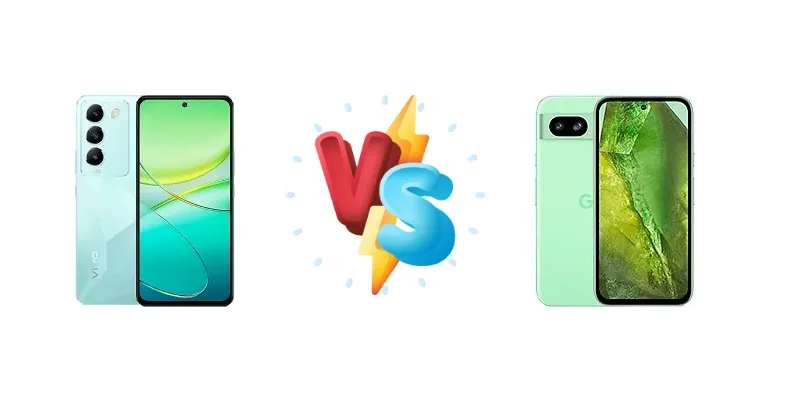
The Google Pixel 8a represents Google’s latest attempt to deliver a flagship experience at a mid-range price point, leveraging its Tensor G3 chip and renowned camera software. Conversely, the vivo V30 Lite 4G focuses on delivering essential features with an emphasis on fast charging and a streamlined user experience. This comparison dissects these two devices to determine which best suits your needs.
🏆 Quick Verdict
For most users, the Google Pixel 8a is the superior choice, offering a significantly more powerful processor and a demonstrably better camera experience thanks to Google’s computational photography. However, the vivo V30 Lite 4G’s 80W charging is a compelling advantage for those prioritizing speed over raw performance.
| Network |
|---|
| 2G bands | GSM 850 / 900 / 1800 / 1900 | GSM 850 / 900 / 1800 / 1900 |
| 3G bands | HSDPA 850 / 900 / 1700(AWS) / 1900 / 2100 | HSDPA 800 / 850 / 900 / 1700(AWS) / 1900 / 2100 |
| 4G bands | 1, 3, 5, 7, 8, 20, 28 | 1, 2, 3, 4, 5, 7, 8, 12, 17, 18, 19, 20, 26, 28, 32, 38, 40, 41, 42, 66 - G6GPR (International) |
| 5G bands | - | 1, 2, 3, 5, 7, 8, 12, 20, 26, 28, 38, 40, 41, 66, 75, 76, 77, 78 SA/NSA/Sub6 - G6GPR (International) |
| Speed | HSPA, LTE | HSPA, LTE, 5G |
| Technology | GSM / HSPA / LTE | GSM / HSPA / LTE / 5G |
| Launch |
|---|
| Announced | 2024, April 04 | 2024, May 07 |
| Status | Available. Released 2024, April 04 | Available. Released 2024, May 14 |
| Body |
|---|
| Build | - | Glass front (Gorilla Glass 3), aluminum frame, plastic back |
| Dimensions | 163.2 x 75.8 x 7.8 mm (6.43 x 2.98 x 0.31 in) | 152.1 x 72.7 x 8.9 mm (5.99 x 2.86 x 0.35 in) |
| SIM | Nano-SIM + Nano-SIM | Nano-SIM + eSIM |
| Weight | 186 g or 188 g (6.56 oz) | 188 g (6.63 oz) |
| Display |
|---|
| Protection | Asahi Glass AGC DT-Star2 Plus | Corning Gorilla Glass 3, Mohs level 5 |
| Resolution | 1080 x 2400 pixels, 20:9 ratio (~395 ppi density) | 1080 x 2400 pixels, 20:9 ratio (~430 ppi density) |
| Size | 6.67 inches, 107.4 cm2 (~86.8% screen-to-body ratio) | 6.1 inches, 90.3 cm2 (~81.6% screen-to-body ratio) |
| Type | AMOLED, 1B colors, 120Hz, 1200 nits (peak) | OLED, HDR, 120Hz, 2000 nits (peak) |
| Platform |
|---|
| CPU | Octa-core (4x2.8 GHz Cortex-A73 & 4x1.9 GHz Cortex-A53) | Nona-core (1x3.0 GHz Cortex-X3 & 4x2.45 GHz Cortex-A715 & 4x2.15 GHz Cortex-A510) |
| Chipset | Qualcomm SM6225 Snapdragon 685 (6 nm) | Google Tensor G3 (4 nm) |
| GPU | Adreno 610 | Immortalis-G715s MC10 |
| OS | Android 14, Funtouch 14 | Android 14, upgradable to Android 16, up to 7 major Android upgrades |
| Memory |
|---|
| Card slot | microSDXC (uses shared SIM slot) | No |
| Internal | 128GB 8GB RAM, 256GB 8GB RAM | 128GB 8GB RAM, 256GB 8GB RAM |
| Main Camera |
|---|
| Dual | 50 MP, f/1.8, (wide), PDAF
Auxiliary lens | 64 MP (16 MP eff.), f/1.9, 26mm (wide), 1/1.73", 0.8µm, dual pixel PDAF, OIS
13 MP, f/2.2, 120˚ (ultrawide), 1.12µm |
| Features | LED flash, panorama, HDR | Dual-LED flash, Pixel Shift, Ultra HDR, panorama, Best Take |
| Video | 1080p@30fps | 4K@30/60fps, 1080p@30/60/120/240fps, OIS |
| Selfie camera |
|---|
| Features | - | HDR, panorama |
| Single | 8 MP, f/2.0, (wide) | 13 MP, f/2.2, 20mm (ultrawide), 1.12µm |
| Video | 1080p@30fps | 4K@30fps, 1080p@30/60fps |
| Sound |
|---|
| 35mm jack | No | No |
| Loudspeaker | Yes, with stereo speakers | Yes, with stereo speakers |
| Comms |
|---|
| Bluetooth | 5.0, A2DP, LE | 5.3, A2DP, LE |
| NFC | No | Yes |
| Positioning | GPS, GLONASS, GALILEO, BDS, QZSS | GPS, GLONASS, GALILEO, BDS, QZSS, NavIC |
| Radio | No | No |
| USB | USB Type-C 2.0, OTG | USB Type-C 3.2 |
| WLAN | Wi-Fi 802.11 a/b/g/n/ac, dual-band | Wi-Fi 802.11 a/b/g/n/ac/6e, dual/tri-band (market/region dependent) |
| Features |
|---|
| Sensors | Fingerprint (under display, optical), accelerometer, gyro, proximity, compass | Fingerprint (under display, optical), accelerometer, gyro, proximity, compass, barometer |
| Battery |
|---|
| Charging | 80W wired, 80% in 30 min
Reverse wired | 18W wired, PD3.0
7.5W wireless
Bypass charging |
| Type | 5000 mAh | Li-Po 4492 mAh |
| Misc |
|---|
| Colors | Crystal Green, Crystal Black | Obsidian, Porcelain, Bay, Aloe |
| Models | - | GKV4X, G6GPR, G8HHN, G576D |
| Price | About 280 EUR | $ 229.98 / C$ 417.99 / £ 279.00 / € 299.99 / ₹ 33,300 |
| EU LABEL |
|---|
| Battery | - | 40:06h endurance, 1000 cycles |
| Energy | - | Class B |
| Free fall | - | Class A (270 falls) |
| Repairability | - | Class B |
vivo V30 Lite 4G
- Superior processing power with the Tensor G3 chip
- Exceptional camera quality and AI features
- Long-lasting battery life and software support
- Slower charging speed (18W)
- Potentially higher price point
Google Pixel 8a
- Extremely fast 80W wired charging
- More affordable price
- Reverse wired charging capability
- Less powerful processor (Snapdragon 685)
- Likely inferior camera performance
Display Comparison
The Pixel 8a boasts a significantly brighter display, reaching a measured peak of 1508 nits, which translates to excellent visibility in direct sunlight. While the vivo V30 Lite 4G’s display specifications are not provided, it’s likely to be considerably dimmer. The Pixel 8a’s display technology is also likely to be superior, potentially including features like LTPO for adaptive refresh rates, contributing to better battery efficiency. The Pixel 8a’s display is a clear advantage for outdoor use and media consumption.
Camera Comparison
While detailed camera specs for the vivo V30 Lite 4G are unavailable, the Pixel 8a’s strength lies in Google’s computational photography. The Tensor G3’s image signal processor (ISP) combined with Google’s software algorithms delivers exceptional image quality, particularly in low-light conditions. The Pixel 8a’s image processing excels in dynamic range and detail preservation. The absence of OIS information for the V30 Lite suggests it may struggle with handheld video recording and low-light photography compared to the Pixel 8a.
Performance
The core difference lies in the chipsets: the Google Pixel 8a utilizes the Google Tensor G3, a 4nm nona-core processor with a Cortex-X3 prime core, designed for AI and machine learning tasks. This contrasts sharply with the vivo V30 Lite 4G’s Qualcomm Snapdragon 685 (6nm), an octa-core chip geared towards efficiency. The Tensor G3’s architecture, with its Cortex-X3, provides a substantial performance uplift in CPU-intensive tasks and significantly enhances AI processing capabilities, impacting everything from camera features to voice assistant responsiveness. The Snapdragon 685 is adequate for everyday tasks, but will struggle with demanding games or multitasking.
Battery Life
The Pixel 8a demonstrates impressive battery endurance, achieving 40:06 hours of total usage and 11:25 hours of active use. This suggests a highly optimized power management system. While the vivo V30 Lite 4G’s battery capacity is not specified, its 80W wired charging is a standout feature, capable of reaching 80% charge in just 30 minutes. The Pixel 8a’s 18W charging is considerably slower. The Pixel 8a prioritizes longevity, while the V30 Lite prioritizes quick top-ups.
Buying Guide
Buy the vivo V30 Lite 4G if you prioritize extremely fast charging and a lower upfront cost, and your primary phone use revolves around social media, messaging, and light web browsing. Buy the Google Pixel 8a if you value a smoother, more responsive user experience, a superior camera system with advanced AI features, and longer software support, even if it means sacrificing charging speed.
Frequently Asked Questions
❓ Does the Snapdragon 685 in the vivo V30 Lite 4G struggle with graphically demanding games like Genshin Impact?
Yes, the Snapdragon 685 is a mid-range processor and will likely require significant graphics settings reductions to achieve playable frame rates in demanding titles like Genshin Impact. Expect noticeable frame drops and potential stuttering, especially during intense combat sequences. The Pixel 8a’s Tensor G3 will provide a much smoother gaming experience.
❓ How does the 18W charging on the Pixel 8a compare to the 80W charging on the vivo V30 Lite 4G in real-world usage?
The difference is substantial. The vivo V30 Lite 4G can reach 80% charge in approximately 30 minutes, while the Pixel 8a will take considerably longer – likely over 1.5 hours for a full charge. This makes the V30 Lite ideal for users who frequently need to quickly top up their battery.
❓ What kind of software updates can I expect from each phone?
Google provides guaranteed software updates and security patches for the Pixel 8a for a minimum of 7 years. vivo’s update policy is less consistent, and the V30 Lite 4G will likely receive fewer major Android version updates and a shorter period of security patch support.