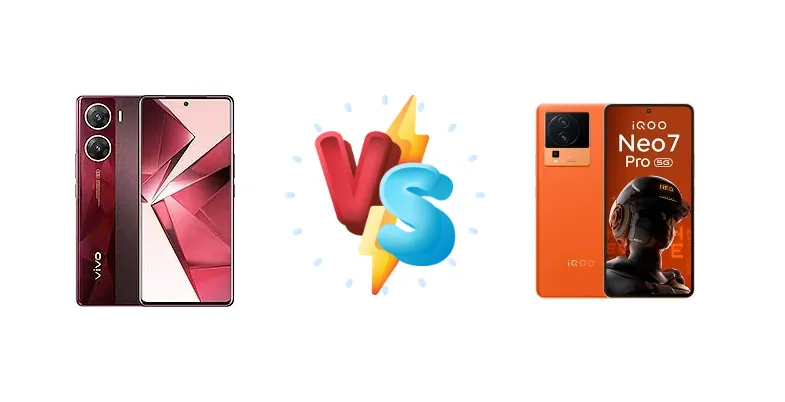
The vivo iQOO Neo 7 Pro and the vivo V29e (India) represent distinct approaches within vivo’s smartphone lineup. The Neo 7 Pro aims for near-flagship performance at a competitive price, leveraging the Snapdragon 8+ Gen 1. Conversely, the V29e focuses on delivering a balanced experience with a more affordable Snapdragon 695 5G chipset, making it a compelling option for budget-conscious consumers. This comparison dissects their key differences to help you determine which device best suits your needs.
🏆 Quick Verdict
For users prioritizing raw performance and fast charging, the vivo iQOO Neo 7 Pro is the clear winner. Its Snapdragon 8+ Gen 1 offers a substantial leap in processing power and gaming capabilities. However, the vivo V29e remains a strong contender for those seeking a reliable 5G experience without breaking the bank.
| Network |
|---|
| 2G bands | GSM 850 / 900 / 1800 / 1900 | GSM 850 / 900 / 1800 / 1900 |
| 3G bands | HSDPA 850 / 900 / 2100 | HSDPA 800 / 850 / 900 / 1700(AWS) / 1900 / 2100 |
| 4G bands | 1, 3, 5, 8, 28, 38, 40, 41 | 1, 2, 3, 4, 5, 8, 28, 34, 38, 39, 40, 41 |
| 5G bands | 1, 3, 5, 8, 28, 77, 78 SA/NSA | 1, 3, 5, 8, 28, 40, 77, 78 SA/NSA |
| Speed | HSPA, LTE, 5G | HSPA, LTE, 5G |
| Technology | GSM / HSPA / LTE / 5G | GSM / HSPA / LTE / 5G |
| Launch |
|---|
| Announced | 2023, August 28 | 2023, July 04 |
| Status | Available. Released 2023, September 07 | Available. Released 2023, July 15 |
| Body |
|---|
| Build | Glass front, plastic frame, glass back | Glass front, plastic frame, glass or leather back |
| Dimensions | 164.4 x 74.9 x 7.6 mm (6.47 x 2.95 x 0.30 in) | 164.8 x 76.9 x 8.5 mm or 8.9 mm |
| SIM | Nano-SIM + Nano-SIM | Nano-SIM + Nano-SIM |
| Weight | 181 g (6.38 oz) | 197 g or 202 g (6.95 oz) |
| Display |
|---|
| Resolution | 1080 x 2400 pixels, 20:9 ratio (~388 ppi density) | 1080 x 2400 pixels, 20:9 ratio (~388 ppi density) |
| Size | 6.78 inches, 111.0 cm2 (~90.1% screen-to-body ratio) | 6.78 inches, 111.0 cm2 (~87.6% screen-to-body ratio) |
| Type | AMOLED, 1B colors, 120Hz, HDR10+, 1300 nits (peak) | AMOLED, 1B colors, 120Hz, HDR10+, 1300 nits (peak) |
| Platform |
|---|
| CPU | Octa-core (2x2.2 GHz Kryo 660 Gold & 6x1.7 GHz Kryo 660 Silver) | Octa-core (1x3.19 GHz Cortex-X2 & 3x2.75 GHz Cortex-A710 & 4x2.0 GHz Cortex-A510) |
| Chipset | Qualcomm SM6375 Snapdragon 695 5G (6 nm) | Qualcomm SM8475 Snapdragon 8+ Gen 1 (4 nm) |
| GPU | Adreno 619 | Adreno 730 |
| OS | Android 13, Funtouch 13 | Android 13, Funtouch 13 |
| Memory |
|---|
| Card slot | microSDXC (uses shared SIM slot) | No |
| Internal | 128GB 8GB RAM, 256GB 8GB RAM | 128GB 8GB RAM, 256GB 12GB RAM |
| Main Camera |
|---|
| Dual | 64 MP, f/1.9, (wide), PDAF, OIS
8 MP, f/2.2, (ultrawide), 1/4.0", 1.12µm | - |
| Features | LED flash, panorama, HDR | LED flash, HDR, panorama |
| Triple | - | 50 MP, f/1.9, 24mm (wide), 1/1.57", 1.0µm, PDAF, OIS
8 MP, f/2.2, 16mm (ultrawide), 1/4.0", 1.12µm
2 MP (macro) |
| Video | 1080p@30fps | 4K@30fps, 1080p@30fps |
| Selfie camera |
|---|
| Features | HDR | HDR |
| Single | 50 MP, f/2.45, 22mm (wide), AF | 16 MP, f/2.5, (wide), 1/3.1", 1.0µm |
| Video | 1080p@30fps | 1080p@30fps |
| Sound |
|---|
| 35mm jack | No | No |
| Loudspeaker | Yes | Yes, with stereo speakers |
| Comms |
|---|
| Bluetooth | 5.1, A2DP, LE | 5.3, A2DP, LE, aptX HD, aptX Adaptive |
| Infrared port | - | Yes |
| NFC | No | No |
| Positioning | GPS, GLONASS, GALILEO, BDS | GPS, GLONASS, GALILEO, BDS, QZSS, NavIC |
| Radio | No | No |
| USB | USB Type-C 2.0, OTG | USB Type-C 2.0, OTG |
| WLAN | Wi-Fi 802.11 a/b/g/n/ac, dual-band | Wi-Fi 802.11 a/b/g/n/ac/6, dual-band, Wi-Fi Direct |
| Features |
|---|
| Sensors | Fingerprint (under display, optical), accelerometer, gyro, proximity, compass | Fingerprint (under display, optical), accelerometer, gyro, proximity, compass |
| Battery |
|---|
| Charging | 44W wired | 120W wired, 50% in 8 min |
| Type | 5000 mAh | 5000 mAh |
| Misc |
|---|
| Colors | Artistic Red, Artistic Blue | Fearless Flame, Dark Storm |
| Models | - | I2217 |
| Price | About 300 EUR | About 380 EUR |
vivo V29e (India)
- More affordable price point
- Reliable 5G connectivity
- Sufficient for everyday tasks
- Significantly weaker performance
- Slower charging speeds
- Less capable camera system
vivo iQOO Neo 7 Pro
- Flagship-level Snapdragon 8+ Gen 1 performance
- Ultra-fast 120W charging
- Likely superior camera capabilities
- Higher price tag
- Potentially more heat generation under load
- May be overkill for basic users
Display Comparison
While both devices likely feature AMOLED panels – a common trait in this price bracket – the specifics are not provided. However, the core difference lies beneath the surface. The iQOO Neo 7 Pro, positioned as a performance-focused device, likely boasts a higher refresh rate (potentially 120Hz) for smoother visuals during gaming and scrolling. The V29e, with its focus on cost-effectiveness, may feature a standard 60Hz or 90Hz panel. The iQOO Neo 7 Pro’s display is also likely to achieve higher peak brightness, improving visibility in direct sunlight.
Camera Comparison
Without detailed camera specifications, a direct comparison is limited. However, the iQOO Neo 7 Pro, being the higher-end device, likely incorporates a more sophisticated camera system, potentially with a larger main sensor and optical image stabilization (OIS). OIS is crucial for capturing sharp, blur-free photos and videos, especially in low-light conditions. While the V29e may offer a decent camera experience for casual photography, the iQOO Neo 7 Pro is expected to deliver superior image quality and versatility. The image processing algorithms will also likely be more advanced on the iQOO Neo 7 Pro, resulting in better dynamic range and detail.
Performance
The performance gap is the most significant differentiator. The iQOO Neo 7 Pro’s Snapdragon 8+ Gen 1 (4nm) is a flagship-tier chipset, featuring a Cortex-X2 prime core clocked at 3.19 GHz. This architecture delivers substantially higher CPU and GPU performance compared to the V29e’s Snapdragon 695 5G (6nm). The 695, while capable for everyday tasks, will struggle with graphically intensive games and demanding applications. The 4nm process of the 8+ Gen 1 also translates to improved thermal efficiency, reducing throttling during sustained workloads. The iQOO Neo 7 Pro will benefit users who frequently game, edit videos, or multitask heavily.
Battery Life
The iQOO Neo 7 Pro’s 120W wired charging is a game-changer, capable of charging the battery from 0% to 50% in just 8 minutes. This is a significant advantage over the V29e’s 44W charging. While battery capacity isn’t specified, the faster charging speed of the iQOO Neo 7 Pro effectively mitigates any potential difference in battery size. Users who frequently find themselves needing a quick power boost will greatly appreciate the iQOO Neo 7 Pro’s charging capabilities.
Buying Guide
Buy the vivo V29e (India) if you need a dependable 5G smartphone for everyday tasks, social media, and light gaming, and value affordability above all else. Buy the vivo iQOO Neo 7 Pro if you prioritize demanding mobile gaming, content creation, and require the fastest possible charging speeds, and are willing to invest a bit more for a significantly enhanced experience.
Frequently Asked Questions
❓ Will the Snapdragon 695 in the V29e struggle with demanding games like Genshin Impact or Call of Duty Mobile?
Yes, the Snapdragon 695 is a mid-range chipset and will likely struggle to deliver a smooth gaming experience in graphically intensive titles like Genshin Impact or Call of Duty Mobile, even at lower settings. Expect noticeable frame drops and potential lag. The iQOO Neo 7 Pro’s Snapdragon 8+ Gen 1 is far better suited for these games.
❓ How much faster is the 120W charging on the iQOO Neo 7 Pro compared to the 44W charging on the V29e in real-world usage?
The 120W charging on the iQOO Neo 7 Pro is significantly faster. While the V29e’s 44W charging will still provide a reasonable charge, the iQOO Neo 7 Pro can add a substantial amount of battery life in just a few minutes – reaching 50% charge in approximately 8 minutes. This is ideal for users who need a quick top-up before heading out.
❓ Is the difference in performance between the two phones noticeable for everyday tasks like browsing, social media, and video streaming?
For basic tasks, the difference won't be dramatically noticeable. Both phones will handle browsing, social media, and video streaming without issue. However, the iQOO Neo 7 Pro will feel snappier and more responsive when switching between apps or multitasking, thanks to its more powerful processor.