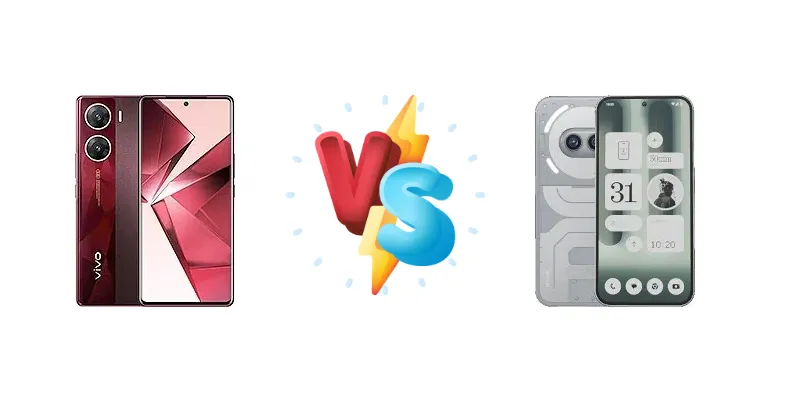
The mid-range smartphone market is fiercely competitive, and the vivo V29e (India) and Nothing Phone (2a) Plus represent compelling options. The V29e focuses on a streamlined experience with a familiar chipset, while the Nothing Phone (2a) Plus aims to disrupt with a newer, more powerful processor and a unique design. This comparison dives deep into the specifications to determine which device delivers the best value.
🏆 Quick Verdict
For the average user prioritizing performance and future-proofing, the Nothing Phone (2a) Plus emerges as the stronger contender. Its Mediatek Dimensity 7350 Pro chipset, coupled with faster charging and a brighter display, offers a more compelling experience than the vivo V29e’s Snapdragon 695.
| Network |
|---|
| 2G bands | GSM 850 / 900 / 1800 / 1900 | GSM 850 / 900 / 1800 / 1900 |
| 3G bands | HSDPA 850 / 900 / 2100 | HSDPA 800 / 850 / 900 / 1700(AWS) / 1900 / 2100 |
| 4G bands | 1, 3, 5, 8, 28, 38, 40, 41 | 1, 3, 4, 5, 7, 8, 18, 19, 20, 26, 28, 38, 39, 40, 41, 42, 66 |
| 5G bands | 1, 3, 5, 8, 28, 77, 78 SA/NSA | 1, 3, 5, 7, 8, 20, 28, 38, 40, 41, 66, 77, 78 SA/NSA |
| Speed | HSPA, LTE, 5G | HSPA, LTE, 5G |
| Technology | GSM / HSPA / LTE / 5G | GSM / HSPA / LTE / 5G |
| Launch |
|---|
| Announced | 2023, August 28 | 2024, July 31 |
| Status | Available. Released 2023, September 07 | Available. Released 2024, August 03 |
| Body |
|---|
| Build | Glass front, plastic frame, glass back | Glass front (Gorilla Glass 5), plastic frame, plastic back |
| Dimensions | 164.4 x 74.9 x 7.6 mm (6.47 x 2.95 x 0.30 in) | 161.7 x 76.3 x 8.5 mm (6.37 x 3.00 x 0.33 in) |
| SIM | Nano-SIM + Nano-SIM | Nano-SIM + Nano-SIM |
| Weight | 181 g (6.38 oz) | 190 g (6.70 oz) |
| Display |
|---|
| Protection | - | Corning Gorilla Glass 5 |
| Resolution | 1080 x 2400 pixels, 20:9 ratio (~388 ppi density) | 1080 x 2412 pixels, 20:9 ratio (~395 ppi density) |
| Size | 6.78 inches, 111.0 cm2 (~90.1% screen-to-body ratio) | 6.7 inches, 107.5 cm2 (~87.1% screen-to-body ratio) |
| Type | AMOLED, 1B colors, 120Hz, HDR10+, 1300 nits (peak) | AMOLED, 1B colors, 120Hz, 2160Hz PWM, HDR10+, 700 nits (typ), 1100 nits (HBM), 1300 nits (peak) |
| Platform |
|---|
| CPU | Octa-core (2x2.2 GHz Kryo 660 Gold & 6x1.7 GHz Kryo 660 Silver) | Octa-core (2x3.0 GHz Cortex-A715 & 6x 2.0 GHz Cortex-A510) |
| Chipset | Qualcomm SM6375 Snapdragon 695 5G (6 nm) | Mediatek Dimensity 7350 Pro (4 nm) |
| GPU | Adreno 619 | Mali-G610 MC4 |
| OS | Android 13, Funtouch 13 | Android 14, up to 3 major Android upgrades, Nothing OS 3.0 |
| Memory |
|---|
| Card slot | microSDXC (uses shared SIM slot) | No |
| Internal | 128GB 8GB RAM, 256GB 8GB RAM | 256GB 8GB RAM, 256GB 12GB RAM |
| Main Camera |
|---|
| Dual | 64 MP, f/1.9, (wide), PDAF, OIS
8 MP, f/2.2, (ultrawide), 1/4.0", 1.12µm | 50 MP, f/1.9, 24mm (wide), 1/1.57", 1.0µm, PDAF, OIS
50 MP, f/2.2, 114˚ (ultrawide), 1/2.76", 0.64µm |
| Features | LED flash, panorama, HDR | LED flash, panorama, HDR |
| Video | 1080p@30fps | 4K@30fps, 1080p@60/120fps, gyro-EIS |
| Selfie camera |
|---|
| Features | HDR | HDR |
| Single | 50 MP, f/2.45, 22mm (wide), AF | 50 MP, f/2.2, (wide), 1/2.76" |
| Video | 1080p@30fps | 4K@30fps |
| Sound |
|---|
| 35mm jack | No | No |
| Loudspeaker | Yes | Yes, with stereo speakers |
| Comms |
|---|
| Bluetooth | 5.1, A2DP, LE | 5.3, A2DP, LE |
| NFC | No | Yes, 360˚ |
| Positioning | GPS, GLONASS, GALILEO, BDS | GPS, GALILEO, GLONASS, BDS, QZSS |
| Radio | No | No |
| USB | USB Type-C 2.0, OTG | USB Type-C 2.0, OTG |
| WLAN | Wi-Fi 802.11 a/b/g/n/ac, dual-band | Wi-Fi 802.11 a/b/g/n/ac/6, dual-band, Wi-Fi Direct |
| Features |
|---|
| Sensors | Fingerprint (under display, optical), accelerometer, gyro, proximity, compass | Fingerprint (under display, optical), accelerometer, gyro, proximity, compass |
| Battery |
|---|
| Charging | 44W wired | 50W wired, 50% in 21 min, 100% in 56 min |
| Type | 5000 mAh | 5000 mAh |
| Misc |
|---|
| Colors | Artistic Red, Artistic Blue | Black, Grey |
| Models | - | A142P |
| Price | About 300 EUR | € 269.90 / ₹ 22,599 |
vivo V29e (India)
- Established Brand Reputation
- Reliable Snapdragon 695 Performance for Everyday Tasks
- Potentially Lower Price Point
- Older Chipset Technology
- Slower Charging Speed
- Likely Lower Peak Display Brightness
Nothing Phone (2a) Plus
- Powerful Mediatek Dimensity 7350 Pro Chipset
- Faster 50W Wired Charging
- Brighter Display (1097 nits)
- Long Active Use Battery Life (16:34h)
- Newer Brand with Less Established Support Network
- Potentially Higher Price Point
- Design may not appeal to all users
Display Comparison
The Nothing Phone (2a) Plus boasts a significant advantage in display technology, achieving a measured peak brightness of 1097 nits. This is crucial for outdoor visibility, a scenario where the V29e’s specifications are not available for comparison, but likely falls short. While the V29e’s panel details are unknown, the Nothing Phone (2a) Plus’s brightness suggests a superior viewing experience in bright conditions. The absence of LTPO on either device suggests neither offers adaptive refresh rates for optimal power efficiency, but the higher peak brightness of the Nothing Phone (2a) Plus is a clear win.
Camera Comparison
Without detailed camera specifications for the V29e, a direct comparison is limited. However, the market positioning suggests the Nothing Phone (2a) Plus likely offers a more advanced camera system. The focus should be on the main sensor and image processing capabilities, as 2MP macro lenses are often of limited practical use. The Dimensity 7350 Pro’s ISP (Image Signal Processor) is also more modern, potentially leading to better image quality and faster processing times. The Nothing Phone (2a) Plus’s image processing algorithms will likely be more sophisticated, offering features like improved dynamic range and noise reduction.
Performance
The core difference lies in the chipsets: the vivo V29e utilizes the Qualcomm Snapdragon 695 5G (6nm), while the Nothing Phone (2a) Plus features the Mediatek Dimensity 7350 Pro (4nm). The Dimensity 7350 Pro’s Cortex-A715 cores, clocked at 3.0 GHz, represent a substantial leap in CPU performance compared to the Snapdragon 695’s Kryo 660 Gold cores at 2.2 GHz. The 4nm process node of the Dimensity 7350 Pro also translates to improved thermal efficiency, potentially reducing throttling during sustained workloads. This means the Nothing Phone (2a) Plus will handle demanding games and applications more smoothly and consistently.
Battery Life
The Nothing Phone (2a) Plus demonstrates a clear advantage in charging speed, achieving 50% charge in 21 minutes and 100% in 56 minutes with its 50W wired charging. The vivo V29e’s 44W charging is slower by comparison. More importantly, the Nothing Phone (2a) Plus achieves an impressive 16:34h of active use, indicating excellent battery optimization and efficiency. While the V29e’s battery capacity is unknown, the Nothing Phone (2a) Plus’s combination of efficient chipset and fast charging provides a more convenient and reliable user experience.
Buying Guide
Buy the vivo V29e (India) if you prioritize a well-established brand with a focus on reliable, everyday performance and are comfortable with a slightly older chipset. Buy the Nothing Phone (2a) Plus if you prefer a more modern processor for demanding tasks, faster charging speeds, and a brighter, more vibrant display, even if it means opting for a newer brand.
Frequently Asked Questions
❓ Does the Mediatek Dimensity 7350 Pro in the Nothing Phone (2a) Plus tend to overheat during prolonged gaming sessions?
The Dimensity 7350 Pro’s 4nm process node is designed for improved thermal efficiency. While some heat generation is inevitable during gaming, the chipset is less prone to throttling compared to older, larger-node chipsets like the Snapdragon 695. The Nothing Phone (2a) Plus also incorporates thermal management systems to further mitigate heat buildup.
❓ How does the Snapdragon 695 in the vivo V29e handle graphically demanding games like PUBG Mobile?
The Snapdragon 695 can run PUBG Mobile, but likely at lower graphics settings to maintain a stable frame rate. The Dimensity 7350 Pro in the Nothing Phone (2a) Plus offers significantly more headroom for higher graphics settings and smoother gameplay, providing a more immersive gaming experience.
❓ Is the 50W charging on the Nothing Phone (2a) Plus compatible with Power Delivery (PD) chargers?
While the Nothing Phone (2a) Plus supports fast charging, compatibility with third-party Power Delivery (PD) chargers may vary. Using a charger specifically designed for the device is recommended to ensure optimal charging speeds and safety. The phone supports the Power Delivery 3.0 protocol.