
vivo V29e (India) vs Motorola Edge 40 Neo: A Detailed Comparison
| Phones Images | |||||
|---|---|---|---|---|---|
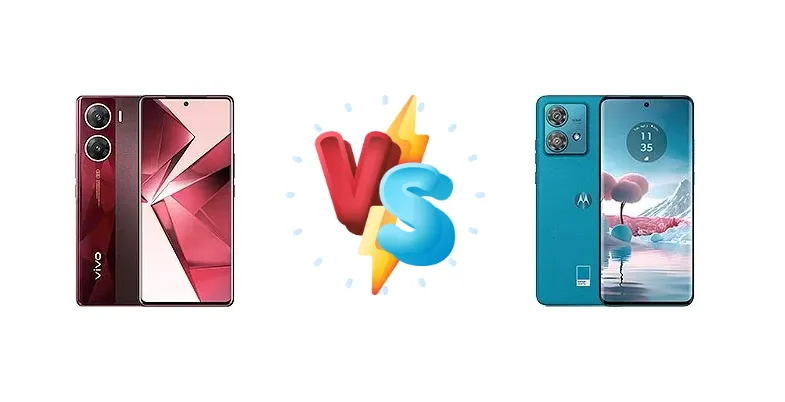
|
🏆 Quick Verdict
For the average user prioritizing battery life and faster charging, the Motorola Edge 40 Neo is the stronger choice. Its Dimensity 7030 offers a performance edge, and the 68W charging significantly reduces downtime. However, the V29e remains a viable option for those seeking a simpler, more streamlined experience.
| PHONES | ||
|---|---|---|
| Phone Names | vivo V29e (India) | Motorola Edge 40 Neo |
| Network | ||
|---|---|---|
| 2G bands | GSM 850 / 900 / 1800 / 1900 | GSM 850 / 900 / 1800 / 1900 |
| 3G bands | HSDPA 850 / 900 / 2100 | HSDPA 800 / 850 / 900 / 1700(AWS) / 1900 / 2100 |
| 4G bands | 1, 3, 5, 8, 28, 38, 40, 41 | 1, 2, 3, 4, 5, 7, 8, 12, 13, 17, 18, 19, 20, 25, 26, 28, 32, 38, 38, 39, 40, 41, 42, 43, 48, 66 |
| 5G bands | 1, 3, 5, 8, 28, 77, 78 SA/NSA | 1, 2, 3, 5, 7, 8, 20, 28, 38, 40, 41, 66, 77, 78 SA/NSA |
| Speed | HSPA, LTE, 5G | HSPA, LTE, 5G |
| Technology | GSM / HSPA / LTE / 5G | GSM / HSPA / LTE / 5G |
| Launch | ||
|---|---|---|
| Announced | 2023, August 28 | 2023, September 14 |
| Status | Available. Released 2023, September 07 | Available. Released 2023, September 14 |
| Body | ||
|---|---|---|
| Build | Glass front, plastic frame, glass back | Glass front (Gorilla Glass 3), plastic frame, plastic back |
| Dimensions | 164.4 x 74.9 x 7.6 mm (6.47 x 2.95 x 0.30 in) | 159.6 x 72 x 7.9 mm (6.28 x 2.83 x 0.31 in) |
| SIM | Nano-SIM + Nano-SIM | · Nano-SIM + eSIM· Nano-SIM + Nano-SIM |
| Weight | 181 g (6.38 oz) | 170 g or 172 g (6.00 oz) |
| Display | ||
|---|---|---|
| Protection | - | Corning Gorilla Glass 3 |
| Resolution | 1080 x 2400 pixels, 20:9 ratio (~388 ppi density) | 1080 x 2400 pixels, 20:9 ratio (~402 ppi density) |
| Size | 6.78 inches, 111.0 cm2 (~90.1% screen-to-body ratio) | 6.55 inches, 103.6 cm2 (~90.1% screen-to-body ratio) |
| Type | AMOLED, 1B colors, 120Hz, HDR10+, 1300 nits (peak) | P-OLED, 1B colors, 144Hz, HDR10+, 1300 nits (peak) |
| Platform | ||
|---|---|---|
| CPU | Octa-core (2x2.2 GHz Kryo 660 Gold & 6x1.7 GHz Kryo 660 Silver) | Octa-core (2x2.5 GHz Cortex-A78 & 6x2.0 GHz Cortex-A55) |
| Chipset | Qualcomm SM6375 Snapdragon 695 5G (6 nm) | MediaTek Dimensity 7030 (6 nm) |
| GPU | Adreno 619 | Mali-G610 MC3 |
| OS | Android 13, Funtouch 13 | Android 13, up to 2 major Android upgrades |
| Memory | ||
|---|---|---|
| Card slot | microSDXC (uses shared SIM slot) | No |
| Internal | 128GB 8GB RAM, 256GB 8GB RAM | 128GB 8GB RAM, 256GB 8GB RAM, 256GB 12GB RAM |
| Main Camera | ||
|---|---|---|
| Dual | 64 MP, f/1.9, (wide), PDAF, OIS 8 MP, f/2.2, (ultrawide), 1/4.0", 1.12µm | 50 MP, f/1.8, (wide), 1/1.55", 1.0µm, multi-directional PDAF, OIS 13 MP, f/2.2, 120˚ (ultrawide), 1/3.0", 1.12µm, PDAF |
| Features | LED flash, panorama, HDR | LED flash, HDR, panorama |
| Video | 1080p@30fps | 4K@30fps, 1080p@30/60/120/240fps, gyro-EIS |
| Selfie camera | ||
|---|---|---|
| Features | HDR | HDR |
| Single | 50 MP, f/2.45, 22mm (wide), AF | 32 MP, f/2.4, (wide), 1/3.0", 0.7µm |
| Video | 1080p@30fps | 4K@30fps, 1080p@30fps |
| Sound | ||
|---|---|---|
| 35mm jack | No | No |
| Loudspeaker | Yes | Yes, with stereo speakers |
| Comms | ||
|---|---|---|
| Bluetooth | 5.1, A2DP, LE | 5.4, A2DP, LE |
| NFC | No | Yes |
| Positioning | GPS, GLONASS, GALILEO, BDS | GPS, GLONASS, GALILEO |
| Radio | No | No |
| USB | USB Type-C 2.0, OTG | USB Type-C 2.0, OTG |
| WLAN | Wi-Fi 802.11 a/b/g/n/ac, dual-band | Wi-Fi 802.11 a/b/g/n/ac/6e, tri-band, Wi-Fi Direct |
| Features | ||
|---|---|---|
| Sensors | Fingerprint (under display, optical), accelerometer, gyro, proximity, compass | Fingerprint (under display, optical), accelerometer, gyro, proximity, compass |
| Battery | ||
|---|---|---|
| Charging | 44W wired | 68W wired, 50% in 15 min |
| Type | 5000 mAh | Li-Po 5000 mAh |
| Misc | ||
|---|---|---|
| Colors | Artistic Red, Artistic Blue | Black, Soothing Sea, Caneel Bay, Peach Fuzz |
| Models | - | XT2307-1 |
| Price | About 300 EUR | $ 299.00 / € 168.73 / ₹ 19,900 |
vivo V29e (India)
- Potentially cleaner software experience (typical of vivo)
- Reliable 5G connectivity with Snapdragon 695
- Competitive price point (likely)
- Less powerful processor compared to Dimensity 7030
- Slower charging speed (44W)
- Display brightness likely lower than Edge 40 Neo
Motorola Edge 40 Neo
- Faster and more efficient Dimensity 7030 chipset
- Significantly faster 68W charging
- Brighter display for better outdoor visibility
- Motorola’s software can be more bloated than vivo’s
- Potentially higher price compared to V29e
- May not have the same level of brand recognition in India as vivo
Display Comparison
The Motorola Edge 40 Neo boasts a brighter display, reaching a measured peak brightness of 1073 nits. While the V29e’s display specifications are not provided, this difference is significant for outdoor visibility. The Edge 40 Neo’s higher brightness, combined with its likely use of an AMOLED panel (common in this segment), will deliver a more vibrant and engaging viewing experience. The absence of refresh rate data for the V29e makes a direct comparison difficult, but the Edge 40 Neo likely offers a smoother experience if it includes a high refresh rate panel.
Camera Comparison
Without detailed camera specifications for the vivo V29e, a direct comparison is challenging. However, the Motorola Edge 40 Neo likely benefits from a more sophisticated image processing pipeline, leveraging the Dimensity 7030’s ISP capabilities. The Edge 40 Neo’s camera system (Photo/Video) suggests a focus on versatility, while the V29e’s camera performance will likely be adequate for social media sharing but may lack the dynamic range and detail of the Edge 40 Neo in challenging lighting conditions. The prevalence of 2MP macro lenses in this segment suggests both phones may include one, but their utility is limited.
Performance
The Motorola Edge 40 Neo’s MediaTek Dimensity 7030, with its 2x2.5 GHz Cortex-A78 cores and 6x2.0 GHz Cortex-A55 cores, represents a clear performance advantage over the vivo V29e’s Qualcomm Snapdragon 695 5G (2x2.2 GHz Kryo 660 Gold & 6x1.7 GHz Kryo 660 Silver). The Cortex-A78 cores in the Dimensity 7030 are architecturally superior, offering better single-core performance crucial for responsive app launches and smoother multitasking. Both chips are fabricated on a 6nm process, suggesting similar efficiency, but the Dimensity 7030’s core configuration provides a noticeable uplift in overall processing power. The V29e will handle everyday tasks adequately, but the Edge 40 Neo is better equipped for demanding applications and gaming.
Battery Life
The Motorola Edge 40 Neo shines in the battery and charging department. Its active use score of 10:28h and endurance rating of 80 hours demonstrate excellent battery life. Crucially, the 68W wired charging capability allows for a 50% charge in just 15 minutes, minimizing downtime. The V29e’s 44W charging is respectable, but significantly slower. While the V29e’s battery capacity is unknown, the Edge 40 Neo’s superior charging speed and endurance rating make it the clear winner for users who prioritize long-lasting power and quick top-ups.
Buying Guide
Buy the vivo V29e (India) if you need a reliable, everyday smartphone with 5G connectivity and prioritize a clean software experience. Buy the Motorola Edge 40 Neo if you prefer a more powerful processor for multitasking and light gaming, coupled with significantly faster charging and longer battery endurance for all-day use.