
Xiaomi 13T vs vivo V29: Which Mid-Range Phone Reigns Supreme?
| Phones Images | |||||
|---|---|---|---|---|---|
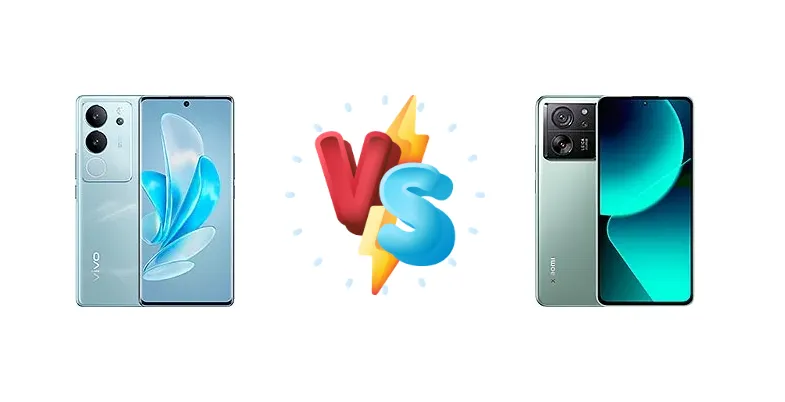
|
🏆 Quick Verdict
For most users, the Xiaomi 13T emerges as the stronger contender. Its significantly more powerful Dimensity 8200 Ultra chipset delivers a noticeable performance boost in demanding tasks and gaming. However, the vivo V29’s excellent battery endurance and slightly brighter display make it a viable alternative for those prioritizing longevity and outdoor visibility.
| PHONES | ||
|---|---|---|
| Phone Names | vivo V29 | Xiaomi 13T |
| Network | ||
|---|---|---|
| 2G bands | GSM 850 / 900 / 1800 / 1900 | GSM 850 / 900 / 1800 / 1900 |
| 3G bands | HSDPA 850 / 900 / 1700(AWS) / 1900 / 2100 | HSDPA 800 / 850 / 900 / 1700(AWS) / 1900 / 2100 |
| 4G bands | 1, 2, 3, 4, 5, 7, 8, 12, 13, 17, 18, 19, 20, 26, 28, 32, 38, 39, 40, 41, 66 | 1, 2, 3, 4, 5, 7, 8, 12, 13, 17, 18, 19, 20, 26, 28, 32, 38, 40, 41, 66 |
| 5G bands | 1, 2, 3, 5, 7, 8, 20, 26, 28, 66, 38, 40, 41, 77, 78 SA/NSA | 1, 3, 5, 7, 8, 20, 28, 38, 40, 41, 66, 77, 78 SA/NSA |
| Speed | HSPA, LTE, 5G | HSPA, LTE, 5G |
| Technology | GSM / CDMA / HSPA / LTE / 5G | GSM / HSPA / LTE / 5G |
| Launch | ||
|---|---|---|
| Announced | 2023, July 31 | 2023, September 26 |
| Status | Available. Released 2023, September | Available. Released 2023, September 26 |
| Body | ||
|---|---|---|
| Build | Glass front, glass back, plastic frame | Glass front (Gorilla Glass 5), glass back or silicone polymer back, plastic frame |
| Dimensions | 164.2 x 74.4 x 7.5 mm (6.46 x 2.93 x 0.30 in) | 162.2 x 75.7 x 8.5 mm (6.39 x 2.98 x 0.33 in) |
| SIM | · Nano-SIM + eSIM· Nano-SIM + Nano-SIM | · Nano-SIM + eSIM· Nano-SIM + Nano-SIM |
| Weight | 186 g (6.56 oz) | 193 g or 197 g (6.81 oz) |
| Display | ||
|---|---|---|
| Protection | - | Corning Gorilla Glass 5 |
| Resolution | 1260 x 2800 pixels, 20:9 ratio (~453 ppi density) | 1220 x 2712 pixels, 20:9 ratio (~446 ppi density) |
| Size | 6.78 inches, 111.0 cm2 (~90.8% screen-to-body ratio) | 6.67 inches, 107.4 cm2 (~87.5% screen-to-body ratio) |
| Type | AMOLED, 1B colors, 120Hz, HDR10+ | AMOLED, 68B colors, 144Hz, Dolby Vision, HDR10+, 1200 nits (HBM), 2600 nits (peak) |
| Platform | ||
|---|---|---|
| CPU | Octa-core (1x2.4 GHz Cortex-A78 & 3x2.2 GHz Cortex-A78 & 4x1.9 GHz Cortex-A55) | Octa-core (1x3.1 GHz Cortex-A78 & 3x3.0 GHz Cortex-A78 & 4x2.0 GHz Cortex-A55) |
| Chipset | Qualcomm SM7325 Snapdragon 778G 5G (6 nm) | Mediatek Dimensity 8200 Ultra (4 nm) |
| GPU | Adreno 642L | Mali-G610 MC6 |
| OS | Android 13, up to 3 major Android upgrades, Funtouch 13 | Android 13, up to 4 major Android upgrades, HyperOS |
| Memory | ||
|---|---|---|
| Card slot | No | No |
| Internal | 128GB 8GB RAM, 256GB 8GB RAM, 256GB 12GB RAM, 512GB 12GB RAM | 256GB 8GB RAM, 256GB 12GB RAM |
| Main Camera | ||
|---|---|---|
| Features | Ring-LED flash, panorama, HDR | Leica lens, color spectrum sensor, LED flash, HDR, panorama |
| Triple | 50 MP, f/1.9, (wide), 1/1.56", 1.0µm, PDAF, OIS 8 MP, f/2.2, (ultrawide), 1/4.0", 1.12µm Auxiliary lens | 50 MP, f/1.9, 24mm (wide), 1/1.28", 1.22µm, PDAF, OIS 50 MP, f/1.9, 50mm (telephoto), 1/2.88", 0.61µm, PDAF, 2x optical zoom 12 MP, f/2.2, 15mm (ultrawide), 1/3.06", 1.12µm |
| Video | 4K@30fps, 1080p@30fps | 4K@30fps (HDR10+), 1080p@30/60/120fps, gyro-EIS |
| Selfie camera | ||
|---|---|---|
| Features | HDR | HDR |
| Single | 50 MP, f/2.0, 22mm (wide), 1/2.76", 0.64µm, AF | 20 MP, f/2.2, (wide), 0.8µm |
| Video | 1080p@30fps | 1080p@30fps, HDR10+ |
| Sound | ||
|---|---|---|
| 35mm jack | No | No |
| Loudspeaker | Yes | Yes, with stereo speakers |
| Comms | ||
|---|---|---|
| Bluetooth | 5.2, A2DP, LE, aptX HD, aptX Adaptive | 5.4, A2DP, LE |
| Infrared port | - | Yes |
| NFC | Yes | Yes (market/region dependent) |
| Positioning | GPS (L1), GLONASS (G1), BDS (B1I), GALILEO (E1), QZSS (L1) | GPS (L1+L5), GLONASS (G1), GALILEO (E1+E5a), QZSS (L1+L5), NavIC (L5), BDS |
| Radio | No | No |
| USB | USB Type-C 2.0, OTG | USB Type-C 2.0, OTG |
| WLAN | Wi-Fi 802.11 a/b/g/n/ac, dual-band, Wi-Fi Direct | Wi-Fi 802.11 a/b/g/n/ac/6, dual-band |
| Features | ||
|---|---|---|
| Sensors | Fingerprint (under display, optical), accelerometer, gyro, proximity, compass | Fingerprint (under display, optical), accelerometer, gyro, proximity, compass |
| Battery | ||
|---|---|---|
| Charging | 80W wired, 50% in 17 min | 67W wired, PD3.0, QC4, 100% in 42 min |
| Type | 4600 mAh | Li-Po 5000 mAh |
| Misc | ||
|---|---|---|
| Colors | Space Black, Himalayan Blue, Purple Fairy, Majestic Red | Alpine Blue, Meadow Green, Black |
| Models | V2250 | 2306EPN60G |
| Price | About 250 EUR | $ 255.96 / £ 326.27 / € 204.18 |
| SAR EU | 0.94 W/kg (head) 1.08 W/kg (body) | 0.99 W/kg (head) 0.99 W/kg (body) |
vivo V29
- Faster processor for gaming and multitasking
- Brighter display for outdoor visibility
- Excellent battery life and endurance
- Slower charging speed compared to vivo V29
- Potentially less refined software experience
Xiaomi 13T
- Faster charging speed for quick top-ups
- Slightly more efficient chipset
- Potentially more stylish design (brand reputation)
- Less powerful processor for demanding tasks
- Dimmer display compared to Xiaomi 13T
Display Comparison
The Xiaomi 13T boasts a brighter display, reaching a measured 1264 nits compared to the vivo V29’s 996 nits. This translates to superior visibility under direct sunlight. Both devices feature capable panels, but the 13T’s higher peak brightness is a tangible advantage. While neither specification details refresh rate or panel type, the Xiaomi 13T’s brightness suggests a more modern panel capable of wider color gamuts. The V29’s brightness is still respectable, but the 13T offers a more vibrant and readable experience outdoors.
Camera Comparison
Both phones are advertised as having capable photo and video capabilities, but detailed sensor information is absent. Without specifics on sensor size, aperture, or image stabilization, a direct comparison is difficult. However, the Xiaomi 13T’s more powerful ISP (integrated signal processor) within the Dimensity 8200 Ultra likely provides superior image processing capabilities, potentially leading to better dynamic range and low-light performance. The absence of details suggests both phones target a similar user – casual photographers rather than enthusiasts.
Performance
The core difference lies in the chipsets. The Xiaomi 13T’s Mediatek Dimensity 8200 Ultra (4nm) is a substantial upgrade over the vivo V29’s Qualcomm Snapdragon 778G 5G (6nm). The Dimensity 8200 Ultra features a faster prime core (3.1 GHz vs 2.4 GHz) and a more efficient manufacturing process. This results in significantly improved CPU and GPU performance, making the 13T better suited for gaming and resource-intensive applications. The Snapdragon 778G remains a capable performer for everyday tasks, but will show its limitations when pushed. The 13T’s 4nm process also implies better thermal efficiency, potentially reducing throttling during sustained workloads.
Battery Life
The Xiaomi 13T achieves an active use score of 12:23h, while the vivo V29 has an endurance rating of 99h, and the 13T has an endurance rating of 101h. While the active use score provides a more realistic measure of real-world performance, the endurance rating suggests similar longevity. However, the Xiaomi 13T’s 67W charging (100% in 42 minutes) is slower than the vivo V29’s 80W charging (50% in 17 minutes). The V29’s faster charging is a significant convenience factor, allowing for quick top-ups throughout the day. The 13T’s larger battery capacity and efficient chipset contribute to its impressive endurance.
Buying Guide
Buy the vivo V29 if you need exceptional battery life and a phone that can comfortably last a full day and beyond with moderate use. It’s ideal for users who prioritize endurance over peak performance. Buy the Xiaomi 13T if you prefer a phone capable of handling demanding games, video editing, and multitasking with ease. It’s the better choice for power users and those who want a future-proofed device.