
vivo iQOO 11S vs. vivo V29: A Deep Dive into Performance and Value
| Phones Images | |||||
|---|---|---|---|---|---|
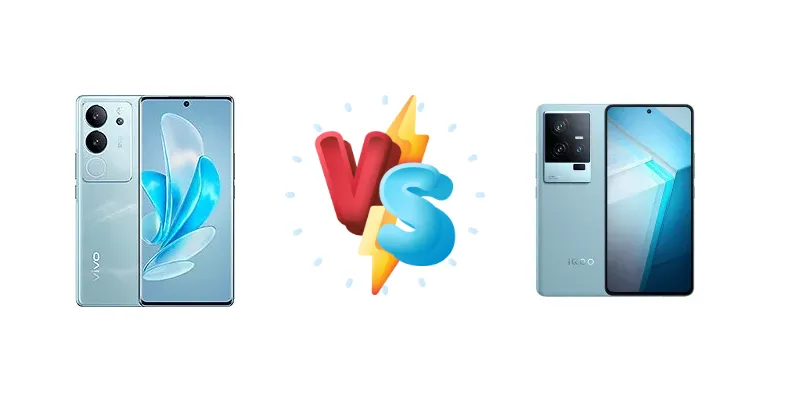
|
🏆 Quick Verdict
For the average user prioritizing a balance of features and battery life, the vivo V29 offers a compelling package. However, the iQOO 11S is the clear winner for gamers and power users who demand the absolute best performance and fastest charging, justifying its higher price point.
| PHONES | ||
|---|---|---|
| Phone Names | vivo V29 | vivo iQOO 11S |
| Network | ||
|---|---|---|
| 2G bands | GSM 850 / 900 / 1800 / 1900 | GSM 850 / 900 / 1800 / 1900 |
| 3G bands | HSDPA 850 / 900 / 1700(AWS) / 1900 / 2100 | HSDPA 800 / 850 / 900 / 1700(AWS) / 1900 / 2100 |
| 4G bands | 1, 2, 3, 4, 5, 7, 8, 12, 13, 17, 18, 19, 20, 26, 28, 32, 38, 39, 40, 41, 66 | 1, 2, 3, 4, 5, 7, 8, 12, 17, 18, 19, 20, 26, 28, 34, 38, 39, 40, 41 |
| 5G bands | 1, 2, 3, 5, 7, 8, 20, 26, 28, 66, 38, 40, 41, 77, 78 SA/NSA | 1, 3, 5, 8, 28, 40, 41, 77, 78 SA/NSA |
| Speed | HSPA, LTE, 5G | HSPA, LTE, 5G |
| Technology | GSM / CDMA / HSPA / LTE / 5G | GSM / CDMA / HSPA / CDMA2000 / LTE / 5G |
| Launch | ||
|---|---|---|
| Announced | 2023, July 31 | 2023, July 04 |
| Status | Available. Released 2023, September | Available. Released 2023, July 10 |
| Body | ||
|---|---|---|
| Build | Glass front, glass back, plastic frame | - |
| Dimensions | 164.2 x 74.4 x 7.5 mm (6.46 x 2.93 x 0.30 in) | 164.9 x 77.1 x 8.4 mm or 8.7 mm |
| SIM | · Nano-SIM + eSIM· Nano-SIM + Nano-SIM | Nano-SIM + Nano-SIM |
| Weight | 186 g (6.56 oz) | 207 g or 210 g (7.30 oz) |
| Display | ||
|---|---|---|
| Protection | - | Corning Gorilla Glass Victus |
| Resolution | 1260 x 2800 pixels, 20:9 ratio (~453 ppi density) | 1440 x 3200 pixels, 20:9 ratio (~518 ppi density) |
| Size | 6.78 inches, 111.0 cm2 (~90.8% screen-to-body ratio) | 6.78 inches, 111.0 cm2 (~87.3% screen-to-body ratio) |
| Type | AMOLED, 1B colors, 120Hz, HDR10+ | LTPO4 AMOLED, 1B colors, 144Hz, HDR10+, 1800 nits (peak) |
| Platform | ||
|---|---|---|
| CPU | Octa-core (1x2.4 GHz Cortex-A78 & 3x2.2 GHz Cortex-A78 & 4x1.9 GHz Cortex-A55) | Octa-core (1x3.2 GHz Cortex-X3 & 2x2.8 GHz Cortex-A715 & 2x2.8 GHz Cortex-A710 & 3x2.0 GHz Cortex-A510) |
| Chipset | Qualcomm SM7325 Snapdragon 778G 5G (6 nm) | Qualcomm SM8550-AB Snapdragon 8 Gen 2 (4 nm) |
| GPU | Adreno 642L | Adreno 740 |
| OS | Android 13, up to 3 major Android upgrades, Funtouch 13 | Android 13, OriginOS 3 (China) |
| Memory | ||
|---|---|---|
| Card slot | No | No |
| Internal | 128GB 8GB RAM, 256GB 8GB RAM, 256GB 12GB RAM, 512GB 12GB RAM | 256GB 12GB RAM, 256GB 16GB RAM, 512GB 16GB RAM, 1TB 16GB RAM |
| Main Camera | ||
|---|---|---|
| Features | Ring-LED flash, panorama, HDR | Dual-LED flash, HDR, panorama |
| Triple | 50 MP, f/1.9, (wide), 1/1.56", 1.0µm, PDAF, OIS 8 MP, f/2.2, (ultrawide), 1/4.0", 1.12µm Auxiliary lens | 50 MP, f/1.9, 23mm (wide), 1/1.49", 1.0µm, PDAF, OIS 13 MP, f/2.5, 47mm (telephoto), PDAF, 2x optical zoom 8 MP, f/2.2, 16mm (ultrawide) |
| Video | 4K@30fps, 1080p@30fps | 8K@30fps, 4K@30/60fps, 1080p@30/60/120/240fps, gyro-EIS |
| Selfie camera | ||
|---|---|---|
| Features | HDR | HDR |
| Single | 50 MP, f/2.0, 22mm (wide), 1/2.76", 0.64µm, AF | 16 MP, f/2.5, (wide) |
| Video | 1080p@30fps | 1080p@30fps, gyro-EIS |
| Sound | ||
|---|---|---|
| 35mm jack | No | No |
| Loudspeaker | Yes | Yes, with stereo speakers |
| Comms | ||
|---|---|---|
| Bluetooth | 5.2, A2DP, LE, aptX HD, aptX Adaptive | 5.3, A2DP, LE, aptX HD, aptX Adaptive, aptX Lossless |
| Infrared port | - | Yes |
| NFC | Yes | Yes |
| Positioning | GPS (L1), GLONASS (G1), BDS (B1I), GALILEO (E1), QZSS (L1) | GPS, GLONASS, GALILEO, BDS, NavIC |
| Radio | No | No |
| USB | USB Type-C 2.0, OTG | USB Type-C 2.0, OTG |
| WLAN | Wi-Fi 802.11 a/b/g/n/ac, dual-band, Wi-Fi Direct | Wi-Fi 802.11 a/b/g/n/ac/6, dual-band, Wi-Fi Direct |
| Features | ||
|---|---|---|
| Sensors | Fingerprint (under display, optical), accelerometer, gyro, proximity, compass | Fingerprint (under display, optical), accelerometer, gyro, proximity, compass |
| Battery | ||
|---|---|---|
| Charging | 80W wired, 50% in 17 min | 200W wired, PD3.0, UFCS |
| Type | 4600 mAh | 4700 mAh |
| Misc | ||
|---|---|---|
| Colors | Space Black, Himalayan Blue, Purple Fairy, Majestic Red | Black, Sky Blue, Legendary White (BMW M branding) |
| Models | V2250 | V2304A |
| Price | About 250 EUR | About 500 EUR |
| SAR EU | 0.94 W/kg (head) 1.08 W/kg (body) | - |
vivo V29
- Excellent battery endurance (99h rating)
- Bright and vibrant display (996 nits)
- More affordable price point
- Less powerful Snapdragon 778G chipset
- Slower charging speed (80W)
vivo iQOO 11S
- Flagship Snapdragon 8 Gen 2 performance
- Blazing-fast 200W charging
- Likely superior camera capabilities
- Potentially shorter battery life due to power-hungry chipset
- Higher price tag
Display Comparison
The vivo V29 features a display capable of reaching 996 nits of peak brightness, ensuring excellent visibility outdoors. While the iQOO 11S’s display specs aren’t provided, it’s likely to offer similar or better brightness given its flagship positioning. The V29’s panel is likely a standard AMOLED, while the iQOO 11S may incorporate LTPO technology for adaptive refresh rates, potentially improving power efficiency. Bezels and color accuracy are unknown for the iQOO 11S, but the V29’s display is geared towards vibrant, consumer-friendly color reproduction.
Camera Comparison
Both devices are listed as having 'Photo / Video' capabilities, lacking specific details. However, given the iQOO 11S’s flagship status, it’s reasonable to expect a larger main sensor and more advanced image processing algorithms. The V29 likely focuses on a balanced camera experience, while the iQOO 11S may prioritize low-light performance and dynamic range. Without sensor size or aperture information, a definitive comparison is impossible, but the iQOO 11S likely benefits from a more sophisticated camera system.
Performance
The core difference lies in the chipsets. The iQOO 11S is powered by the Qualcomm SM8550-AB Snapdragon 8 Gen 2 (4nm), featuring a Cortex-X3 prime core clocked at 3.2 GHz. This represents a significant leap in performance over the vivo V29’s Snapdragon 778G 5G (6nm). The 8 Gen 2’s architecture – with its Cortex-A715 and A710 cores – offers substantial gains in both single-core and multi-core performance. The 4nm process node of the 8 Gen 2 also translates to improved thermal efficiency, reducing throttling during sustained workloads. The V29’s Snapdragon 778G is still capable, but will struggle with the most demanding games and applications compared to the iQOO 11S.
Battery Life
The vivo V29 boasts an endurance rating of 99 hours, suggesting a respectable battery life. However, the iQOO 11S’s 200W wired charging is a game-changer. While the V29 charges to 50% in 17 minutes with its 80W charging, the iQOO 11S will achieve a full charge in a significantly shorter timeframe. This rapid charging capability offsets any potential battery capacity difference, making the iQOO 11S ideal for users who need to quickly top up their device. The iQOO 11S also supports PD3.0 and UFCS, offering wider compatibility and potentially faster charging with compatible accessories.
Buying Guide
Buy the vivo V29 if you need a stylish phone with a good camera and all-day battery life, and aren't heavily invested in mobile gaming or demanding applications. Buy the vivo iQOO 11S if you prioritize raw processing power, lightning-fast charging speeds, and a smoother experience with graphically intensive games and apps, even if it means sacrificing some battery endurance.