
vivo V29 vs Oppo Find X6 Pro: A Detailed Comparison of Mid-Range and Flagship Power
| Phones Images | |||||
|---|---|---|---|---|---|
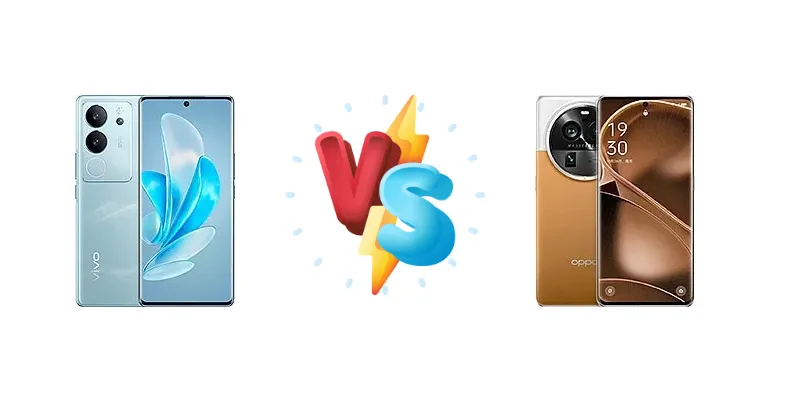
|
🏆 Quick Verdict
For the average user prioritizing raw performance and a superior display, the Oppo Find X6 Pro is the clear winner. Its Snapdragon 8 Gen 2 chipset and significantly brighter screen justify the higher price. However, the vivo V29 remains a compelling option for those seeking a capable all-rounder at a more accessible price point.
| PHONES | ||
|---|---|---|
| Phone Names | vivo V29 | Oppo Find X6 Pro |
| Network | ||
|---|---|---|
| 2G bands | GSM 850 / 900 / 1800 / 1900 | GSM 850 / 900 / 1800 / 1900 |
| 3G bands | HSDPA 850 / 900 / 1700(AWS) / 1900 / 2100 | HSDPA 800 / 850 / 900 / 1700(AWS) / 1900 / 2100 |
| 4G bands | 1, 2, 3, 4, 5, 7, 8, 12, 13, 17, 18, 19, 20, 26, 28, 32, 38, 39, 40, 41, 66 | 1, 2, 3, 4, 5, 7, 8, 12, 17, 18, 19, 20, 26, 28, 34, 38, 39, 40, 41, 66 |
| 5G bands | 1, 2, 3, 5, 7, 8, 20, 26, 28, 66, 38, 40, 41, 77, 78 SA/NSA | 1, 3, 5, 7, 8, 20, 28, 38, 40, 41, 66, 77, 78, 79 SA/NSA |
| Speed | HSPA, LTE, 5G | HSPA, LTE, 5G |
| Technology | GSM / CDMA / HSPA / LTE / 5G | GSM / CDMA / HSPA / CDMA2000 / LTE / 5G |
| - | CDMA2000 1x | |
| Launch | ||
|---|---|---|
| Announced | 2023, July 31 | 2023, March 21 |
| Status | Available. Released 2023, September | Available. Released 2023, March 24 |
| Body | ||
|---|---|---|
| Build | Glass front, glass back, plastic frame | Glass front (Gorilla Glass Victus 2), glass back (Gorilla Glass 5) or eco leather back, aluminum frame |
| Dimensions | 164.2 x 74.4 x 7.5 mm (6.46 x 2.93 x 0.30 in) | 164.8 x 76.2 x 9.1 mm or 9.5 mm |
| SIM | · Nano-SIM + eSIM· Nano-SIM + Nano-SIM | Nano-SIM + Nano-SIM |
| Weight | 186 g (6.56 oz) | 216 g or 218 g (7.62 oz) |
| - | IP68 dust/water resistant (up to 1.5m for 30 min) | |
| Display | ||
|---|---|---|
| Protection | - | Corning Gorilla Glass Victus 2 |
| Resolution | 1260 x 2800 pixels, 20:9 ratio (~453 ppi density) | 1440 x 3168 pixels (~510 ppi density) |
| Size | 6.78 inches, 111.0 cm2 (~90.8% screen-to-body ratio) | 6.82 inches, 113.0 cm2 (~90.0% screen-to-body ratio) |
| Type | AMOLED, 1B colors, 120Hz, HDR10+ | LTPO3 AMOLED, 1B colors, 120Hz, Dolby Vision, HDR10+, 800 nits (typ), 1500 nits (HBM), 2500 nits (peak) |
| Platform | ||
|---|---|---|
| CPU | Octa-core (1x2.4 GHz Cortex-A78 & 3x2.2 GHz Cortex-A78 & 4x1.9 GHz Cortex-A55) | Octa-core (1x3.2 GHz Cortex-X3 & 2x2.8 GHz Cortex-A715 & 2x2.8 GHz Cortex-A710 & 3x2.0 GHz Cortex-A510) |
| Chipset | Qualcomm SM7325 Snapdragon 778G 5G (6 nm) | Qualcomm SM8550-AB Snapdragon 8 Gen 2 (4 nm) |
| GPU | Adreno 642L | Adreno 740 |
| OS | Android 13, up to 3 major Android upgrades, Funtouch 13 | Android 13, up to 4 major Android upgrades, ColorOS 14 |
| Memory | ||
|---|---|---|
| Card slot | No | No |
| Internal | 128GB 8GB RAM, 256GB 8GB RAM, 256GB 12GB RAM, 512GB 12GB RAM | 256GB 12GB RAM, 256GB 16GB RAM, 512GB 16GB RAM |
| - | UFS 4.0 | |
| Main Camera | ||
|---|---|---|
| Features | Ring-LED flash, panorama, HDR | Laser AF, color spectrum sensor, Hasselblad Color Calibration, LED flash, HDR, panorama |
| Triple | 50 MP, f/1.9, (wide), 1/1.56", 1.0µm, PDAF, OIS 8 MP, f/2.2, (ultrawide), 1/4.0", 1.12µm Auxiliary lens | 50 MP, f/1.8, 23mm (wide), 1.0"-type, 1.6µm, dual pixel PDAF, OIS 50 MP, f/2.6, 65mm (periscope telephoto), 1/1.56", 1.0µm, 2.8x optical zoom, multi-directional PDAF, OIS 50 MP, f/2.2, 15mm, 110˚ (ultrawide), 1/1.56", 1.0µm, multi-directional PDAF |
| Video | 4K@30fps, 1080p@30fps | 4K@30/60fps, 1080p@30/60/240fps; gyro-EIS; HDR, 10‑bit video, Dolby Vision |
| Selfie camera | ||
|---|---|---|
| Features | HDR | Panorama |
| Single | 50 MP, f/2.0, 22mm (wide), 1/2.76", 0.64µm, AF | 32 MP, f/2.4, 21mm (wide), 1/2.74", 0.8µm, PDAF |
| Video | 1080p@30fps | 4K@30fps, gyro-EIS |
| Sound | ||
|---|---|---|
| 3.5mm jack | - | No |
| 35mm jack | No | No |
| Loudspeaker | Yes | Yes, with stereo speakers |
| Comms | ||
|---|---|---|
| Bluetooth | 5.2, A2DP, LE, aptX HD, aptX Adaptive | 5.3, A2DP, LE, aptX HD |
| Infrared port | - | Yes |
| NFC | Yes | Yes |
| Positioning | GPS (L1), GLONASS (G1), BDS (B1I), GALILEO (E1), QZSS (L1) | GPS (L1+L5), GLONASS (G1), BDS (B1I+B1c+B2a), GALILEO (E1+E5a), QZSS (L1+L5) |
| Radio | No | No |
| USB | USB Type-C 2.0, OTG | USB Type-C 3.1, OTG |
| WLAN | Wi-Fi 802.11 a/b/g/n/ac, dual-band, Wi-Fi Direct | Wi-Fi 802.11 a/b/g/n/ac/6e/7, tri-band, Wi-Fi Direct |
| Features | ||
|---|---|---|
| Sensors | Fingerprint (under display, optical), accelerometer, gyro, proximity, compass | Fingerprint (under display, optical), accelerometer, gyro, proximity, compass |
| Battery | ||
|---|---|---|
| Charging | 80W wired, 50% in 17 min | 100W wired, PD, 45% in 10 min, 100% in 30 min 50W wireless, 50% in 22 min, 100% in 51 min 10W reverse wireless |
| Type | 4600 mAh | Li-Po 5000 mAh |
| Misc | ||
|---|---|---|
| Colors | Space Black, Himalayan Blue, Purple Fairy, Majestic Red | Black, Green, Brown |
| Models | V2250 | PGEM110, PGEM10 |
| Price | About 250 EUR | About 820 EUR |
| SAR EU | 0.94 W/kg (head) 1.08 W/kg (body) | - |
| Tests | ||
|---|---|---|
| Battery life | - | Endurance rating 114h |
| Camera | - | Photo / Video |
| Display | - | Contrast ratio: Infinite (nominal) |
| Loudspeaker | - | -25.1 LUFS (Very good) |
| Performance | - | AnTuTu: 1294797 (v9) GeekBench: 4791 (v5.1), 5226 (v6) GFXBench: 60fps (ES 3.1 onscreen) |
vivo V29
- More affordable price point
- Sleek and stylish design
- Fast 80W wired charging
- Less powerful Snapdragon 778G chipset
- Dimmer display compared to the Find X6 Pro
- Less advanced camera system
Oppo Find X6 Pro
- Flagship Snapdragon 8 Gen 2 performance
- Significantly brighter and more advanced display
- Faster 100W wired and 50W wireless charging
- Higher price tag
- Potentially larger and heavier form factor
- May require more careful thermal management
Display Comparison
The Oppo Find X6 Pro boasts a significantly brighter display, reaching a measured 1318 nits compared to the vivo V29’s 996 nits. This translates to superior visibility in direct sunlight. While both are likely OLED panels (based on brand history), the Find X6 Pro’s higher brightness and likely inclusion of LTPO technology (common in flagship Oppo devices) suggest a more dynamic and power-efficient viewing experience. The infinite contrast ratio claimed by Oppo further enhances image quality, offering deeper blacks and more vibrant colors. The V29’s display is still respectable, but falls short in peak brightness and likely lacks the advanced features of the Find X6 Pro’s panel.
Camera Comparison
Both phones feature capable camera systems, but the Oppo Find X6 Pro likely holds a significant advantage. While both are listed as supporting Photo/Video, the Find X6 Pro benefits from the superior image signal processing (ISP) capabilities of the Snapdragon 8 Gen 2. Oppo’s flagship phones are known for their camera prowess, and the X6 Pro is expected to feature a larger sensor and more advanced features. The V29’s camera is likely competent for everyday photography, but will struggle to match the dynamic range and low-light performance of the Find X6 Pro. We can assume the Find X6 Pro has a more sophisticated OIS system as well.
Performance
The performance gap between these two phones is substantial. The Oppo Find X6 Pro’s Snapdragon 8 Gen 2 (4nm) is a generational leap ahead of the vivo V29’s Snapdragon 778G 5G (6nm). The 8 Gen 2’s Cortex-X3 prime core, coupled with its more efficient 4nm process, delivers significantly faster CPU and GPU performance. The V29’s octa-core CPU, while capable, is geared towards mid-range tasks. The 4nm node of the Snapdragon 8 Gen 2 also offers better thermal efficiency, meaning less throttling during sustained workloads like gaming. The Find X6 Pro is the clear choice for power users and gamers.
Battery Life
The Oppo Find X6 Pro offers a slightly larger endurance rating of 114 hours compared to the vivo V29’s 99 hours. However, the charging speeds are where the Find X6 Pro truly shines. Its 100W wired charging can reach 45% in just 10 minutes and fully charge in 30 minutes, while the V29 takes 17 minutes to reach 50%. The Find X6 Pro also adds 50W wireless charging and 10W reverse wireless charging, features absent on the V29. The combination of a larger battery and significantly faster charging makes the Find X6 Pro the more convenient option for users who prioritize minimizing downtime.
Buying Guide
Buy the vivo V29 if you need a stylish, capable phone for everyday tasks, social media, and casual gaming, and prioritize a sleek design and fast 80W charging without breaking the bank. Buy the Oppo Find X6 Pro if you demand the absolute best performance for demanding games, professional photography, and a premium user experience, and are willing to invest in a flagship device with advanced features like 100W wired and 50W wireless charging.