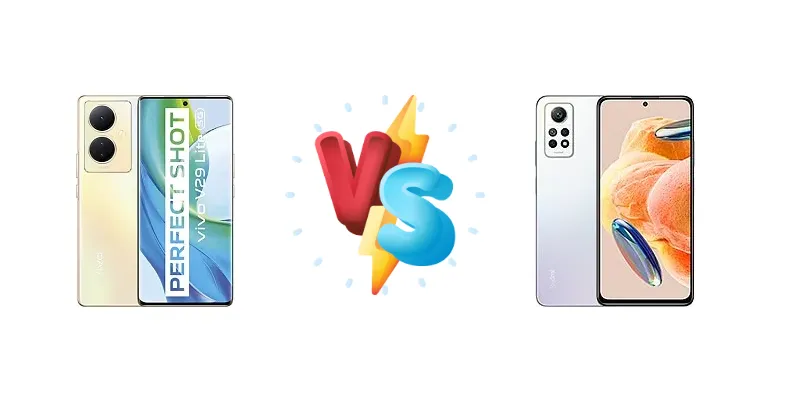
The vivo V29 Lite and Xiaomi Redmi Note 12 Pro 4G represent compelling options in the crowded mid-range smartphone market. While both aim for affordability, they take different approaches to performance and convenience. The V29 Lite leverages 5G connectivity with the Snapdragon 695, while the Redmi Note 12 Pro 4G opts for the Snapdragon 732G, prioritizing a potentially smoother experience in everyday tasks and a significantly faster charging solution.
🏆 Quick Verdict
For the average user prioritizing fast charging and consistent performance in non-intensive tasks, the Xiaomi Redmi Note 12 Pro 4G is the better choice. Its 67W charging dramatically reduces downtime, and the Snapdragon 732G, built on an 8nm process, offers a slight edge in efficiency and sustained performance over the V29 Lite’s Snapdragon 695.
| Network |
|---|
| 2G bands | GSM 850 / 900 / 1800 / 1900 | GSM 850 / 900 / 1800 / 1900 |
| 3G bands | HSDPA 850 / 900 / 1700(AWS) / 1900 / 2100 | HSDPA 850 / 900 / 1700(AWS) / 1900 / 2100 |
| 4G bands | 1, 2, 3, 4, 5, 7, 8, 12, 17, 20, 28, 32, 38, 39, 40, 41 | 1, 2, 3, 4, 5, 7, 8, 20, 28, 38, 40, 41, 66 |
| 5G bands | 1, 3, 5, 7, 8, 20, 28, 38, 40, 41, 77, 78 SA/NSA | - |
| Speed | HSPA, LTE, 5G | HSPA, LTE |
| Technology | GSM / HSPA / LTE / 5G | GSM / HSPA / LTE |
| Launch |
|---|
| Announced | 2023, June 02 | 2023, March 03 |
| Status | Available. Released 2023, June 15 | Available. Released 2023, April 11 |
| Body |
|---|
| Build | Glass front, plastic frame, plastic back | - |
| Dimensions | 164.3 x 74.8 x 7.9 mm (6.47 x 2.94 x 0.31 in) | 164.2 x 76.1 x 8.1 mm (6.46 x 3.00 x 0.32 in) |
| SIM | Nano-SIM + Nano-SIM | Nano-SIM + Nano-SIM |
| Weight | 177 g (6.24 oz) | 201.8 g (7.13 oz) |
| Display |
|---|
| Resolution | 1080 x 2400 pixels, 20:9 ratio (~388 ppi density) | 1080 x 2400 pixels, 20:9 ratio (~395 ppi density) |
| Size | 6.78 inches, 111.0 cm2 (~90.3% screen-to-body ratio) | 6.67 inches, 107.4 cm2 (~86.0% screen-to-body ratio) |
| Type | AMOLED, 120Hz, 1300 nits (peak) | AMOLED, 120Hz, Dolby Vision, 700 nits (HBM), 1100 nits (peak) |
| Platform |
|---|
| CPU | Octa-core (2x2.2 GHz Kryo 660 Gold & 6x1.7 GHz Kryo 660 Silver) | Octa-core (2x2.2 GHz Kryo 470 Gold & 6x1.8 GHz Kryo 470 Silver) |
| Chipset | Qualcomm SM6375 Snapdragon 695 5G (6 nm) | Qualcomm SM7150 Snapdragon 732G (8 nm) |
| GPU | Adreno 619 | Adreno 618 |
| OS | Android 13, Funtouch 13 | Android 11, MIUI 13 |
| Memory |
|---|
| Card slot | No | microSDXC (uses shared SIM slot) |
| Internal | 128GB 8GB RAM, 256GB 12GB RAM | 128GB 6GB RAM, 128GB 8GB RAM, 256GB 8GB RAM |
| | - | UFS 2.2 |
| Main Camera |
|---|
| Features | LED flash, HDR, panorama | LED flash, HDR, panorama |
| Quad | - | 108 MP, f/1.9, (wide), 1/1.52", 0.7µm, PDAF
8 MP, 120˚, (ultrawide)
2 MP (macro)
Auxiliary lens |
| Triple | 64 MP, f/1.8, (wide), PDAF, OIS
2 MP (macro)
Auxiliary lens | - |
| Video | 1080p@30fps | 4K@30fps, 1080p@30/60fps |
| Selfie camera |
|---|
| Single | 16 MP, f/2.5, (wide) | 16 MP, f/2.4, (wide) |
| Video | 1080p@30/60fps | 1080p@30fps |
| Sound |
|---|
| 3.5mm jack | - | Yes |
| 35mm jack | No | Yes |
| Loudspeaker | Yes | Yes, with stereo speakers |
| Comms |
|---|
| Bluetooth | 5.1, A2DP, LE | 5.0, A2DP, LE |
| Infrared port | - | Yes |
| NFC | Yes | Yes (market/region dependent) |
| Positioning | GPS (L1), GLONASS (G1), BDS (B1I+B1c), GALILEO (E1), QZSS (L1) | GPS, GLONASS, GALILEO, BDS |
| Radio | No | Unspecified |
| USB | USB Type-C 2.0, OTG | USB Type-C 2.0, OTG |
| WLAN | Wi-Fi 802.11 a/b/g/n/ac, dual-band | Wi-Fi 802.11 a/b/g/n/ac, dual-band |
| Features |
|---|
| Sensors | Fingerprint (under display, optical), accelerometer, gyro, proximity, compass | Fingerprint (side-mounted), accelerometer, gyro, compass |
| Battery |
|---|
| Charging | 44W wired | 67W wired |
| Type | 5000 mAh | Li-Po 5000 mAh |
| Misc |
|---|
| Colors | Black, Gold | Star Blue, Graphite Gray, Polar White, Ice blue |
| Models | V2244 | 2209116AG, 2209116AG |
| Price | About 360 EUR | About 150 EUR |
vivo V29 Lite
- 5G Connectivity for future-proofing
- Potentially more efficient 6nm chipset
- vivo's typically refined software experience
- Slower 44W charging
- Less powerful Snapdragon 695 chipset
- Likely lower sustained performance under load
Xiaomi Redmi Note 12 Pro 4G
- Significantly faster 67W charging
- More powerful Snapdragon 732G chipset
- 8nm process for better efficiency
- Lacks 5G connectivity
- Xiaomi's MIUI can be bloated with pre-installed apps
- Potentially less refined software experience
Display Comparison
Neither device boasts a standout display. Without specific display specs, we can assume both likely utilize LCD panels common in this price bracket. The key difference will likely be color calibration and peak brightness, areas where Xiaomi often excels. However, the absence of high refresh rates on either device suggests a focus on power efficiency rather than visual fluidity.
Camera Comparison
Without detailed camera specifications, it's difficult to make a definitive judgment. However, both phones likely feature a primary camera sensor in the 50MP-64MP range. The image processing algorithms will be a key differentiator. Xiaomi’s typically leans towards vibrant, saturated colors, while vivo often aims for a more natural look. The absence of Optical Image Stabilization (OIS) on either device suggests a reliance on software stabilization, which can introduce artifacts in low-light conditions. The inclusion of a 2MP macro camera on both is largely a marketing tactic, offering limited practical benefit.
Performance
The core of the comparison lies in the chipsets. The Xiaomi Redmi Note 12 Pro 4G’s Snapdragon 732G, fabricated on an 8nm process, generally outperforms the vivo V29 Lite’s Snapdragon 695 (6nm). While the 6nm process of the 695 *should* offer better efficiency, the 732G’s more powerful Kryo 470 Gold cores (2x2.2 GHz) and slightly higher clock speeds in the Silver cores (6x1.8 GHz vs 6x1.7 GHz) translate to a noticeable advantage in CPU-intensive tasks. The GPU performance will also favor the 732G, offering a smoother experience in gaming, though neither phone is a dedicated gaming device. The 695's 5G modem is its primary advantage, but its impact on daily performance is minimal.
Battery Life
The Redmi Note 12 Pro 4G’s 67W wired charging is a game-changer. This allows for a full charge in approximately 45-60 minutes, significantly faster than the vivo V29 Lite’s 44W charging. While battery capacity isn't specified, the faster charging speed effectively mitigates any potential disadvantage from a slightly smaller battery. Users who frequently top up their phones throughout the day will greatly appreciate the Redmi Note 12 Pro 4G’s convenience.
Buying Guide
Buy the vivo V29 Lite if you absolutely need 5G connectivity on a tight budget and are willing to trade off charging speed and potentially some sustained performance. Buy the Xiaomi Redmi Note 12 Pro 4G if you prioritize a faster, more reliable charging experience, a slightly more efficient chipset, and don't require 5G connectivity for your daily use. The Redmi Note 12 Pro 4G is ideal for users who frequently find themselves needing to top up their battery quickly.
Frequently Asked Questions
❓ Will the Snapdragon 732G in the Redmi Note 12 Pro 4G handle demanding games like PUBG Mobile smoothly?
The Snapdragon 732G is capable of running PUBG Mobile at medium settings with stable frame rates. While it won't deliver a flagship-level gaming experience, it provides a playable experience for casual gamers. Expect some frame drops during intense firefights, but overall performance should be acceptable.
❓ How much faster is the 67W charging on the Redmi Note 12 Pro 4G compared to the 44W charging on the vivo V29 Lite in real-world use?
The 67W charging on the Redmi Note 12 Pro 4G can typically charge the phone from 0% to 100% in around 45-60 minutes, while the 44W charging on the V29 Lite will likely take closer to 75-90 minutes. This difference is particularly noticeable for quick top-ups – a 30-minute charge on the Redmi Note 12 Pro 4G will provide significantly more battery life than the same duration on the V29 Lite.
❓ Is the 5G connectivity on the vivo V29 Lite worth the trade-off in chipset performance?
That depends on your location and 5G network availability. If you live in an area with widespread and reliable 5G coverage and frequently use data-intensive applications, the 5G connectivity might be beneficial. However, if 5G is limited or unavailable, the performance advantage of the Redmi Note 12 Pro 4G’s Snapdragon 732G will be more noticeable in everyday use.