
Google Pixel 7a vs. vivo V29 Lite: A Detailed Comparison of Mid-Range Powerhouses
| Phones Images | |||||
|---|---|---|---|---|---|
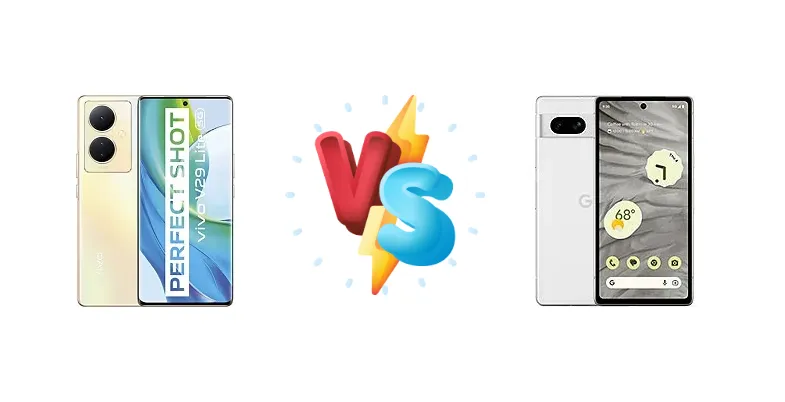
|
🏆 Quick Verdict
For most users, the Google Pixel 7a is the superior choice. Its Tensor G2 chipset provides significantly better performance and future-proofing, coupled with Google’s exceptional camera processing. While the vivo V29 Lite offers faster 44W charging, the Pixel 7a’s overall experience and software support justify the price difference.
| PHONES | ||
|---|---|---|
| Phone Names | vivo V29 Lite | Google Pixel 7a |
| Network | ||
|---|---|---|
| 2G bands | GSM 850 / 900 / 1800 / 1900 | GSM 850 / 900 / 1800 / 1900 |
| 3G bands | HSDPA 850 / 900 / 1700(AWS) / 1900 / 2100 | HSDPA 800 / 850 / 900 / 1700(AWS) / 1900 / 2100 |
| 4G bands | 1, 2, 3, 4, 5, 7, 8, 12, 17, 20, 28, 32, 38, 39, 40, 41 | 1, 2, 3, 4, 5, 7, 8, 12, 13, 14, 17, 20, 25, 26, 28, 29, 30, 38, 40, 41, 48, 66, 71 - GWKK3, G0DZQ |
| 5G bands | 1, 3, 5, 7, 8, 20, 28, 38, 40, 41, 77, 78 SA/NSA | 1, 2, 3, 5, 7, 8, 12, 14, 20, 25, 28, 30, 38, 41, 48, 66, 71, 77, 78 SA/NSA/Sub6 - GWKK3 |
| Speed | HSPA, LTE, 5G | HSPA, LTE, 5G |
| Technology | GSM / HSPA / LTE / 5G | GSM / HSPA / LTE / 5G |
| - | 1, 2, 3, 5, 7, 8, 12, 20, 25, 28, 38, 40, 41, 66, 75, 76, 77, 78, 79 SA/NSA/Sub6 - GHL1X, G82U8 | |
| Launch | ||
|---|---|---|
| Announced | 2023, June 02 | 2023, May 10 |
| Status | Available. Released 2023, June 15 | Available. Released 2023, May 10 |
| Body | ||
|---|---|---|
| Build | Glass front, plastic frame, plastic back | Glass front (Gorilla Glass 3), aluminum frame, plastic back |
| Dimensions | 164.3 x 74.8 x 7.9 mm (6.47 x 2.94 x 0.31 in) | 152 x 72.9 x 9 mm (5.98 x 2.87 x 0.35 in) |
| SIM | Nano-SIM + Nano-SIM | Nano-SIM + eSIM |
| Weight | 177 g (6.24 oz) | 193.5 g (6.84 oz) |
| - | IP67 dust/water resistant (up to 1m for 30 min) | |
| Display | ||
|---|---|---|
| Protection | - | Corning Gorilla Glass 3 |
| Resolution | 1080 x 2400 pixels, 20:9 ratio (~388 ppi density) | 1080 x 2400 pixels, 20:9 ratio (~429 ppi density) |
| Size | 6.78 inches, 111.0 cm2 (~90.3% screen-to-body ratio) | 6.1 inches, 90.7 cm2 (~81.8% screen-to-body ratio) |
| Type | AMOLED, 120Hz, 1300 nits (peak) | OLED, HDR, 90Hz |
| - | Always-on display | |
| Platform | ||
|---|---|---|
| CPU | Octa-core (2x2.2 GHz Kryo 660 Gold & 6x1.7 GHz Kryo 660 Silver) | Octa-core (2x2.85 GHz Cortex-X1 & 2x2.35 GHz Cortex-A78 & 4x1.80 GHz Cortex-A55) |
| Chipset | Qualcomm SM6375 Snapdragon 695 5G (6 nm) | Google Tensor G2 (5 nm) |
| GPU | Adreno 619 | Mali-G710 MP7 |
| OS | Android 13, Funtouch 13 | Android 13, upgradable to Android 15, up to 5 major Android upgrades |
| Memory | ||
|---|---|---|
| Card slot | No | No |
| Internal | 128GB 8GB RAM, 256GB 12GB RAM | 128GB 8GB RAM |
| - | UFS 3.1 | |
| Main Camera | ||
|---|---|---|
| Dual | - | 64 MP, f/1.9, 26mm (wide), 1/1.73", 0.8µm, dual pixel PDAF, OIS 13 MP, f/2.2, 120˚ (ultrawide), 1.12µm |
| Features | LED flash, HDR, panorama | Dual-LED flash, Pixel Shift, Auto-HDR, panorama |
| Triple | 64 MP, f/1.8, (wide), PDAF, OIS 2 MP (macro) Auxiliary lens | - |
| Video | 1080p@30fps | 4K@30/60fps, 1080p@30/60/120/240fps, OIS |
| Selfie camera | ||
|---|---|---|
| Features | - | HDR, panorama |
| Single | 16 MP, f/2.5, (wide) | 13 MP, f/2.2, 20mm (ultrawide), 1.12µm |
| Video | 1080p@30/60fps | 4K@30fps, 1080p@30fps |
| Sound | ||
|---|---|---|
| 3.5mm jack | - | No |
| 35mm jack | No | No |
| Loudspeaker | Yes | Yes, with stereo speakers |
| Comms | ||
|---|---|---|
| Bluetooth | 5.1, A2DP, LE | 5.3, A2DP, LE |
| NFC | Yes | Yes |
| Positioning | GPS (L1), GLONASS (G1), BDS (B1I+B1c), GALILEO (E1), QZSS (L1) | GPS, GLONASS, GALILEO, BDS, QZSS, NavIC |
| Radio | No | No |
| USB | USB Type-C 2.0, OTG | USB Type-C 3.2 |
| WLAN | Wi-Fi 802.11 a/b/g/n/ac, dual-band | Wi-Fi 802.11 a/b/g/n/ac/6e, tri-band |
| Features | ||
|---|---|---|
| Sensors | Fingerprint (under display, optical), accelerometer, gyro, proximity, compass | Fingerprint (under display, optical), accelerometer, gyro, proximity, compass, barometer |
| Battery | ||
|---|---|---|
| Charging | 44W wired | 18W wired, PD3.0 7.5W wireless |
| Type | 5000 mAh | Li-Po 4385 mAh |
| Misc | ||
|---|---|---|
| Colors | Black, Gold | Charcoal, Snow, Sea, Coral |
| Models | V2244 | GWKK3, GHL1X, G0DZQ, G82U8 |
| Price | About 360 EUR | € 179.90 / $ 150.00 / £ 170.00 / ₹ 25,980 |
vivo V29 Lite
- Superior performance with the Google Tensor G2
- Exceptional camera quality and image processing
- Guaranteed software updates and long-term support
- Slower 18W charging
- Higher price point
Google Pixel 7a
- Faster 44W wired charging
- More affordable price
- 5G connectivity
- Significantly weaker performance
- Less refined camera system
- Potentially limited software support
Display Comparison
The Pixel 7a boasts a brighter display, reaching a measured peak of 1070 nits, compared to an unspecified brightness for the V29 Lite. This translates to better visibility outdoors under direct sunlight. While both likely utilize OLED panels, the Pixel 7a’s higher peak brightness and Google’s color calibration offer a more vibrant and accurate viewing experience. The V29 Lite’s display specifications are less detailed, suggesting a potentially lower-quality panel, though it may benefit from a higher refresh rate (not specified in the data).
Camera Comparison
The Pixel 7a’s camera system is a clear advantage. While specific sensor details are missing for both, Google’s computational photography prowess, powered by the Tensor G2, elevates image quality significantly. The Pixel 7a excels in dynamic range, low-light performance, and overall image clarity. The V29 Lite likely relies more on hardware and less on software processing, potentially resulting in less refined images. The absence of details regarding OIS on the V29 Lite suggests it may struggle with video stabilization compared to the Pixel 7a.
Performance
The performance gap between these devices is substantial. The Google Pixel 7a’s Tensor G2, built on a 5nm process, features a tri-cluster configuration with high-performance Cortex-X1 cores, delivering significantly more processing power than the vivo V29 Lite’s Snapdragon 695 5G (6nm). The Snapdragon 695 is geared towards efficient 5G connectivity but lacks the raw horsepower for demanding tasks. The Tensor G2’s architecture allows for advanced AI processing, enhancing features like voice recognition and image processing. This difference is particularly noticeable in multitasking, gaming, and video editing.
Battery Life
The Pixel 7a has an endurance rating of 76 hours, indicating strong battery life despite its 18W charging. The vivo V29 Lite’s battery capacity is unknown, but its 44W wired charging is considerably faster than the Pixel 7a’s 18W charging. A full charge on the V29 Lite will take significantly less time. However, the Pixel 7a’s more efficient Tensor G2 chip and optimized software may offset the charging speed difference in real-world usage, providing comparable or even better overall battery endurance.
Buying Guide
Buy the vivo V29 Lite if you prioritize 5G connectivity on a tight budget and value rapid 44W charging above all else. It’s a solid option for basic smartphone tasks and media consumption. Buy the Google Pixel 7a if you demand a smoother, more responsive experience, a class-leading camera, and guaranteed software updates, even if it means sacrificing charging speed and paying a premium.