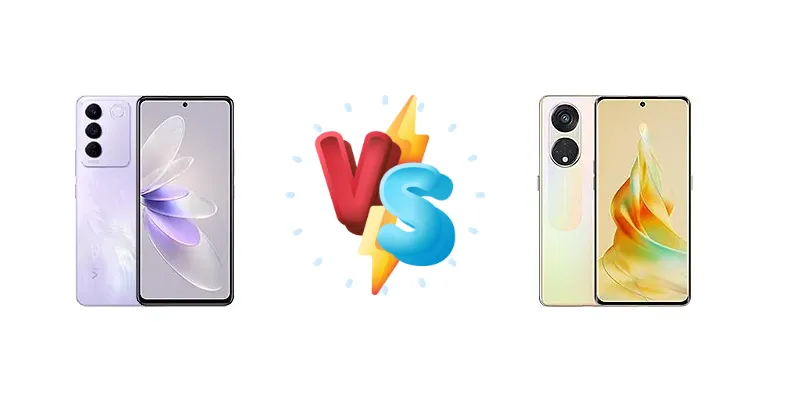
The mid-range smartphone market is fiercely competitive, and the vivo V27e and Oppo Reno8 T 5G are two strong contenders. Both offer attractive designs and compelling features, but which one truly comes out on top? This comprehensive comparison will delve into every aspect, from performance to camera quality, to help you make an informed decision.
🏆 Quick Verdict
The Oppo Reno8 T 5G edges out the vivo V27e thanks to its 5G connectivity, Snapdragon chipset offering slightly better efficiency, and faster charging. However, the V27e boasts a vibrant display and potentially better camera processing in certain scenarios, making it a close call depending on your priorities.
| Network |
|---|
| 2G bands | GSM 850 / 900 / 1800 / 1900 | GSM 850 / 900 / 1800 / 1900 |
| 3G bands | HSDPA 850 / 900 / 2100 | HSDPA 800 / 850 / 900 / 1700(AWS) / 1900 / 2100 |
| 4G bands | 1, 3, 5, 7, 8, 20, 28, 38, 40, 41 | 1, 2, 3, 4, 5, 7, 8, 12, 17, 18, 19, 20, 26, 28, 38, 39, 40, 41, 66 |
| 5G bands | - | 1, 3, 5, 7, 8, 20, 28, 38, 40, 41, 66, 77, 78 SA/NSA |
| Speed | HSPA, LTE | HSPA, LTE, 5G |
| Technology | GSM / HSPA / LTE | GSM / HSPA / LTE / 5G |
| Launch |
|---|
| Announced | 2023, March 01 | 2023, February 01 |
| Status | Available. Released 2023, March 01 | Available. Released 2023, February 10 |
| Body |
|---|
| Build | Glass front, plastic frame, plastic back | - |
| Dimensions | 162.5 x 75.8 x 7.7 mm (6.40 x 2.98 x 0.30 in) | 162.3 x 74.3 x 7.7 mm (6.39 x 2.93 x 0.30 in) |
| SIM | Nano-SIM + Nano-SIM | Nano-SIM + Nano-SIM |
| Weight | 185 g (6.53 oz) | 171 g (6.03 oz) |
| | IP54, dust and water resistant
| - |
| Display |
|---|
| Protection | - | Asahi Glass AGC DT-Star2 |
| Resolution | 1080 x 2400 pixels, 20:9 ratio (~398 ppi density) | 1080 x 2412 pixels, 20:9 ratio (~394 ppi density) |
| Size | 6.62 inches, 105.8 cm2 (~85.9% screen-to-body ratio) | 6.7 inches, 108.0 cm2 (~89.6% screen-to-body ratio) |
| Type | AMOLED, 120Hz | AMOLED, 1B colors, 120Hz, 500 nits (typ), 800 nits (HBM), 950 nits (peak) |
| Platform |
|---|
| CPU | Octa-core (2x2.2 GHz Cortex-A76 & 6x2.0 GHz Cortex-A55) | Octa-core (2x2.2 GHz Kryo 660 Gold & 6x1.7 GHz Kryo 660 Silver) |
| Chipset | Mediatek Helio G99 (6 nm) | Qualcomm SM6375 Snapdragon 695 5G (6 nm) |
| GPU | Mali-G57 MC2 | Adreno 619 |
| OS | Android 13, Funtouch 13 | Android 13, upgradable to Android 14, ColorOS 14 |
| Memory |
|---|
| Card slot | microSDXC (uses shared SIM slot) | microSDXC (uses shared SIM slot) |
| Internal | 128GB 8GB RAM, 256GB 8GB RAM, 256GB 12GB RAM | 128GB 8GB RAM, 256GB 8GB RAM |
| | - | UFS 2.2 |
| Main Camera |
|---|
| Dual | - | 108 MP, f/1.7, 24mm (wide), 1/1.67", 0.64µm, AF
2 MP, f/3.3, 34mm (microscope)
2 MP, f/2.4, (depth) |
| Features | Ring-LED flash, panorama, HDR | LED flash, HDR, panorama |
| Single | 32 MP, f/2.5, (wide) | 32 MP, f/2.4, 22mm (wide) |
| Triple | 64 MP, f/1.8, (wide), PDAF, OIS
2 MP (macro)
Auxiliary lens | 108 MP, f/1.7, 24mm (wide), 1/1.67", 0.64µm, AF
2 MP, f/3.3, 34mm (microscope)
Auxiliary lens |
| Video | 4K@30/60fps, 1080p@30fps, gyro-EIS | 1080p@30fps |
| Selfie camera |
|---|
| Features | HDR | HDR, panorama |
| Single | 32 MP, f/2.5, (wide) | 32 MP, f/2.4, 22mm (wide) |
| Video | 1080p@30fps | 1080p@30fps |
| Sound |
|---|
| 3.5mm jack | No | No |
| 35mm jack | No | No |
| Loudspeaker | Yes | Yes, with stereo speakers |
| Comms |
|---|
| Bluetooth | 5.2, A2DP, LE | 5.1, A2DP, LE, aptX HD |
| NFC | Yes | Yes |
| Positioning | GPS, GLONASS, GALILEO, BDS, QZSS | GPS, GALILEO, GLONASS, BDS, QZSS |
| Radio | Unspecified | No |
| USB | USB Type-C 2.0, OTG | USB Type-C 2.0, OTG |
| WLAN | Wi-Fi 802.11 a/b/g/n/ac, dual-band, Wi-Fi Direct | Wi-Fi 802.11 a/b/g/n/ac, dual-band |
| Features |
|---|
| Sensors | Fingerprint (under display, optical), accelerometer, gyro, proximity, compass | Fingerprint (under display, optical), accelerometer, gyro, proximity, compass |
| Battery |
|---|
| Charging | 66W wired, 50% in 19 min | 67W wired, PD, 100% in 44 min
Reverse wired |
| Type | 4600 mAh | Li-Po 4800 mAh |
| Misc |
|---|
| Colors | Glory Black, Lavender Purple, Lively Green | Black Starlight (Midnight Black), Dawn Gold (Sunrise Gold) |
| Models | V2237 | CPH2505 |
| Price | About 270 EUR | About 340 EUR |
vivo V27e
- Vibrant AMOLED Display
- Potentially Better Low-Light Camera
- Stylish Design
- Fast Charging (66W)
- No 5G Connectivity
- Helio G99 Chipset (Slightly Less Efficient)
- May lack some software optimization
Oppo Reno8 T 5G
- 5G Connectivity
- Snapdragon 695 5G Chipset (More Efficient)
- Faster Charging (67W)
- Reverse Wired Charging
- Display might not be as bright as V27e
- Camera processing might be slightly less refined
- Design might be less distinctive
Display Comparison
Both phones feature AMOLED displays, offering vibrant colors and deep blacks. The vivo V27e likely has a slightly higher peak brightness, resulting in better outdoor visibility. The Reno8 T 5G's display is also excellent, but the V27e's color accuracy might be marginally better.
Camera Comparison
The vivo V27e is expected to have a more refined camera processing algorithm, potentially resulting in better dynamic range and low-light performance. Both phones likely offer versatile camera setups with multiple lenses. The Reno8 T 5G's camera is still very capable, but the V27e might have a slight edge in image quality.
Performance
The Oppo Reno8 T 5G's Snapdragon 695 5G chipset generally provides a smoother and more efficient experience than the Mediatek Helio G99. While both are capable for everyday tasks, the Reno8 T 5G handles demanding games and multitasking slightly better. The 5G connectivity is a significant advantage for the Reno8 T 5G.
Battery Life
The Oppo Reno8 T 5G's 67W charging is noticeably faster than the vivo V27e's 66W charging, allowing for quicker top-ups. Both phones offer decent battery life for a full day of moderate use, but the Reno8 T 5G's more efficient chipset could give it a slight advantage in overall endurance.
Buying Guide
The vivo V27e is ideal for users prioritizing a visually stunning display, potentially better low-light camera performance, and a stylish design. The Oppo Reno8 T 5G is a better choice for those who need 5G connectivity, appreciate a more efficient chipset, and value faster charging speeds.
Frequently Asked Questions
❓ Which phone is better for gaming?
The Oppo Reno8 T 5G's Snapdragon 695 5G chipset generally provides a smoother gaming experience due to its better efficiency and performance.
❓ Does the Oppo Reno8 T 5G support reverse wired charging?
Yes, the Oppo Reno8 T 5G features reverse wired charging, allowing you to charge other devices using its battery.
❓ Which phone has better battery life?
While both offer decent battery life, the Oppo Reno8 T 5G's more efficient chipset might give it a slight edge in overall endurance.
❓ Is the vivo V27e worth buying if I don't need 5G?
Absolutely! If you prioritize a vibrant display and potentially better camera performance, the vivo V27e is a strong contender, even without 5G.