
Vivo V27 vs Xiaomi 13 Lite: A Detailed Comparison for the Discerning Buyer
| Phones Images | |||||
|---|---|---|---|---|---|
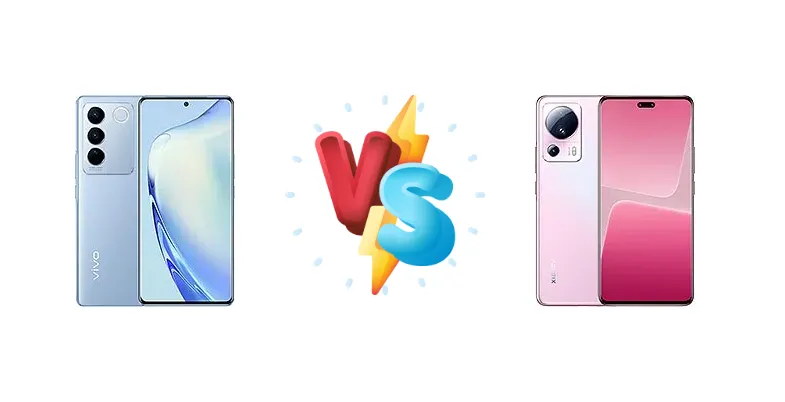
|
🏆 Quick Verdict
For the average user prioritizing all-day battery life and sustained performance, the Vivo V27 emerges as the stronger contender. Its significantly better endurance rating (134h vs 93h) and the more efficient Dimensity 7200 chipset provide a noticeable advantage, despite the Xiaomi 13 Lite's faster charging.
| PHONES | ||
|---|---|---|
| Phone Names | vivo V27 | Xiaomi 13 Lite |
| Network | ||
|---|---|---|
| 2G bands | GSM 850 / 900 / 1800 / 1900 | GSM 850 / 900 / 1800 / 1900 |
| 3G bands | HSDPA 850 / 900 / 1700(AWS) / 1900 / 2100 - International | HSDPA 800 / 850 / 900 / 1700(AWS) / 1900 / 2100 |
| 4G bands | 1, 2, 3, 4, 5, 7, 8, 18, 19, 20, 26, 28, 38, 39, 40, 41 - International | 1, 2, 3, 4, 5, 7, 8, 12, 13, 17, 18, 19, 20, 26, 28, 32, 38, 40, 41, 42, 66 |
| 5G bands | 1, 3, 5, 7, 8, 20, 28, 38, 40, 41, 77, 78 SA/NSA - International | 1, 3, 5, 7, 8, 20, 28, 38, 40, 41, 66, 77, 78 SA/NSA |
| Speed | HSPA, LTE, 5G | HSPA, LTE, 5G |
| Technology | GSM / HSPA / LTE / 5G | GSM / HSPA / LTE / 5G |
| 1, 3, 5, 8, 28, 78 SA/NSA - Asia | - | |
| Launch | ||
|---|---|---|
| Announced | 2023, March 01 | 2023, February 26 |
| Status | Available. Released 2023, March 01 | Available. Released 2023, March 08 |
| Body | ||
|---|---|---|
| Build | Glass front, glass back | Glass front (Gorilla Glass 5), glass back, plastic frame |
| Dimensions | 164.1 x 74.8 x 7.4 mm (6.46 x 2.94 x 0.29 in) | 159.2 x 72.7 x 7.2 mm (6.27 x 2.86 x 0.28 in) |
| SIM | Nano-SIM + Nano-SIM | · Nano-SIM + eSIM· Nano-SIM + Nano-SIM |
| Weight | 180 g (6.35 oz) | 171 g (6.03 oz) |
| Color changing back panel color | IP53, dust and splash resistant | |
| Display | ||
|---|---|---|
| Protection | - | Corning Gorilla Glass 5 |
| Resolution | 1080 x 2400 pixels, 20:9 ratio (~388 ppi density) | 1080 x 2400 pixels, 20:9 ratio (~402 ppi density) |
| Size | 6.78 inches, 111.0 cm2 (~90.4% screen-to-body ratio) | 6.55 inches, 103.6 cm2 (~89.5% screen-to-body ratio) |
| Type | AMOLED, 1B colors, 120Hz, HDR10+ | AMOLED, 68B colors, Dolby Vision, HDR10+, 120Hz, 500 nits (typ), 1000 nits (peak) |
| Platform | ||
|---|---|---|
| CPU | Octa-core (2x2.8 GHz Cortex-A715 & 6x Cortex-A510) | Octa-core (1x2.4 GHz Cortex-A710 & 3x2.36 GHz Cortex-A710 & 4x1.8 GHz Cortex-A510) |
| Chipset | Mediatek Dimensity 7200 (4 nm) | Qualcomm SM7450-AB Snapdragon 7 Gen 1 (4 nm) |
| GPU | Mali-G610 MC4 | Adreno 644 |
| OS | Android 13, Funtouch 13 | Android 12, MIUI 14 |
| Memory | ||
|---|---|---|
| Card slot | No | No |
| Internal | 128GB 8GB RAM, 256GB 8GB RAM, 256GB 12GB RAM | 64GB 8GB RAM, 128GB 8GB RAM, 256GB 8GB RAM |
| - | UFS 2.2 | |
| Main Camera | ||
|---|---|---|
| Features | Ring-LED flash, panorama, HDR | Dual-LED dual-tone flash, HDR, panorama |
| Single | 50 MP, f/2.5, (wide), AF | - |
| Triple | 50 MP, f/1.9, (wide), 1/1.56", 1.0µm, PDAF, OIS 8 MP, f/2.2, 16mm, 120˚ (ultrawide), 1/4.0", 1.12µm 2 MP (macro) | 50 MP, f/1.8, 23mm (wide), 1/1.56", 1.0µm, PDAF 8 MP, f/2.2, 119˚ (ultrawide), 1/4.0", 1.12µm 2 MP (macro) |
| Video | 4K@30/60fps, 1080p@30fps, gyro-EIS | 4K@30fps, 1080p@30/60/120fps, 720p@960fps |
| Selfie camera | ||
|---|---|---|
| Dual | - | 32 MP, f/2.4, 100˚ (ultrawide), 1/2.74", 0.8µm 8 MP, f/2.3, (depth) |
| Features | Dual-LED flash, HDR | Dual-LED flash, HDR |
| Single | 50 MP, f/2.5, (wide), AF | - |
| Video | 4K@30/60fps, 1080p@30fps, gyro-EIS | 1080p@30/60fps |
| Sound | ||
|---|---|---|
| 3.5mm jack | No | No |
| 35mm jack | No | No |
| Loudspeaker | Yes | Yes |
| 24-bit/192kHz audio | 24-bit/192kHz audio | |
| Comms | ||
|---|---|---|
| Bluetooth | 5.3, A2DP, LE | 5.2, A2DP, LE |
| Infrared port | - | Yes |
| NFC | Yes | Yes (market/region dependent) |
| Positioning | GPS, GLONASS, GALILEO, BDS, QZSS, NavIC | GPS (L1), GLONASS (G1), BDS (B1I+B1c), GALILEO (E1), QZSS (L1) |
| Radio | No | No |
| USB | USB Type-C 2.0, OTG | USB Type-C 2.0, OTG |
| WLAN | Wi-Fi 802.11 a/b/g/n/ac, dual-band, Wi-Fi Direct | Wi-Fi 802.11 a/b/g/n/ac/6, dual-band |
| Features | ||
|---|---|---|
| Sensors | Fingerprint (under display, optical), accelerometer, gyro, proximity, compass | Fingerprint (under display, optical), accelerometer, gyro, proximity, compass |
| Battery | ||
|---|---|---|
| Charging | 66W wired, 50% in 19 min | 67W wired, 100% in 40 min |
| Type | 4600 mAh | Li-Po 4500 mAh |
| Misc | ||
|---|---|---|
| Colors | Magic Blue, Noble Black, Emerald Green, Flowing Gold | Black, Lite Blue, Lite Pink |
| Models | V2231, V2246 | - |
| Price | About 380 EUR | About 180 EUR |
| Tests | ||
|---|---|---|
| Battery life | Endurance rating 134h | Endurance rating 93h |
| Camera | Photo / Video | Photo / Video |
| Display | Contrast ratio: Infinite (nominal) | Contrast ratio: Infinite (nominal) |
| Loudspeaker | -28.2 LUFS (Average) | -28.5 LUFS (Average) |
| Performance | AnTuTu: 613641 (v9) GeekBench: 2400 (v5.1), 2689 (v6) GFXBench: 34fps (ES 3.1 onscreen) | AnTuTu: 534143 (v9) GeekBench: 2936 (v5.1), 2434 (v6) GFXBench: 33fps (ES 3.1 onscreen) |
vivo V27
- Significantly longer battery life (134h endurance)
- More powerful chipset (Dimensity 7200)
- Higher peak display brightness (1055 nits)
- Slightly slower full charge time (40 mins vs 40 mins)
- Camera details are currently unknown
Xiaomi 13 Lite
- Faster full charge time (40 minutes)
- Potentially lighter and more stylish design (based on brand reputation)
- Competitive price point (likely)
- Significantly shorter battery life (93h endurance)
- Less powerful chipset (Snapdragon 7 Gen 1)
- Lower peak display brightness (938 nits)
Display Comparison
Both the Vivo V27 and Xiaomi 13 Lite feature displays with an 'Infinite' contrast ratio, suggesting deep blacks. However, the V27 boasts a higher peak brightness of 1055 nits compared to the 13 Lite’s 938 nits. This translates to better visibility in direct sunlight for the V27. While both likely utilize AMOLED panels, the V27’s higher brightness gives it a clear edge for outdoor use. We lack information on refresh rates, but assuming standard 60Hz or 120Hz for both, the brightness difference is the key differentiator.
Camera Comparison
Both phones are listed as having 'Photo / Video' capabilities, but lack specific details. Without sensor size, aperture, or OIS information, a direct comparison is difficult. However, given the market positioning, it’s reasonable to assume both will feature a primary camera around the 50MP mark. The image processing style will likely be the biggest differentiator – Vivo typically leans towards vibrant, social media-ready images, while Xiaomi often aims for a more natural look. The absence of details on secondary cameras suggests they are likely standard fare (ultrawide, macro) and won't be a major deciding factor.
Performance
The chipset is where the two phones diverge significantly. The Vivo V27 is powered by the Mediatek Dimensity 7200 (4nm), featuring an octa-core configuration with 2x2.8 GHz Cortex-A715 cores and 6x Cortex-A510 cores. The Xiaomi 13 Lite utilizes the Qualcomm SM7450-AB Snapdragon 7 Gen 1 (4nm), with a slightly different core arrangement: 1x2.4 GHz Cortex-A710, 3x2.36 GHz Cortex-A710, and 4x1.8 GHz Cortex-A510. While both are 4nm chips, the Dimensity 7200’s newer architecture and higher clock speeds on its prime cores suggest superior CPU performance. The Xiaomi 13 Lite's core configuration, with more A710 cores, might offer a slight advantage in multi-threaded tasks, but the V27 is likely to excel in single-core performance and gaming.
Battery Life
The Vivo V27’s endurance rating of 134 hours significantly surpasses the Xiaomi 13 Lite’s 93 hours. This indicates a substantial advantage in real-world battery life for the V27. While the Xiaomi 13 Lite offers 67W charging, promising a full charge in 40 minutes, the V27’s 66W charging reaches 50% in just 19 minutes. The difference in full charge time isn't massive, but the V27’s superior battery capacity and efficiency mean you’ll likely need to charge it less frequently.
Buying Guide
Buy the Vivo V27 if you need a phone that can reliably last a full day with moderate to heavy use, and if you value consistent performance during extended gaming sessions. Buy the Xiaomi 13 Lite if you prioritize a lighter, more stylish design and appreciate the convenience of extremely fast charging, even if it means sacrificing some battery longevity.