
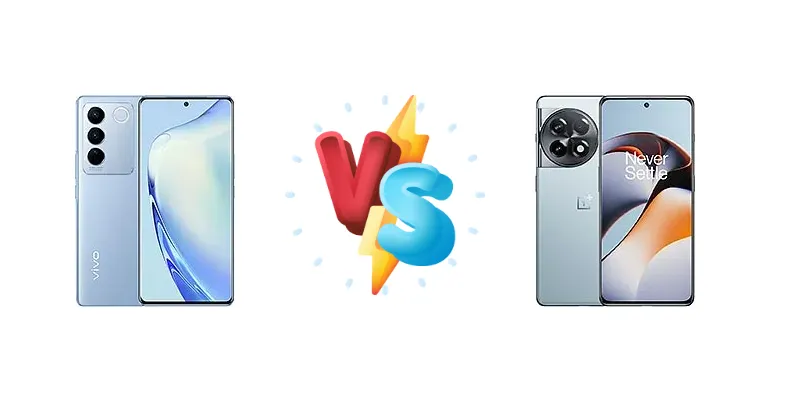
OnePlus 11R vs vivo V27: A Deep Dive into Mid-Range Power and Endurance
| Phones Images | |||||
|---|---|---|---|---|---|
|
🏆 Quick Verdict
For users prioritizing raw power and fast charging, the OnePlus 11R is the clear winner. Its Snapdragon 8+ Gen 1 offers significantly higher performance, and the 100W charging is a game-changer. However, the vivo V27 provides respectable performance and a solid endurance rating, making it a viable option for those seeking a more balanced device.
| PHONES | ||
|---|---|---|
| Phone Names | vivo V27 | OnePlus 11R |
| Network | ||
|---|---|---|
| 2G bands | GSM 850 / 900 / 1800 / 1900 | GSM 850 / 900 / 1800 / 1900 |
| 3G bands | HSDPA 850 / 900 / 1700(AWS) / 1900 / 2100 - International | HSDPA 850 / 900 / 1700(AWS) / 2100 |
| 4G bands | 1, 2, 3, 4, 5, 7, 8, 18, 19, 20, 26, 28, 38, 39, 40, 41 - International | 1, 3, 4, 5, 8, 28, 34, 38, 39, 40, 41 |
| 5G bands | 1, 3, 5, 7, 8, 20, 28, 38, 40, 41, 77, 78 SA/NSA - International | 1, 3, 5, 8, 28, 40, 41, 77, 78 SA/NSA |
| Speed | HSPA, LTE, 5G | HSPA, LTE (3CA), 5G |
| Technology | GSM / HSPA / LTE / 5G | GSM / CDMA / HSPA / LTE / 5G |
| 1, 3, 5, 8, 28, 78 SA/NSA - Asia | CDMA 800 | |
| Launch | ||
|---|---|---|
| Announced | 2023, March 01 | 2023, February 07 |
| Status | Available. Released 2023, March 01 | Available. Released 2023, February 21 |
| Body | ||
|---|---|---|
| Build | Glass front, glass back | Glass front, glass back (Gorilla Glass 5), plastic frame |
| Dimensions | 164.1 x 74.8 x 7.4 mm (6.46 x 2.94 x 0.29 in) | 163.4 x 74.3 x 8.7 mm (6.43 x 2.93 x 0.34 in) |
| SIM | Nano-SIM + Nano-SIM | Nano-SIM + Nano-SIM |
| Weight | 180 g (6.35 oz) | 204 g (7.20 oz) |
| Color changing back panel color | - | |
| Display | ||
|---|---|---|
| Resolution | 1080 x 2400 pixels, 20:9 ratio (~388 ppi density) | 1240 x 2772 pixels, 20:9 ratio (~451 ppi density) |
| Size | 6.78 inches, 111.0 cm2 (~90.4% screen-to-body ratio) | 6.74 inches, 109.2 cm2 (~90.0% screen-to-body ratio) |
| Type | AMOLED, 1B colors, 120Hz, HDR10+ | Fluid AMOLED, 1B colors, 120Hz, HDR10+, 1450 nits (peak) |
| Platform | ||
|---|---|---|
| CPU | Octa-core (2x2.8 GHz Cortex-A715 & 6x Cortex-A510) | Octa-core (1x3.0 GHz Cortex-X2 & 3x2.5 GHz Cortex-A710 & 4x1.80 GHz Cortex-A510) |
| Chipset | Mediatek Dimensity 7200 (4 nm) | Qualcomm SM8475 Snapdragon 8+ Gen 1 (4 nm) |
| GPU | Mali-G610 MC4 | Adreno 730 |
| OS | Android 13, Funtouch 13 | Android 13, upgradable to Android 15, OxygenOS 15 |
| Memory | ||
|---|---|---|
| Card slot | No | No |
| Internal | 128GB 8GB RAM, 256GB 8GB RAM, 256GB 12GB RAM | 128GB 8GB RAM, 256GB 16GB RAM, 512GB 18GB RAM |
| - | UFS 3.1 | |
| Main Camera | ||
|---|---|---|
| Features | Ring-LED flash, panorama, HDR | Color spectrum sensor, LED flash, HDR, panorama |
| Single | 50 MP, f/2.5, (wide), AF | 16 MP, f/2.4, 24mm (wide), 1/3.09", 1.0µm |
| Triple | 50 MP, f/1.9, (wide), 1/1.56", 1.0µm, PDAF, OIS 8 MP, f/2.2, 16mm, 120˚ (ultrawide), 1/4.0", 1.12µm 2 MP (macro) | 50 MP, f/1.8, 24mm (wide), 1/1.56", 1.0µm, multi-directional PDAF, OIS 8 MP, f/2.2, 120˚ (ultrawide), 1/4.0", 1.12µm 2 MP (macro) |
| Video | 4K@30/60fps, 1080p@30fps, gyro-EIS | 4K@30/60fps, 1080p@30/60/240fps, gyro-EIS |
| Selfie camera | ||
|---|---|---|
| Features | Dual-LED flash, HDR | HDR |
| Single | 50 MP, f/2.5, (wide), AF | 16 MP, f/2.4, 24mm (wide), 1/3.09", 1.0µm |
| Video | 4K@30/60fps, 1080p@30fps, gyro-EIS | 1080p@30fps |
| Sound | ||
|---|---|---|
| 3.5mm jack | No | No |
| 35mm jack | No | No |
| Loudspeaker | Yes | Yes, with stereo speakers |
| 24-bit/192kHz audio | 24-bit/192kHz audio | |
| Comms | ||
|---|---|---|
| Bluetooth | 5.3, A2DP, LE | 5.3, A2DP, LE, aptX HD |
| Infrared port | - | Yes |
| NFC | Yes | Yes |
| Positioning | GPS, GLONASS, GALILEO, BDS, QZSS, NavIC | GPS (L1+L5), GLONASS (G1), BDS (B1I+B1c+B2a), GALILEO (E1+E5a), QZSS (L1+L5) |
| Radio | No | No |
| USB | USB Type-C 2.0, OTG | USB Type-C 2.0 |
| WLAN | Wi-Fi 802.11 a/b/g/n/ac, dual-band, Wi-Fi Direct | Wi-Fi 802.11 a/b/g/n/ac/6, dual-band |
| Features | ||
|---|---|---|
| Sensors | Fingerprint (under display, optical), accelerometer, gyro, proximity, compass | Fingerprint (under display, optical), accelerometer, gyro, proximity, compass |
| Battery | ||
|---|---|---|
| Charging | 66W wired, 50% in 19 min | 100W wired |
| Type | 4600 mAh | Li-Po 5000 mAh |
| Misc | ||
|---|---|---|
| Colors | Magic Blue, Noble Black, Emerald Green, Flowing Gold | Galactic Silver, Sonic Black, Solar Red |
| Models | V2231, V2246 | CPH2487 |
| Price | About 380 EUR | About 600 EUR |
| SAR | - | 1.16 W/kg (head) 0.61 W/kg (body) |
| Tests | ||
|---|---|---|
| Battery life | Endurance rating 134h | - |
| Camera | Photo / Video | - |
| Display | Contrast ratio: Infinite (nominal) | - |
| Loudspeaker | -28.2 LUFS (Average) | - |
| Performance | AnTuTu: 613641 (v9) GeekBench: 2400 (v5.1), 2689 (v6) GFXBench: 34fps (ES 3.1 onscreen) | - |
vivo V27
- Excellent battery endurance (134h)
- Bright display (1055 nits)
- Efficient Dimensity 7200 chipset
- Less powerful chipset compared to the 11R
- Slower charging speed (66W)
OnePlus 11R
- Flagship-level performance with Snapdragon 8+ Gen 1
- Ultra-fast 100W charging
- Potentially better camera image processing
- Potentially lower battery endurance
- May experience thermal throttling under sustained load
Display Comparison
The vivo V27 boasts a display capable of reaching 1055 nits of peak brightness, ensuring excellent visibility even in direct sunlight. While the OnePlus 11R’s display specifications aren’t provided, OnePlus typically prioritizes high refresh rates. The V27’s ‘Infinite’ contrast ratio (nominal) suggests a typical OLED panel, offering deep blacks. Without specific details on the 11R’s panel technology, it’s difficult to assess its color accuracy or viewing angles relative to the V27, but the V27’s brightness gives it an edge for outdoor use.
Camera Comparison
Both phones are listed as having Photo/Video capabilities, but detailed sensor information is absent. Given the market positioning, it’s likely the OnePlus 11R will feature a more robust primary sensor. The Snapdragon 8+ Gen 1’s ISP (Image Signal Processor) is also more advanced, potentially leading to better image processing, especially in low-light conditions. Without specific details, it’s difficult to assess the quality of the video recording capabilities of either device. The absence of information suggests neither phone is likely to be a standout camera performer, focusing instead on all-around competence.
Performance
The core difference lies in the chipsets. The OnePlus 11R’s Snapdragon 8+ Gen 1 (4nm) features a prime Cortex-X2 core clocked at 3.0 GHz, alongside three Cortex-A710 cores and four Cortex-A510 cores. This configuration is designed for sustained peak performance. Conversely, the vivo V27 utilizes the Mediatek Dimensity 7200 (4nm) with a dual-core Cortex-A715 setup and six Cortex-A510 cores. While both are 4nm chips, the Snapdragon 8+ Gen 1’s architecture is demonstrably more powerful, particularly in GPU-intensive tasks. The 11R will excel in gaming and demanding applications, while the V27 will handle everyday tasks smoothly but may show limitations in graphically intensive scenarios. Thermal management will be crucial for the 11R to maintain peak performance.
Battery Life
The vivo V27 achieves an endurance rating of 134 hours, indicating solid battery life. However, the OnePlus 11R compensates for potentially lower battery capacity with its 100W wired charging, capable of delivering a 50% charge in a significantly shorter timeframe than the V27’s 66W charging (19 minutes for 50%). This rapid charging capability is a major advantage for users who frequently need to top up their battery quickly. The V27 prioritizes longevity, while the 11R prioritizes convenience.
Buying Guide
Buy the vivo V27 if you need a phone with good all-day battery life and a focus on balanced performance for everyday tasks and casual photography. Buy the OnePlus 11R if you prioritize gaming, demanding applications, and incredibly fast charging speeds, even if it means slightly reduced battery endurance.