
Nothing Phone (2) vs. vivo V27: A Deep Dive into Performance, Battery, and Display
| Phones Images | |||||
|---|---|---|---|---|---|
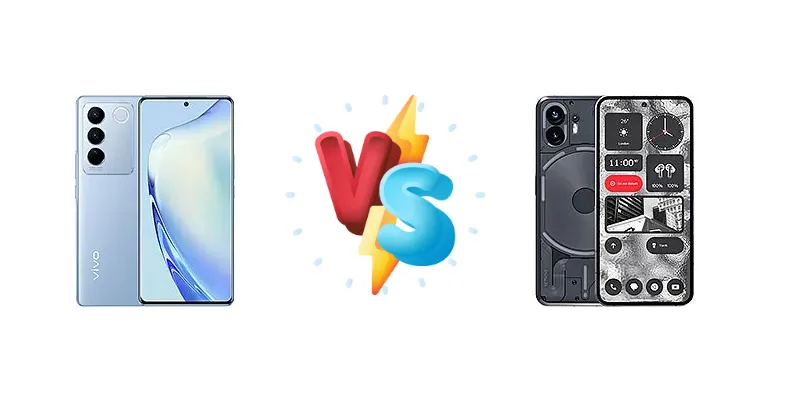
|
🏆 Quick Verdict
For users prioritizing raw performance and a distinctive design, the Nothing Phone (2) is the clear winner. Its Snapdragon 8+ Gen 1 chipset delivers significantly faster processing speeds. However, the vivo V27 offers competitive battery endurance and a comparable display, making it a strong contender for those seeking a more balanced and potentially more affordable option.
| PHONES | ||
|---|---|---|
| Phone Names | vivo V27 | Nothing Phone (2) |
| Network | ||
|---|---|---|
| 2G bands | GSM 850 / 900 / 1800 / 1900 | GSM 850 / 900 / 1800 / 1900 |
| 3G bands | HSDPA 850 / 900 / 1700(AWS) / 1900 / 2100 - International | HSDPA 800 / 850 / 900 / 1700(AWS) / 1900 / 2100 |
| 4G bands | 1, 2, 3, 4, 5, 7, 8, 18, 19, 20, 26, 28, 38, 39, 40, 41 - International | 1, 2, 3, 4, 5, 7, 8, 12, 17, 18, 19, 20, 25, 26, 28, 30, 32, 34, 38, 39, 40, 41, 42, 48, 66, 71 |
| 5G bands | 1, 3, 5, 7, 8, 20, 28, 38, 40, 41, 77, 78 SA/NSA - International | 1, 2, 3, 5, 7, 8, 12, 20, 25, 28, 30, 38, 40, 41, 66, 71, 75, 77, 78 SA/NSA |
| Speed | HSPA, LTE, 5G | HSPA, LTE, 5G |
| Technology | GSM / HSPA / LTE / 5G | GSM / HSPA / LTE / 5G |
| 1, 3, 5, 8, 28, 78 SA/NSA - Asia | - | |
| Launch | ||
|---|---|---|
| Announced | 2023, March 01 | 2023, July 11 |
| Status | Available. Released 2023, March 01 | Available. Released 2023, July 17 |
| Body | ||
|---|---|---|
| Build | Glass front, glass back | Glass front (Gorilla Glass 5), glass back (Gorilla Glass 5), aluminum frame |
| Dimensions | 164.1 x 74.8 x 7.4 mm (6.46 x 2.94 x 0.29 in) | 162.1 x 76.4 x 8.6 mm (6.38 x 3.01 x 0.34 in) |
| SIM | Nano-SIM + Nano-SIM | Nano-SIM + Nano-SIM |
| Weight | 180 g (6.35 oz) | 201.2 g (7.09 oz) |
| Color changing back panel color | - | |
| Display | ||
|---|---|---|
| Protection | - | Corning Gorilla Glass 5 |
| Resolution | 1080 x 2400 pixels, 20:9 ratio (~388 ppi density) | 1080 x 2412 pixels, 20:9 ratio (~394 ppi density) |
| Size | 6.78 inches, 111.0 cm2 (~90.4% screen-to-body ratio) | 6.7 inches, 108.0 cm2 (~87.2% screen-to-body ratio) |
| Type | AMOLED, 1B colors, 120Hz, HDR10+ | LTPO OLED, 1B colors, 120Hz, 1920Hz PWM, HDR10+, 1600 nits (HBM), 1600 nits (peak) |
| Platform | ||
|---|---|---|
| CPU | Octa-core (2x2.8 GHz Cortex-A715 & 6x Cortex-A510) | Octa-core (1x3.0 GHz Cortex-X2 & 3x2.5 GHz Cortex-A710 & 4x1.80 GHz Cortex-A510) |
| Chipset | Mediatek Dimensity 7200 (4 nm) | Qualcomm SM8475 Snapdragon 8+ Gen 1 (4 nm) |
| GPU | Mali-G610 MC4 | Adreno 730 |
| OS | Android 13, Funtouch 13 | Android 13, upgradable to Android 15, up to 3 major Android upgrades, Nothing OS 3.0 |
| Memory | ||
|---|---|---|
| Card slot | No | No |
| Internal | 128GB 8GB RAM, 256GB 8GB RAM, 256GB 12GB RAM | 128GB 8GB RAM, 256GB 12GB RAM, 512GB 12GB RAM |
| Main Camera | ||
|---|---|---|
| Dual | - | 50 MP, f/1.9, 24mm (wide), 1/1.56", 1.0µm, PDAF, OIS 50 MP, f/2.2, 114˚ (ultrawide), 1/2.76", 0.64µm, AF |
| Features | Ring-LED flash, panorama, HDR | LED flash, panorama, HDR |
| Single | 50 MP, f/2.5, (wide), AF | - |
| Triple | 50 MP, f/1.9, (wide), 1/1.56", 1.0µm, PDAF, OIS 8 MP, f/2.2, 16mm, 120˚ (ultrawide), 1/4.0", 1.12µm 2 MP (macro) | - |
| Video | 4K@30/60fps, 1080p@30fps, gyro-EIS | 4K@30/60fps, 1080p@30/60fps, gyro-EIS, live HDR, OIS |
| Selfie camera | ||
|---|---|---|
| Features | Dual-LED flash, HDR | HDR |
| Single | 50 MP, f/2.5, (wide), AF | 32 MP, f/2.5, (wide), 1/2.74", 0.8µm |
| Video | 4K@30/60fps, 1080p@30fps, gyro-EIS | 1080p@30fps |
| Sound | ||
|---|---|---|
| 3.5mm jack | No | - |
| 35mm jack | No | No |
| Loudspeaker | Yes | Yes, with stereo speakers |
| 24-bit/192kHz audio | - | |
| Comms | ||
|---|---|---|
| Bluetooth | 5.3, A2DP, LE | 5.3, A2DP, LE, aptX HD, aptX Adaptive |
| NFC | Yes | Yes |
| Positioning | GPS, GLONASS, GALILEO, BDS, QZSS, NavIC | GPS (L1+L5), GLONASS (L1), BDS (B1I+B1c), GALILEO (E1), QZSS (L1), NavIC |
| Radio | No | No |
| USB | USB Type-C 2.0, OTG | USB Type-C 2.0, OTG |
| WLAN | Wi-Fi 802.11 a/b/g/n/ac, dual-band, Wi-Fi Direct | Wi-Fi 802.11 a/b/g/n/ac/6, dual-band, Wi-Fi Direct |
| Features | ||
|---|---|---|
| Sensors | Fingerprint (under display, optical), accelerometer, gyro, proximity, compass | Fingerprint (under display, optical), accelerometer, proximity, gyro, compass |
| Battery | ||
|---|---|---|
| Charging | 66W wired, 50% in 19 min | 45W wired, PD3.0, PPS, QC4, 100% in 55 min 15W wireless, 100% in 130 min 5W reverse wireless |
| Type | 4600 mAh | Li-Ion 4700 mAh |
| Misc | ||
|---|---|---|
| Colors | Magic Blue, Noble Black, Emerald Green, Flowing Gold | White, Dark Gray |
| Models | V2231, V2246 | A065 |
| Price | About 380 EUR | $ 379.99 / £ 370.00 |
| Tests | ||
|---|---|---|
| Battery life | Endurance rating 134h | - |
| Camera | Photo / Video | - |
| Display | Contrast ratio: Infinite (nominal) | - |
| Loudspeaker | -28.2 LUFS (Average) | - |
| Performance | AnTuTu: 613641 (v9) GeekBench: 2400 (v5.1), 2689 (v6) GFXBench: 34fps (ES 3.1 onscreen) | - |
vivo V27
- Faster processor (Snapdragon 8+ Gen 1)
- Longer battery life (Active Use Score)
- Wireless and Reverse Wireless Charging
- Unique Glyph Interface
- Slightly dimmer display
- Slower wired charging than vivo V27
Nothing Phone (2)
- Faster wired charging (66W)
- Brighter display (1055 nits)
- Potentially more affordable
- Strong camera reputation (vivo)
- Less powerful processor (Dimensity 7200)
- No wireless charging
Display Comparison
Both the vivo V27 and Nothing Phone (2) feature displays capable of reaching high brightness levels, with the vivo V27 edging out the Nothing Phone (2) at 1055 nits versus 998 nits, respectively. While the difference isn't massive, the vivo V27 will offer slightly better visibility in direct sunlight. Both devices lack official refresh rate information, but are assumed to be 120Hz. The 'Infinite' contrast ratio claimed by vivo is a marketing term; real-world contrast performance will depend on panel technology. The Nothing Phone (2)'s display, while slightly dimmer, benefits from the Glyph Interface, which can integrate with display notifications for a unique user experience.
Camera Comparison
Both phones offer capable camera systems, but detailed sensor information is limited. The context data only indicates 'Photo / Video' capabilities for both. However, considering vivo’s strong camera reputation, the V27 likely prioritizes image processing for vibrant, social media-ready photos. The Nothing Phone (2) aims for a more natural and balanced look. Without specific sensor size or aperture details, it’s difficult to definitively declare a winner. The Nothing Phone (2)'s dual 50MP cameras offer versatility, while the vivo V27's camera system is likely optimized for portrait and selfie photography, a common strength of the brand. The absence of details on OIS is a notable omission.
Performance
The performance gap is the most significant differentiator. The Nothing Phone (2) is powered by the Qualcomm Snapdragon 8+ Gen 1 (4nm), featuring an octa-core CPU with a prime Cortex-X2 core clocked at 3.0 GHz. This architecture is demonstrably more powerful than the Mediatek Dimensity 7200 (4nm) in the vivo V27, which utilizes a dual-core Cortex-A715 setup at 2.8 GHz. The Snapdragon 8+ Gen 1’s superior GPU will translate to smoother gaming and faster video rendering. While both chips are built on a 4nm process, the Snapdragon 8+ Gen 1’s architecture provides a performance advantage, though potentially at the cost of slightly higher thermal output. The Nothing Phone (2) is likely to handle sustained workloads more effectively.
Battery Life
The Nothing Phone (2) boasts an active use score of 14:21h, translating to a more substantial real-world battery life compared to the vivo V27’s endurance rating of 134 hours (equivalent to roughly 5.6 days of standby, a less useful metric). However, charging speeds are where the vivo V27 shines. Its 66W wired charging can replenish 50% of the battery in just 19 minutes, significantly faster than the Nothing Phone (2)’s 45W charging (100% in 55 minutes). The Nothing Phone (2) also offers 15W wireless charging and 5W reverse wireless charging, features absent in the vivo V27. The trade-off is clear: longer runtime with the Nothing Phone (2) versus faster top-ups with the vivo V27.
Buying Guide
Buy the vivo V27 if you need exceptional charging speeds (66W) and prioritize a consistently bright display for outdoor visibility. It’s ideal for users who frequently capture photos and videos and value a reliable, all-around experience. Buy the Nothing Phone (2) if you prefer a more powerful processor for demanding tasks like gaming and video editing, appreciate a unique and minimalist aesthetic, and desire faster software updates and a more open ecosystem.