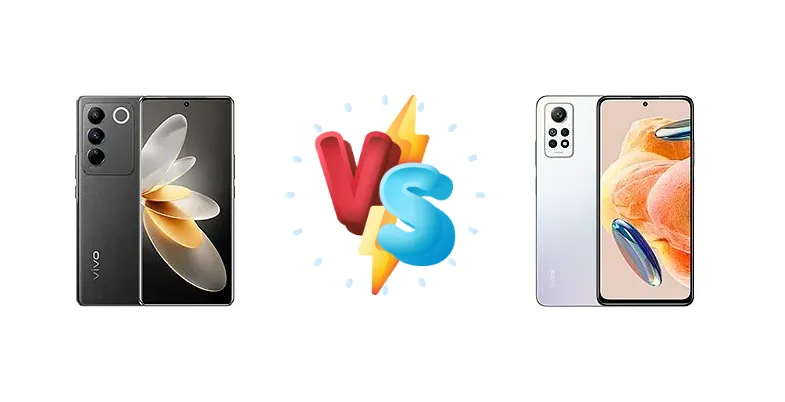
The mid-range smartphone market is fiercely competitive, and the vivo V27 Pro and Xiaomi Redmi Note 12 Pro 4G are two strong contenders. Both offer compelling features at attractive price points, but cater to slightly different needs. Let's dive into a detailed comparison to help you decide which one deserves your money.
🏆 Quick Verdict
The vivo V27 Pro takes the lead with its superior chipset, brighter display, and incredibly long battery life. While the Redmi Note 12 Pro 4G offers fast charging and a competitive price, the V27 Pro's overall performance and features make it the better choice for most users.
| Network |
|---|
| 2G bands | GSM 850 / 900 / 1800 / 1900 | GSM 850 / 900 / 1800 / 1900 |
| 3G bands | HSDPA 850 / 900 / 1700(AWS) / 2100 | HSDPA 850 / 900 / 1700(AWS) / 1900 / 2100 |
| 4G bands | 1, 3, 4, 5, 8, 28, 38, 40, 41 | 1, 2, 3, 4, 5, 7, 8, 20, 28, 38, 40, 41, 66 |
| 5G bands | 1, 3, 5, 8, 28, 77, 78 SA/NSA | - |
| Speed | HSPA, LTE, 5G | HSPA, LTE |
| Technology | GSM / HSPA / LTE / 5G | GSM / HSPA / LTE |
| Launch |
|---|
| Announced | 2023, March 01 | 2023, March 03 |
| Status | Available. Released 2023, March 01 | Available. Released 2023, April 11 |
| Body |
|---|
| Build | Glass front, plastic frame, glass back | - |
| Dimensions | 164.1 x 74.8 x 7.4 mm (6.46 x 2.94 x 0.29 in) | 164.2 x 76.1 x 8.1 mm (6.46 x 3.00 x 0.32 in) |
| SIM | Nano-SIM + Nano-SIM | Nano-SIM + Nano-SIM |
| Weight | 182 g (6.42 oz) | 201.8 g (7.13 oz) |
| | Color changing back panel color | - |
| Display |
|---|
| Resolution | 1080 x 2400 pixels, 20:9 ratio (~388 ppi density) | 1080 x 2400 pixels, 20:9 ratio (~395 ppi density) |
| Size | 6.78 inches, 111.0 cm2 (~90.4% screen-to-body ratio) | 6.67 inches, 107.4 cm2 (~86.0% screen-to-body ratio) |
| Type | AMOLED, 1B colors, 120Hz, HDR10+ | AMOLED, 120Hz, Dolby Vision, 700 nits (HBM), 1100 nits (peak) |
| Platform |
|---|
| CPU | Octa-core (1x3.1 GHz Cortex-A78 & 3x3.0 GHz Cortex-A78 & 4x2.0 GHz Cortex-A55) | Octa-core (2x2.2 GHz Kryo 470 Gold & 6x1.8 GHz Kryo 470 Silver) |
| Chipset | Mediatek Dimensity 8200 (4 nm) | Qualcomm SM7150 Snapdragon 732G (8 nm) |
| GPU | Mali-G610 MC6 | Adreno 618 |
| OS | Android 13, Funtouch 13 | Android 11, MIUI 13 |
| Memory |
|---|
| Card slot | No | microSDXC (uses shared SIM slot) |
| Internal | 128GB 8GB RAM, 256GB 8GB RAM, 256GB 12GB RAM | 128GB 6GB RAM, 128GB 8GB RAM, 256GB 8GB RAM |
| | UFS 3.1 | UFS 2.2 |
| Main Camera |
|---|
| Features | Ring-LED flash, panorama, HDR | LED flash, HDR, panorama |
| Quad | - | 108 MP, f/1.9, (wide), 1/1.52", 0.7µm, PDAF
8 MP, 120˚, (ultrawide)
2 MP (macro)
Auxiliary lens |
| Single | 50 MP, f/2.5, (wide), AF | - |
| Triple | 50 MP, f/1.9, (wide), 1/1.56", 1.0µm, PDAF, OIS
8 MP, f/2.2, 16mm, 120˚ (ultrawide), 1/4.0", 1.12µm
2 MP (macro) | - |
| Video | 4K@30/60fps, 1080p@30fps, gyro-EIS | 4K@30fps, 1080p@30/60fps |
| Selfie camera |
|---|
| Features | Dual-LED flash, HDR | - |
| Single | 50 MP, f/2.5, (wide), AF | 16 MP, f/2.4, (wide) |
| Video | 4K@30/60fps, 1080p@30fps, gyro-EIS | 1080p@30fps |
| Sound |
|---|
| 3.5mm jack | No | Yes |
| 35mm jack | No | Yes |
| Loudspeaker | Yes | Yes, with stereo speakers |
| | 24-bit/192kHz audio | - |
| Comms |
|---|
| Bluetooth | 5.3, A2DP, LE | 5.0, A2DP, LE |
| Infrared port | - | Yes |
| NFC | Yes | Yes (market/region dependent) |
| Positioning | GPS, GLONASS, GALILEO, BDS, NavIC | GPS, GLONASS, GALILEO, BDS |
| Radio | No | Unspecified |
| USB | USB Type-C 2.0, OTG | USB Type-C 2.0, OTG |
| WLAN | Wi-Fi 802.11 a/b/g/n/ac/6, dual-band, Wi-Fi Direct | Wi-Fi 802.11 a/b/g/n/ac, dual-band |
| Features |
|---|
| Sensors | Fingerprint (under display, optical), accelerometer, gyro, proximity, compass | Fingerprint (side-mounted), accelerometer, gyro, compass |
| Battery |
|---|
| Charging | 66W wired, 50% in 19 min, 72% in 30 min | 67W wired |
| Type | 4600 mAh | Li-Po 5000 mAh |
| Misc |
|---|
| Colors | Magic Blue, Noble Black | Star Blue, Graphite Gray, Polar White, Ice blue |
| Models | V2230 | 2209116AG, 2209116AG |
| Price | About 440 EUR | About 150 EUR |
| SAR | 1.22 W/kg (head) 0.89 W/kg (body) | - |
| Tests |
|---|
| Battery life |
Endurance rating 121h
| - |
| Camera |
Photo / Video | - |
| Display |
Contrast ratio: Infinite (nominal) | - |
| Loudspeaker |
-29.1 LUFS (Average)
| - |
| Performance |
AnTuTu: 846767 (v9)
GeekBench: 3933 (v5.1), 3421 (v6)
GFXBench: 57fps (ES 3.1 onscreen) | - |
vivo V27 Pro
- Superior Performance (Dimensity 8200)
- Brighter Display (978 nits)
- Exceptional Battery Life (121h Endurance)
- Fast Charging (66W)
- Potentially Higher Price
- Camera Specs Need Further Review
Xiaomi Redmi Note 12 Pro 4G
- Fast Charging (67W)
- Competitive Price
- Reliable Performance for Everyday Tasks
- Less Powerful Chipset (Snapdragon 732G)
- Lower Display Brightness
- Shorter Battery Life
Display Comparison
The vivo V27 Pro boasts a significantly brighter display at 978 nits compared to the Redmi Note 12 Pro 4G (estimated around 600-800 nits). Both likely feature AMOLED panels with vibrant colors and deep blacks, but the V27 Pro's brightness advantage makes it better for outdoor visibility. The contrast ratio is listed as 'Infinite' for the V27 Pro, indicating excellent contrast.
Camera Comparison
While both phones offer capable cameras, the V27 Pro likely has an edge. The specific camera specs are missing, but the Dimensity 8200 generally supports more advanced camera features and image processing. The Redmi Note 12 Pro 4G is expected to have a good main sensor, but may lack the V27 Pro's advanced features like OIS (Optical Image Stabilization) or higher resolution sensors.
Performance
Here, the vivo V27 Pro clearly wins. Its Mediatek Dimensity 8200 chipset is considerably more powerful than the Snapdragon 732G in the Redmi Note 12 Pro 4G. Expect smoother multitasking, faster app loading times, and better gaming performance on the V27 Pro. The Dimensity 8200's 4nm process also contributes to better power efficiency.
Battery Life
The vivo V27 Pro's battery life is exceptional, boasting an endurance rating of 121 hours. This is significantly better than what the Redmi Note 12 Pro 4G is likely to achieve. While the Redmi Note 12 Pro 4G has 67W fast charging, the V27 Pro's 66W charging is still very fast, and the massive battery capacity means you'll need to charge it far less frequently.
Buying Guide
The vivo V27 Pro is ideal for users who prioritize performance, camera quality, and exceptional battery life. It's a great choice for content creators and power users. The Xiaomi Redmi Note 12 Pro 4G is best suited for budget-conscious buyers who want a reliable smartphone with fast charging and a decent camera, but aren't as concerned about top-tier performance.
Frequently Asked Questions
❓ Is the vivo V27 Pro worth the extra money?
If you prioritize performance, a brighter display, and long battery life, then yes, the V27 Pro is worth the investment. However, if you're on a tight budget and primarily need a phone for basic tasks, the Redmi Note 12 Pro 4G is a solid option.
❓ Which phone has better gaming performance?
The vivo V27 Pro's Dimensity 8200 chipset provides significantly better gaming performance compared to the Snapdragon 732G in the Redmi Note 12 Pro 4G. Expect smoother frame rates and less lag on the V27 Pro.