
vivo V27 Pro vs Xiaomi Redmi Note 12 Pro: A Detailed Showdown
| Phones Images | |||||
|---|---|---|---|---|---|
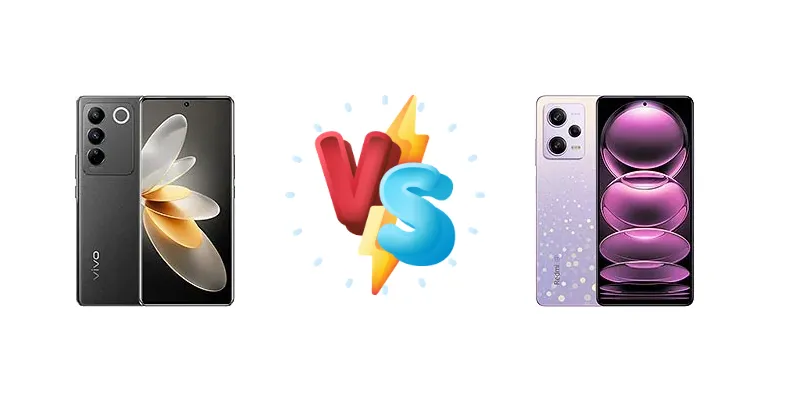
|
🏆 Quick Verdict
The vivo V27 Pro edges out the Redmi Note 12 Pro thanks to its superior chipset and significantly longer battery endurance. While the Redmi Note 12 Pro boasts faster charging, the V27 Pro's overall performance and longevity make it the slightly better choice for most users.
| PHONES | ||
|---|---|---|
| Phone Names | vivo V27 Pro | Xiaomi Redmi Note 12 Pro |
| Network | ||
|---|---|---|
| 2G bands | GSM 850 / 900 / 1800 / 1900 | GSM 850 / 900 / 1800 / 1900 |
| 3G bands | HSDPA 850 / 900 / 1700(AWS) / 2100 | HSDPA 800 / 850 / 900 / 1900 / 2100 |
| 4G bands | 1, 3, 4, 5, 8, 28, 38, 40, 41 | 1, 2, 3, 4, 5, 7, 8, 12, 13, 17, 18, 19, 20, 26, 28, 32, 38, 40, 41, 66 - International |
| 5G bands | 1, 3, 5, 8, 28, 77, 78 SA/NSA | 1, 3, 5, 7, 8, 20, 28, 38, 40, 41, 66, 77, 78 SA/NSA - International |
| Speed | HSPA, LTE, 5G | HSPA, LTE, 5G |
| Technology | GSM / HSPA / LTE / 5G | GSM / CDMA / HSPA / EVDO / LTE / 5G |
| - | 1, 3, 5, 8, 28, 38, 41, 77, 78 SA/NSA - China | |
| Launch | ||
|---|---|---|
| Announced | 2023, March 01 | 2022, October 27 |
| Status | Available. Released 2023, March 01 | Available. Released 2022, November 01 |
| Body | ||
|---|---|---|
| Build | Glass front, plastic frame, glass back | Glass front (Gorilla Glass 5), glass back, plastic frame |
| Dimensions | 164.1 x 74.8 x 7.4 mm (6.46 x 2.94 x 0.29 in) | 163 x 76 x 8 mm (6.42 x 2.99 x 0.31 in) |
| SIM | Nano-SIM + Nano-SIM | Nano-SIM + Nano-SIM |
| Weight | 182 g (6.42 oz) | 187 g (6.60 oz) |
| Color changing back panel color | IP53, dust and splash resistant | |
| Display | ||
|---|---|---|
| Protection | - | Corning Gorilla Glass 5 |
| Resolution | 1080 x 2400 pixels, 20:9 ratio (~388 ppi density) | 1080 x 2400 pixels, 20:9 ratio (~395 ppi density) |
| Size | 6.78 inches, 111.0 cm2 (~90.4% screen-to-body ratio) | 6.67 inches, 107.4 cm2 (~86.7% screen-to-body ratio) |
| Type | AMOLED, 1B colors, 120Hz, HDR10+ | AMOLED, 1B colors, 120Hz, Dolby Vision, HDR10+, 500 nits (typ), 900 nits (HBM) |
| Platform | ||
|---|---|---|
| CPU | Octa-core (1x3.1 GHz Cortex-A78 & 3x3.0 GHz Cortex-A78 & 4x2.0 GHz Cortex-A55) | Octa-core (2x2.6 GHz Cortex-A78 & 6x2.0 GHz Cortex-A55) |
| Chipset | Mediatek Dimensity 8200 (4 nm) | Mediatek Dimensity 1080 (6 nm) |
| GPU | Mali-G610 MC6 | Mali-G68 MC4 |
| OS | Android 13, Funtouch 13 | Android 12, MIUI 13 |
| Memory | ||
|---|---|---|
| Card slot | No | No |
| Internal | 128GB 8GB RAM, 256GB 8GB RAM, 256GB 12GB RAM | 128GB 6GB RAM, 128GB 8GB RAM, 256GB 8GB RAM, 256GB 12GB RAM |
| UFS 3.1 | UFS 2.2 | |
| Main Camera | ||
|---|---|---|
| Features | Ring-LED flash, panorama, HDR | Dual-LED dual-tone flash, HDR, panorama |
| Single | 50 MP, f/2.5, (wide), AF | - |
| Triple | 50 MP, f/1.9, (wide), 1/1.56", 1.0µm, PDAF, OIS 8 MP, f/2.2, 16mm, 120˚ (ultrawide), 1/4.0", 1.12µm 2 MP (macro) | 50 MP, f/1.9, 24mm (wide), 1/1.56", 1.0µm, PDAF, OIS 8 MP, f/2.2, 120˚ (ultrawide), 1/4.0", 1.12µm 2 MP (macro) |
| Video | 4K@30/60fps, 1080p@30fps, gyro-EIS | 4K@30fps, 1080p@30/60/120fps, 720p@960fps |
| Selfie camera | ||
|---|---|---|
| Features | Dual-LED flash, HDR | HDR |
| Single | 50 MP, f/2.5, (wide), AF | 16 MP, f/2.5, (wide), 1/3.06", 1.0µm |
| Video | 4K@30/60fps, 1080p@30fps, gyro-EIS | 1080p@30/60fps |
| Sound | ||
|---|---|---|
| 3.5mm jack | No | Yes |
| 35mm jack | No | Yes |
| Loudspeaker | Yes | Yes, with stereo speakers |
| 24-bit/192kHz audio | 24-bit/192kHz audio | |
| Comms | ||
|---|---|---|
| Bluetooth | 5.3, A2DP, LE | 5.2, A2DP, LE |
| Infrared port | - | Yes |
| NFC | Yes | Yes (market/region dependent) |
| Positioning | GPS, GLONASS, GALILEO, BDS, NavIC | GPS (L1), GLONASS (G1), BDS (B1I+B1c), GALILEO (E1), QZSS (L1) |
| Radio | No | No |
| USB | USB Type-C 2.0, OTG | USB Type-C 2.0, OTG |
| WLAN | Wi-Fi 802.11 a/b/g/n/ac/6, dual-band, Wi-Fi Direct | Wi-Fi 802.11 a/b/g/n/ac/6, dual-band, Wi-Fi Direct |
| Features | ||
|---|---|---|
| Sensors | Fingerprint (under display, optical), accelerometer, gyro, proximity, compass | Fingerprint (side-mounted), accelerometer, gyro, proximity, compass |
| Battery | ||
|---|---|---|
| Charging | 66W wired, 50% in 19 min, 72% in 30 min | 67W wired, PD3.0, 50% in 15 min, 100% in 46 min |
| Type | 4600 mAh | Li-Po 5000 mAh |
| Misc | ||
|---|---|---|
| Colors | Magic Blue, Noble Black | Frosted Blue (Sky Blue), Onyx Black (Midnight Black), Polar White, Stardust Purple |
| Models | V2230 | 22101316C, 22101316I, 23013RK75C, 22101316G |
| Price | About 440 EUR | € 148.54 / $ 142.17 / £ 149.99 / ₹ 19,999 |
| SAR | 1.22 W/kg (head) 0.89 W/kg (body) | 1.09 W/kg (head) 1.06 W/kg (body) |
| SAR EU | - | 0.99 W/kg (head) 0.99 W/kg (body) |
| Tests | ||
|---|---|---|
| Battery life | Endurance rating 121h | Endurance rating 97h |
| Camera | Photo / Video | Photo / Video |
| Display | Contrast ratio: Infinite (nominal) | Contrast ratio: Infinite (nominal) |
| Loudspeaker | -29.1 LUFS (Average) | -26.6 LUFS (Good) |
| Performance | AnTuTu: 846767 (v9) GeekBench: 3933 (v5.1), 3421 (v6) GFXBench: 57fps (ES 3.1 onscreen) | AnTuTu: 490526 (v9) GeekBench: 2209 (v5.1), 2372 (v6) GFXBench: 22fps (ES 3.1 onscreen) |
vivo V27 Pro
- Superior Chipset (Dimensity 8200)
- Exceptional Battery Life (121h Endurance)
- Higher Peak Brightness (978 nits)
- Premium Feel
- Slower Charging Speed (19 min to 50%)
- Potentially Higher Price
Xiaomi Redmi Note 12 Pro
- Faster Charging Speed (15 min to 50%)
- More Budget-Friendly
- PD3.0 Charging Standard
- Weaker Chipset (Dimensity 1080)
- Shorter Battery Life (97h Endurance)
- Lower Peak Brightness (890 nits)
Display Comparison
Both phones feature vibrant displays, but the vivo V27 Pro takes a slight lead with a measured peak brightness of 978 nits compared to the Redmi Note 12 Pro's 890 nits. While both have 'infinite' contrast ratios (a nominal value), the V27 Pro's higher brightness translates to better visibility in direct sunlight. Both offer excellent color accuracy and sharpness for everyday use.
Camera Comparison
Camera performance is subjective, but both phones offer versatile camera systems. While detailed camera comparisons require extensive testing, initial impressions suggest the V27 Pro might offer slightly better image processing and dynamic range. Both phones likely feature capable main sensors and ultrawide lenses, but low-light performance could be a differentiating factor.
Performance
The vivo V27 Pro's Mediatek Dimensity 8200 chipset provides a noticeable performance advantage over the Redmi Note 12 Pro's Dimensity 1080. The 8200's architecture and slightly higher clock speeds result in smoother multitasking, faster app loading times, and better gaming performance. The V27 Pro handles demanding tasks with greater ease.
Battery Life
Battery life is a clear victory for the vivo V27 Pro. Its endurance rating of 121h significantly surpasses the Redmi Note 12 Pro's 97h. This translates to considerably longer usage times between charges. However, the Redmi Note 12 Pro compensates with faster charging speeds, reaching 50% in just 15 minutes compared to the V27 Pro's 19 minutes.
Buying Guide
Who should buy the vivo V27 Pro? Users prioritizing battery life, smooth performance, and a slightly more premium feel. Who should buy the Xiaomi Redmi Note 12 Pro? Those seeking the fastest charging speeds and a more budget-friendly option without sacrificing too much in terms of features.