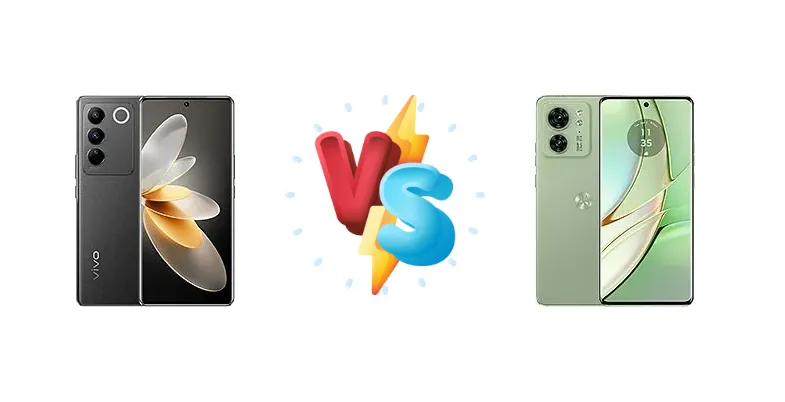
The mid-range smartphone market is fiercely competitive, and the vivo V27 Pro and Motorola Edge 40 are two strong contenders. Both offer compelling features and attractive designs, but which one truly comes out on top? This comprehensive comparison will delve into every aspect, from display quality to camera performance, to help you make an informed decision.
🏆 Quick Verdict
The vivo V27 Pro edges out the Motorola Edge 40 thanks to its superior battery life and slightly more powerful chipset. However, the Edge 40 boasts a brighter display and the added convenience of wireless charging, making it a close call depending on your priorities. Ultimately, the V27 Pro offers a more well-rounded experience.
| Network |
|---|
| 2G bands | GSM 850 / 900 / 1800 / 1900 | GSM 850 / 900 / 1800 / 1900 |
| 3G bands | HSDPA 850 / 900 / 1700(AWS) / 2100 | HSDPA 850 / 900 / 1700(AWS) / 1900 / 2100 |
| 4G bands | 1, 3, 4, 5, 8, 28, 38, 40, 41 | 1, 2, 3, 4, 5, 7, 8, 12, 13, 17, 20, 26, 28, 32, 38, 39, 40, 41, 42, 43, 66 |
| 5G bands | 1, 3, 5, 8, 28, 77, 78 SA/NSA | 1, 2, 3, 5, 7, 8, 20, 28, 38, 40, 41, 66, 77, 78 SA/NSA/Sub6 |
| Speed | HSPA, LTE, 5G | HSPA, LTE, 5G |
| Technology | GSM / HSPA / LTE / 5G | GSM / HSPA / LTE / 5G |
| Launch |
|---|
| Announced | 2023, March 01 | 2023, May 04 |
| Status | Available. Released 2023, March 01 | Available. Released 2023, May 04 |
| Body |
|---|
| Build | Glass front, plastic frame, glass back | Glass front, aluminum frame, plastic back or eco leather back |
| Dimensions | 164.1 x 74.8 x 7.4 mm (6.46 x 2.94 x 0.29 in) | 158.4 x 72 x 7.6 mm (6.24 x 2.83 x 0.30 in) |
| SIM | Nano-SIM + Nano-SIM | · Nano-SIM· Nano-SIM + eSIM· Nano-SIM + Nano-SIM |
| Weight | 182 g (6.42 oz) | 167 g or 171 g (5.89 oz) |
| | Color changing back panel color | IP68 dust/water resistant (up to 1.5m for 30 min) |
| Display |
|---|
| Resolution | 1080 x 2400 pixels, 20:9 ratio (~388 ppi density) | 1080 x 2400 pixels, 20:9 ratio (~402 ppi density) |
| Size | 6.78 inches, 111.0 cm2 (~90.4% screen-to-body ratio) | 6.55 inches, 103.6 cm2 (~90.8% screen-to-body ratio) |
| Type | AMOLED, 1B colors, 120Hz, HDR10+ | P-OLED, 144Hz, HDR10+, 1200 nits (peak) |
| Platform |
|---|
| CPU | Octa-core (1x3.1 GHz Cortex-A78 & 3x3.0 GHz Cortex-A78 & 4x2.0 GHz Cortex-A55) | Octa-core (4x2.6 GHz Cortex-A78 & 4x2.0 GHz Cortex-A55) |
| Chipset | Mediatek Dimensity 8200 (4 nm) | Mediatek Dimensity 8020 (6 nm) |
| GPU | Mali-G610 MC6 | Mali-G77 MC9 |
| OS | Android 13, Funtouch 13 | Android 13, up to 2 major Android upgrades |
| Memory |
|---|
| Card slot | No | No |
| Internal | 128GB 8GB RAM, 256GB 8GB RAM, 256GB 12GB RAM | 128GB 8GB RAM, 256GB 8GB RAM |
| | UFS 3.1 | UFS 3.1 |
| Main Camera |
|---|
| Dual | - | 50 MP, f/1.4, (wide), 1/1.55", 1.0µm, multi-directional PDAF, OIS
13 MP, f/2.2, 120˚ (ultrawide), 1/3.0", 1.12µm, AF |
| Features | Ring-LED flash, panorama, HDR | Dual-LED flash, HDR, panorama |
| Single | 50 MP, f/2.5, (wide), AF | - |
| Triple | 50 MP, f/1.9, (wide), 1/1.56", 1.0µm, PDAF, OIS
8 MP, f/2.2, 16mm, 120˚ (ultrawide), 1/4.0", 1.12µm
2 MP (macro) | - |
| Video | 4K@30/60fps, 1080p@30fps, gyro-EIS | 4K@30fps, 1080p@30/60/120fps, 720p@960fps, HDR10, gyro-EIS |
| Selfie camera |
|---|
| Features | Dual-LED flash, HDR | HDR |
| Single | 50 MP, f/2.5, (wide), AF | 32 MP, f/2.4, (wide), 1/3.0", 0.7µm |
| Video | 4K@30/60fps, 1080p@30fps, gyro-EIS | 4K@30fps, 1080p@30/120fps |
| Sound |
|---|
| 3.5mm jack | No | No |
| 35mm jack | No | No |
| Loudspeaker | Yes | Yes, with stereo speakers |
| | 24-bit/192kHz audio | - |
| Comms |
|---|
| Bluetooth | 5.3, A2DP, LE | 5.2, A2DP, LE |
| NFC | Yes | Yes |
| Positioning | GPS, GLONASS, GALILEO, BDS, NavIC | GPS, GLONASS, GALILEO, BDS |
| Radio | No | No |
| USB | USB Type-C 2.0, OTG | USB Type-C 2.0, OTG |
| WLAN | Wi-Fi 802.11 a/b/g/n/ac/6, dual-band, Wi-Fi Direct | Wi-Fi 802.11 a/b/g/n/ac/6e, tri-band, Wi-Fi Direct |
| Features |
|---|
| Sensors | Fingerprint (under display, optical), accelerometer, gyro, proximity, compass | Fingerprint (under display, optical), accelerometer, gyro, proximity, compass |
| | - | Moto Ready For support |
| Battery |
|---|
| Charging | 66W wired, 50% in 19 min, 72% in 30 min | 68W wired
15W wireless |
| Type | 4600 mAh | Li-Po 4400 mAh |
| Misc |
|---|
| Colors | Magic Blue, Noble Black | Nebula Green, Lunar Blue, Eclipse Black, Viva Magenta |
| Models | V2230 | XT2303-2 |
| Price | About 440 EUR | € 202.03 / $ 419.99 / £ 199.00 / ₹ 29,999 |
| SAR | 1.22 W/kg (head) 0.89 W/kg (body) | - |
| Tests |
|---|
| Battery life |
Endurance rating 121h
|
Endurance rating 98h
|
| Camera |
Photo / Video |
Photo / Video |
| Display |
Contrast ratio: Infinite (nominal) |
Contrast ratio: Infinite (nominal) |
| Loudspeaker |
-29.1 LUFS (Average)
|
-24.2 LUFS (Very good)
|
| Performance |
AnTuTu: 846767 (v9)
GeekBench: 3933 (v5.1), 3421 (v6)
GFXBench: 57fps (ES 3.1 onscreen) |
AnTuTu: 688347 (v9)
GeekBench: 3320 (v5.1), 3603 (v6)
GFXBench: 33fps (ES 3.1 onscreen) |
vivo V27 Pro
- Exceptional battery life
- Powerful Dimensity 8200 chipset
- Vibrant OLED display
- Fast 66W wired charging
- No wireless charging
- Camera versatility could be improved
Motorola Edge 40
- Brighter display (1043 nits)
- Wireless charging support
- Sleek and minimalist design
- Fast 68W wired charging
- Shorter battery life
- Slightly less powerful chipset
- Camera performance slightly behind V27 Pro
Display Comparison
The Motorola Edge 40 takes the lead in display brightness, measuring a peak of 1043 nits compared to the vivo V27 Pro's 978 nits. Both feature OLED panels with excellent contrast ratios (nominally infinite) and vibrant colors. While both offer smooth scrolling, the Edge 40's slightly higher brightness makes it more visible in direct sunlight. The V27 Pro's display is still excellent, but the Edge 40 has a slight edge.
Camera Comparison
Both phones offer capable camera systems, but the vivo V27 Pro is generally considered to have a slightly more versatile setup. While specific camera specs are not detailed, reviews suggest the V27 Pro excels in low-light photography and offers more creative shooting modes. The Edge 40's camera is still very good, producing sharp and vibrant images in well-lit conditions.
Performance
The vivo V27 Pro's Mediatek Dimensity 8200 chipset provides a noticeable performance advantage over the Motorola Edge 40's Dimensity 8020. The 8200's higher clock speeds and more efficient architecture translate to smoother multitasking, faster app loading times, and better gaming performance. Both phones handle everyday tasks with ease, but the V27 Pro offers a more premium feel.
Battery Life
The vivo V27 Pro dominates in battery life, boasting an impressive endurance rating of 121 hours, significantly higher than the Motorola Edge 40's 98 hours. This translates to noticeably longer usage times between charges. The Edge 40 does offer wireless charging, which can be convenient, but it can't compensate for the V27 Pro's superior battery capacity.
Buying Guide
Who should buy the vivo V27 Pro? Users prioritizing long battery life, a smooth performance experience, and a vibrant display. Who should buy the Motorola Edge 40? Those seeking a brighter screen, wireless charging capabilities, and a sleek, minimalist design.
Frequently Asked Questions
❓ Which phone is better for gaming?
The vivo V27 Pro's Dimensity 8200 chipset provides a smoother and more responsive gaming experience compared to the Edge 40.
❓ Does the Motorola Edge 40 support fast charging?
Yes, the Motorola Edge 40 supports 68W wired charging and 15W wireless charging.