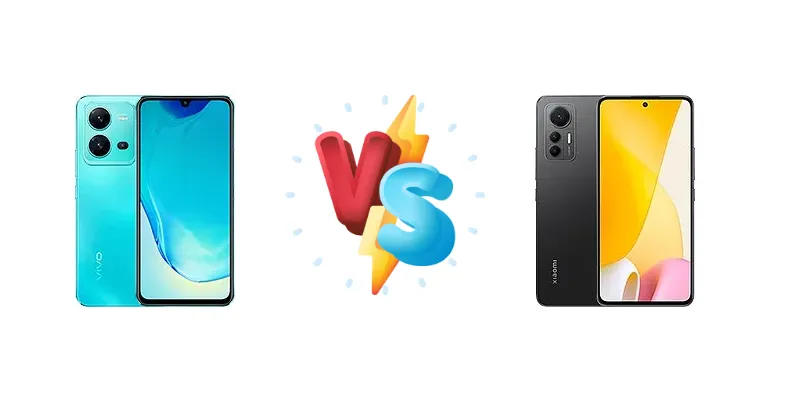
The Xiaomi 12 Lite and vivo V25 both target the competitive mid-range smartphone market, offering a blend of style and functionality. However, they approach this segment with different strengths. The Xiaomi 12 Lite prioritizes rapid charging and a slightly brighter display, while the vivo V25 focuses on a balanced chipset and respectable endurance. This comparison dives deep into the specifics to determine which device best suits your needs.
🏆 Quick Verdict
For most users, the Xiaomi 12 Lite emerges as the stronger choice. Its 67W charging, capable of reaching 50% in just 13 minutes, significantly outperforms the vivo V25’s 44W charging. While the vivo V25 offers a comparable chipset, the Xiaomi’s faster charging and slightly brighter display provide a more compelling overall experience.
| Network |
|---|
| 2G bands | GSM 850 / 900 / 1800 / 1900 | GSM 850 / 900 / 1800 / 1900 |
| 3G bands | HSDPA 850 / 900 / 1900 / 2100 | HSDPA 850 / 900 / 1700(AWS) / 1900 / 2100 |
| 4G bands | 1, 3, 5, 8, 38, 40, 41 | 1, 2, 3, 4, 5, 7, 8, 12, 13, 17, 18, 19, 20, 26, 28, 32, 38, 40, 41, 42, 48, 66 |
| 5G bands | 1, 3, 41, 77, 78 SA/NSA | 1, 3, 5, 7, 8, 20, 28, 38, 40, 41, 66, 77, 78 SA/NSA |
| Speed | HSPA, LTE, 5G | HSPA, LTE, 5G |
| Technology | GSM / HSPA / LTE / 5G | GSM / HSPA / LTE / 5G |
| Launch |
|---|
| Announced | 2022, August 17 | 2022, July 09 |
| Status | Available. Released 2022, September 21 | Available. Released 2022, July 11 |
| Body |
|---|
| Build | Glass front, glass back | Glass front (Gorilla Glass 5), glass back, plastic frame |
| Dimensions | 159.2 x 74.2 x 7.8 mm (6.27 x 2.92 x 0.31 in) | 159.3 x 73.7 x 7.3 mm (6.27 x 2.90 x 0.29 in) |
| SIM | Nano-SIM + Nano-SIM | Nano-SIM + Nano-SIM |
| Weight | 186 g (6.56 oz) | 173 g (6.10 oz) |
| | Color changing back panel color | - |
| Display |
|---|
| Protection | - | Corning Gorilla Glass 5 |
| Resolution | 1080 x 2404 pixels, 20:9 ratio (~409 ppi density) | 1080 x 2400 pixels, 20:9 ratio (~402 ppi density) |
| Size | 6.44 inches, 100.0 cm2 (~84.7% screen-to-body ratio) | 6.55 inches, 103.6 cm2 (~88.2% screen-to-body ratio) |
| Type | AMOLED, 90Hz, HDR10+, 1300 nits (peak) | AMOLED, 68B colors, 120Hz, Dolby Vision, HDR10+, 950 nits (peak) |
| Platform |
|---|
| CPU | Octa-core (2x2.4 GHz Cortex-A78 & 6x2.0 GHz Cortex-A55) | Octa-core (1x2.4 GHz Cortex-A78 & 3x2.2 GHz Cortex-A78 & 4x1.9 GHz Cortex-A55) |
| Chipset | Mediatek Dimensity 900 (6 nm) | Qualcomm SM7325 Snapdragon 778G 5G (6 nm) |
| GPU | Mali-G68 MC4 | Adreno 642L |
| OS | Android 12, Funtouch 12 | Android 12, upgradable to Android 14, HyperOS |
| Memory |
|---|
| Card slot | microSDXC (uses shared SIM slot) | No |
| Internal | 128GB 8GB RAM, 256GB 8GB RAM, 256GB 12GB RAM | 128GB 6GB RAM, 128GB 8GB RAM, 256GB 8GB RAM |
| | - | UFS 2.2 |
| Main Camera |
|---|
| Features | LED flash, HDR, panorama | Dual-LED dual-tone flash, HDR, panorama |
| Single | 50 MP, f/2.0, (wide), AF | 32 MP, f/2.5, (wide), 1/2.8", 0.8µm, AF |
| Triple | 64 MP, f/1.8, (wide), 0.7µm, PDAF, OIS
8 MP, f/2.2, 16mm, 120˚ (ultrawide), 1/4.0", 1.12µm
2 MP (macro) | 108 MP, f/1.9, 26mm (wide), 1/1.52", 0.7µm, PDAF
8 MP, f/2.2, 120˚ (ultrawide), 1/4.0", 1.12µm
2 MP (macro) |
| Video | 4K@30fps, 1080p@30fps | 4K@30fps, 1080p@30/60/120fps; gyro-EIS |
| Selfie camera |
|---|
| Features | HDR | HDR, panorama |
| Single | 50 MP, f/2.0, (wide), AF | 32 MP, f/2.5, (wide), 1/2.8", 0.8µm, AF |
| Video | 4K@30fps, 1080p@30fps, HDR | 1080p@30/60fps, 720p@120fps |
| Sound |
|---|
| 3.5mm jack | No | No |
| 35mm jack | No | No |
| Loudspeaker | Yes | Yes, with dual speakers |
| | 24-bit/192kHz audio | 24-bit/192kHz audio |
| Comms |
|---|
| Bluetooth | 5.2, A2DP, LE | 5.2, A2DP, LE, aptX HD, aptX Adaptive |
| Infrared port | - | Yes |
| NFC | Yes (market/region dependent) | Yes (market/region dependent) |
| Positioning | GPS, GLONASS, BDS, GALILEO, QZSS, NavIC | GPS (L1), GLONASS (G1), BDS (B1I+B1c), GALILEO (E1), QZSS (L1) |
| Radio | No | No |
| USB | USB Type-C 2.0, OTG | USB Type-C 2.0, OTG |
| WLAN | Wi-Fi 802.11 a/b/g/n/ac, dual-band, Wi-Fi Direct | Wi-Fi 802.11 a/b/g/n/ac/6, dual-band, Wi-Fi Direct |
| Features |
|---|
| Sensors | Fingerprint (under display, optical), accelerometer, gyro, proximity, compass | Fingerprint (under display, optical), accelerometer, gyro, compass |
| | - | Virtual proximity sensing |
| Battery |
|---|
| Charging | 44W wired, 61% in 30 min | 67W wired, PD3.0, QC4, 50% in 13 min |
| Type | 4500 mAh | Li-Po 4300 mAh |
| Misc |
|---|
| Colors | Elegant Black, Sunrise Gold, Surfing Blue | Black, Lite Green, Lite Pink |
| Models | V2202 | 2203129G |
| Price | About 350 EUR | € 119.80 / $ 269.00 / £ 121.15 |
| SAR | 0.94 W/kg (head) 1.24 W/kg (body) | 1.09 W/kg (head) 0.73 W/kg (body) |
| SAR EU | - | 0.60 W/kg (head) 1.00 W/kg (body) |
| Tests |
|---|
| Battery life |
Endurance rating 120h
|
Endurance rating 100h
|
| Camera |
Photo / Video |
Photo / Video |
| Display |
Contrast ratio: Infinite (nominal) |
Contrast ratio: Infinite (nominal) |
| Loudspeaker |
-28.3 LUFS (Average)
|
-25.2 LUFS (Very good)
|
| Performance |
AnTuTu: 461428 (v9)
GeekBench: 2023 (v5.1)
GFXBench: 21fps (ES 3.1 onscreen) |
AnTuTu: 528905 (v9)
GeekBench: 2943 (v5.1)
GFXBench: 29fps (ES 3.1 onscreen) |
vivo V25
- Longer battery endurance (120h rating)
- Balanced chipset for everyday tasks
- Slightly more subtle design (subjective)
- Slower charging speed (44W)
- Lower peak display brightness
Xiaomi 12 Lite
- Significantly faster charging (67W, 50% in 13 min)
- Brighter display for outdoor visibility
- Potentially stronger GPU performance
- Shorter battery endurance (100h rating)
- May run slightly warmer under sustained load
Display Comparison
Both the vivo V25 and Xiaomi 12 Lite feature displays with an 'Infinite' contrast ratio, suggesting deep blacks. However, the Xiaomi 12 Lite boasts a measured peak brightness of 824 nits, exceeding the vivo V25’s 781 nits. This difference translates to better visibility in direct sunlight. While both likely employ AMOLED panels (implied by the contrast ratio), neither specification details refresh rate or PWM dimming frequency, crucial factors for visual comfort. The Xiaomi’s higher brightness is a clear advantage for outdoor use.
Camera Comparison
Both phones are listed as having 'Photo / Video' capabilities, offering minimal insight. Without sensor size or megapixel counts, a detailed camera comparison is impossible. However, the Xiaomi 12 Lite’s Snapdragon 778G ISP generally offers more advanced image processing capabilities than the Dimensity 900’s ISP. The absence of any mention of OIS (Optical Image Stabilization) on either device suggests reliance on digital stabilization, potentially impacting low-light video quality. Focusing on the chipset’s image signal processing capabilities is the most reasonable approach given the limited data.
Performance
The Xiaomi 12 Lite is equipped with the Qualcomm SM7325 Snapdragon 778G 5G, featuring an octa-core CPU configuration with a prime Cortex-A78 core clocked at 2.4 GHz, alongside three additional Cortex-A78 cores at 2.2 GHz and four Cortex-A55 cores at 1.9 GHz. The vivo V25 utilizes the Mediatek Dimensity 900, also an octa-core chip, but with a dual-A78 setup at 2.4 GHz and six A55 cores at 2.0 GHz. The Xiaomi’s inclusion of *three* higher-performance A78 cores suggests a potential edge in multi-threaded tasks and sustained performance, despite similar peak clock speeds. Both chips are fabricated on a 6nm process, indicating comparable efficiency, but the Snapdragon 778G is generally regarded as having a slightly stronger GPU.
Battery Life
The vivo V25 claims an endurance rating of 120 hours, while the Xiaomi 12 Lite manages 100 hours. This suggests the vivo V25 offers better overall battery life, despite having a similar capacity (not specified in the data). However, the Xiaomi 12 Lite’s 67W charging with PD3.0 and QC4 support dramatically reduces downtime, achieving 50% charge in just 13 minutes. The vivo V25’s 44W charging takes 30 minutes to reach 61%. This charging speed disparity is a significant advantage for the Xiaomi, effectively mitigating any endurance difference.
Buying Guide
Buy the vivo V25 if you prioritize a balanced chipset and a consistently smooth experience over outright speed and charging convenience. It’s a solid all-rounder for everyday tasks and moderate gaming. Buy the Xiaomi 12 Lite if you value fast charging above all else, frequently find yourself needing to top up quickly, and appreciate a slightly brighter screen for outdoor visibility. It’s ideal for users on the go.
Frequently Asked Questions
❓ Does the Dimensity 900 in the vivo V25 struggle with demanding games like Genshin Impact?
The Dimensity 900 is a capable chipset, but Genshin Impact is notoriously demanding. Expect to play at medium settings with moderate frame rates. The Xiaomi 12 Lite’s Snapdragon 778G may offer slightly better sustained performance due to its more robust GPU and potentially better thermal management, but neither phone is a dedicated gaming device.
❓ How much of a difference will the 67W charging on the Xiaomi 12 Lite make in daily use?
The difference is substantial. Being able to add 50% charge in just 13 minutes is a game-changer for users who frequently forget to charge overnight or need a quick top-up before heading out. The vivo V25’s 44W charging, while respectable, feels significantly slower in comparison.
❓ Are there any significant differences in the software experience between vivo’s Funtouch OS and Xiaomi’s MIUI?
Yes. Funtouch OS is generally considered to be more visually distinct and offers a wider range of customization options, while MIUI is known for its feature-richness and extensive ecosystem integration. Both have improved significantly over the years, but MIUI is often criticized for pre-installed bloatware, which may or may not be present on the 12 Lite depending on the region.