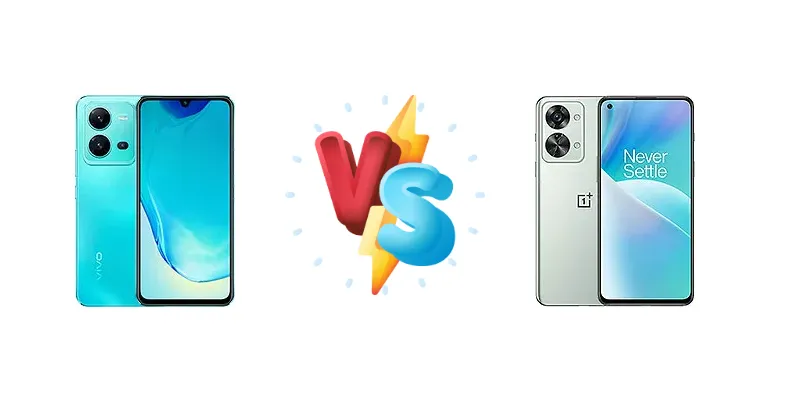
The mid-range smartphone market is fiercely competitive, and the OnePlus Nord 2T and vivo V25 represent compelling options. While both devices aim for a balance of features and affordability, they take different approaches. The Nord 2T prioritizes charging speed and raw processing power, while the V25 focuses on a more balanced experience with a slightly longer-lasting battery. This comparison will dissect their key differences to help you choose the right phone.
🏆 Quick Verdict
For most users, the OnePlus Nord 2T emerges as the stronger choice. Its Dimensity 1300 chipset delivers noticeably better performance, and the 80W SuperVOOC charging is a game-changer, significantly reducing downtime. While the vivo V25 boasts slightly better battery endurance, the Nord 2T’s speed advantage is more impactful for daily use.
| Network |
|---|
| 2G bands | GSM 850 / 900 / 1800 / 1900 | GSM 850 / 900 / 1800 / 1900 |
| 3G bands | HSDPA 850 / 900 / 1900 / 2100 | HSDPA 800 / 850 / 900 / 1700(AWS) / 1800 / 1900 / 2100 |
| 4G bands | 1, 3, 5, 8, 38, 40, 41 | 1, 2, 3, 4, 5, 7, 8, 12, 17, 18, 19, 20, 26, 28, 32, 34, 38, 39, 40, 41, 66 |
| 5G bands | 1, 3, 41, 77, 78 SA/NSA | 1, 3, 7, 8, 20, 28, 38, 41, 78 SA/NSA |
| Speed | HSPA, LTE, 5G | HSPA 42.2/5.76 Mbps, LTE Cat18 1200/150 Mbps, 5G |
| Technology | GSM / HSPA / LTE / 5G | GSM / HSPA / LTE / 5G |
| Launch |
|---|
| Announced | 2022, August 17 | 2022, May 19 |
| Status | Available. Released 2022, September 21 | Available. Released 2022, May 21 |
| Body |
|---|
| Build | Glass front, glass back | Glass front (Gorilla Glass 5), plastic frame |
| Dimensions | 159.2 x 74.2 x 7.8 mm (6.27 x 2.92 x 0.31 in) | 159.1 x 73.2 x 8.2 mm (6.26 x 2.88 x 0.32 in) |
| SIM | Nano-SIM + Nano-SIM | Nano-SIM + Nano-SIM |
| Weight | 186 g (6.56 oz) | 190 g (6.70 oz) |
| | Color changing back panel color | - |
| Display |
|---|
| Protection | - | Corning Gorilla Glass 5 |
| Resolution | 1080 x 2404 pixels, 20:9 ratio (~409 ppi density) | 1080 x 2400 pixels, 20:9 ratio (~409 ppi density) |
| Size | 6.44 inches, 100.0 cm2 (~84.7% screen-to-body ratio) | 6.43 inches, 99.8 cm2 (~85.7% screen-to-body ratio) |
| Type | AMOLED, 90Hz, HDR10+, 1300 nits (peak) | AMOLED, 90Hz, HDR10+ |
| Platform |
|---|
| CPU | Octa-core (2x2.4 GHz Cortex-A78 & 6x2.0 GHz Cortex-A55) | Octa-core (1x3.0 GHz Cortex-A78 & 3x2.6 GHz Cortex-A78 & 4x2.0 GHz Cortex-A55) |
| Chipset | Mediatek Dimensity 900 (6 nm) | Mediatek Dimensity 1300 (6 nm) |
| GPU | Mali-G68 MC4 | Mali-G77 MC9 |
| OS | Android 12, Funtouch 12 | Android 12, upgradable to Android 14, OxygenOS 14 |
| Memory |
|---|
| Card slot | microSDXC (uses shared SIM slot) | No |
| Internal | 128GB 8GB RAM, 256GB 8GB RAM, 256GB 12GB RAM | 128GB 8GB RAM, 256GB 12GB RAM |
| | - | UFS 3.1 |
| Main Camera |
|---|
| Features | LED flash, HDR, panorama | Dual-LED flash, HDR, panorama |
| Single | 50 MP, f/2.0, (wide), AF | 32 MP, f/2.4, (wide), 1/2.8", 0.8µm |
| Triple | 64 MP, f/1.8, (wide), 0.7µm, PDAF, OIS
8 MP, f/2.2, 16mm, 120˚ (ultrawide), 1/4.0", 1.12µm
2 MP (macro) | 50 MP, f/1.9, 24mm (wide), 1/1.56", 1.0µm, PDAF, OIS
8 MP, f/2.2, 120˚ (ultrawide)
Auxiliary lens |
| Video | 4K@30fps, 1080p@30fps | 4K@30fps, 1080p@30/60/120/480fps, gyro-EIS |
| Selfie camera |
|---|
| Features | HDR | Auto HDR |
| Single | 50 MP, f/2.0, (wide), AF | 32 MP, f/2.4, (wide), 1/2.8", 0.8µm |
| Video | 4K@30fps, 1080p@30fps, HDR | 1080p@30fps, gyro-EIS |
| Sound |
|---|
| 3.5mm jack | No | No |
| 35mm jack | No | No |
| Loudspeaker | Yes | Yes, with stereo speakers |
| | 24-bit/192kHz audio | - |
| Comms |
|---|
| Bluetooth | 5.2, A2DP, LE | 5.2, A2DP, LE, aptX HD |
| NFC | Yes (market/region dependent) | Yes |
| Positioning | GPS, GLONASS, BDS, GALILEO, QZSS, NavIC | GPS, GLONASS, GALILEO, BDS, NavIC |
| Radio | No | No |
| USB | USB Type-C 2.0, OTG | USB Type-C 2.0, OTG |
| WLAN | Wi-Fi 802.11 a/b/g/n/ac, dual-band, Wi-Fi Direct | Wi-Fi 802.11 a/b/g/n/ac/6, dual-band, Wi-Fi Direct |
| Features |
|---|
| Sensors | Fingerprint (under display, optical), accelerometer, gyro, proximity, compass | Fingerprint (under display, optical), accelerometer, gyro, proximity, compass |
| Battery |
|---|
| Charging | 44W wired, 61% in 30 min | 80W wired, PD |
| Type | 4500 mAh | Li-Po 4500 mAh |
| Misc |
|---|
| Colors | Elegant Black, Sunrise Gold, Surfing Blue | Gray Shadow, Jade Fog |
| Models | V2202 | CPH2399, CPH2401 |
| Price | About 350 EUR | € 144.39 / $ 169.99 / ₹ 31,490 |
| SAR | 0.94 W/kg (head) 1.24 W/kg (body) | - |
| Tests |
|---|
| Battery life |
Endurance rating 120h
|
Endurance rating 100h
|
| Camera |
Photo / Video |
Photo / Video |
| Display |
Contrast ratio: Infinite (nominal) |
Contrast ratio: Infinite (nominal) |
| Loudspeaker |
-28.3 LUFS (Average)
|
-25.6 LUFS (Very good)
|
| Performance |
AnTuTu: 461428 (v9)
GeekBench: 2023 (v5.1)
GFXBench: 21fps (ES 3.1 onscreen) |
AnTuTu: 490545 (v8) | 604467 (v9)
GeekBench: 2790 (v5.1)
GFXBench: 40fps (ES 3.1 onscreen) |
vivo V25
- Brighter display for better outdoor visibility
- Slightly longer battery endurance rating
- Potentially more refined color science (vivo's strength)
- Less powerful chipset for demanding tasks
- Slower 44W charging compared to the Nord 2T
OnePlus Nord 2T
- Faster Dimensity 1300 chipset for smoother performance
- 80W SuperVOOC charging for incredibly fast top-ups
- More responsive user experience
- Dimmer display compared to the vivo V25
- Slightly shorter battery endurance rating
Display Comparison
The vivo V25 boasts a brighter display, reaching a measured 781 nits compared to the Nord 2T’s 636 nits. This translates to better visibility outdoors under direct sunlight. Both displays share an 'Infinite' (nominal) contrast ratio, suggesting deep blacks typical of OLED panels. However, the difference in peak brightness is substantial, making the V25 more comfortable to use in bright environments. While both likely employ similar PWM dimming rates (data unavailable), the V25’s higher brightness could potentially mitigate flicker perception for some users.
Camera Comparison
Both phones feature capable camera systems, but detailed sensor information is lacking. Assuming similar primary sensor resolutions, the image processing algorithms will likely be the key differentiator. The Nord 2T’s more powerful chipset could enable faster image processing and potentially better low-light performance. Without specific details on sensor size and aperture, it’s difficult to definitively declare a winner. The inclusion of OIS (Optical Image Stabilization) on either device would be a significant advantage for video recording and low-light photography, but this information is not provided.
Performance
The OnePlus Nord 2T’s Mediatek Dimensity 1300 chipset represents a significant upgrade over the vivo V25’s Dimensity 900. The Nord 2T features a faster prime core (3.0 GHz Cortex-A78 vs 2.4 GHz) and an additional high-performance core (3x 2.6 GHz Cortex-A78), resulting in a more responsive experience, particularly in demanding tasks. While both chips are built on a 6nm process, the architectural improvements in the Dimensity 1300 provide a clear performance advantage. The Nord 2T is better suited for sustained gaming and heavy multitasking.
Battery Life
The vivo V25 holds a slight edge in battery endurance, achieving a 120-hour rating compared to the Nord 2T’s 100-hour rating. However, this difference is partially offset by the Nord 2T’s significantly faster 80W charging. The Nord 2T can reach 61% charge in just 30 minutes, while the V25’s 44W charging is considerably slower. This means the Nord 2T can quickly recover from heavy usage, minimizing downtime. The faster charging effectively mitigates the slightly smaller battery capacity.
Buying Guide
Buy the vivo V25 if you prioritize maximizing battery life and prefer a more subtle, balanced feature set. It’s ideal for users who don’t heavily game or require the absolute fastest charging speeds. Buy the OnePlus Nord 2T if you demand quicker performance for multitasking and gaming, and value the convenience of incredibly fast 80W charging. This phone is geared towards power users and those who frequently find themselves needing a quick top-up.
Frequently Asked Questions
❓ Does the Dimensity 1300 in the Nord 2T get noticeably warmer during extended gaming sessions compared to the Dimensity 900 in the V25?
While both chips are 6nm, the Dimensity 1300's higher performance ceiling means it *can* generate more heat under sustained load. However, OnePlus typically employs effective thermal management solutions, and the Nord 2T's larger surface area may help dissipate heat. Expect some warming, but likely not to the point of significant throttling.
❓ Is the 80W charging on the Nord 2T compatible with Power Delivery (PD) chargers, or is a proprietary charger required?
Yes, the Nord 2T's 80W charging supports the Power Delivery (PD) standard, but to achieve the full 80W speed, you'll need a PD charger specifically rated for that wattage. Using a lower-wattage PD charger will still charge the phone, but at a slower rate.
❓ Given the battery endurance ratings, how much real-world usage difference can I expect between the two phones?
The 20-hour difference in endurance ratings translates to roughly an extra hour or two of typical usage per day. However, the Nord 2T’s 80W charging allows you to quickly replenish the battery, minimizing the impact of the slightly lower endurance. For heavy users, the Nord 2T’s charging speed is more valuable than the V25’s slightly longer runtime.