
OnePlus Nord 2 5G vs. vivo V23e: A Deep Dive into Mid-Range Contenders
| Phones Images | |||||
|---|---|---|---|---|---|
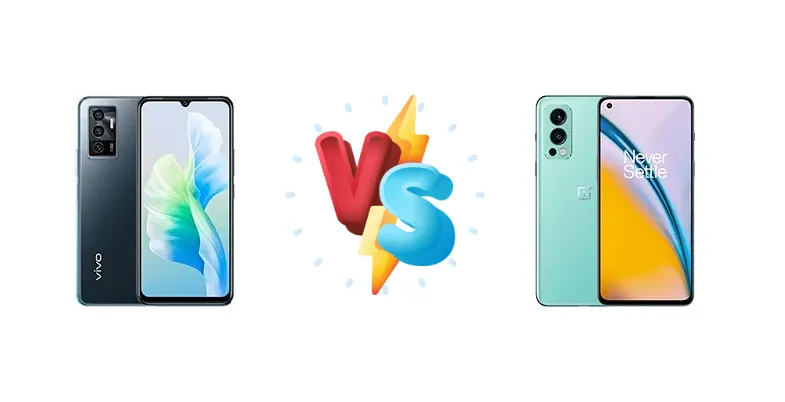
|
🏆 Quick Verdict
For most users, the OnePlus Nord 2 5G emerges as the superior choice. Its Mediatek Dimensity 1200 chipset delivers substantially faster processing power and a more responsive experience, justifying the slight price premium. While the V23e offers respectable performance for everyday tasks, the Nord 2 is the clear winner for demanding users and gamers.
| PHONES | ||
|---|---|---|
| Phone Names | vivo V23e | OnePlus Nord 2 5G |
| Network | ||
|---|---|---|
| 2G bands | GSM 850 / 900 / 1800 / 1900 | GSM 850 / 900 / 1800 / 1900 |
| 3G bands | HSDPA 850 / 900 / 2100 | HSDPA 800 / 850 / 900 / 1700(AWS) / 1800 / 1900 / 2100 |
| 4G bands | 1, 3, 5, 7, 8, 18, 19, 20, 26, 28, 38, 39, 40, 41 | 1, 2, 3, 4, 5, 7, 8, 12, 17, 18, 19, 20, 26, 28, 32, 34, 38, 39, 40, 41, 66 - EU |
| 5G bands | - | 1, 3, 7, 8, 20, 28, 38, 41, 66, 78 SA/NSA - EU |
| Speed | HSPA, LTE | HSPA 42.2/5.76 Mbps, LTE Cat18 1200/150 Mbps, 5G |
| Technology | GSM / CDMA / HSPA / LTE | GSM / HSPA / LTE / 5G |
| CDMA 800 | - | |
| Launch | ||
|---|---|---|
| Announced | 2021, November 09 | 2021, July 22 |
| Status | Available. Released 2021, November 09 | Available. Released 2021, July 28 |
| Body | ||
|---|---|---|
| Build | - | Glass front (Gorilla Glass 5), glass back (Gorilla Glass 5), plastic frame |
| Dimensions | 160.9 x 74.3 x 7.4 mm (6.33 x 2.93 x 0.29 in) | 159.1 x 73.3 x 8.3 mm (6.26 x 2.89 x 0.33 in) |
| SIM | Nano-SIM + Nano-SIM | Nano-SIM + Nano-SIM |
| Weight | 172 g (6.07 oz) | 189 g (6.67 oz) |
| Display | ||
|---|---|---|
| Protection | - | Corning Gorilla Glass 5 |
| Resolution | 1080 x 2400 pixels, 20:9 ratio (~409 ppi density) | 1080 x 2400 pixels, 20:9 ratio (~409 ppi density) |
| Size | 6.44 inches, 100.1 cm2 (~83.8% screen-to-body ratio) | 6.43 inches, 99.8 cm2 (~85.6% screen-to-body ratio) |
| Type | AMOLED | Fluid AMOLED, 90Hz, HDR10+ |
| Platform | ||
|---|---|---|
| CPU | Octa-core (2x2.05 GHz Cortex-A76 & 6x2.0 GHz Cortex-A55) | Octa-core (1x3.0 GHz Cortex-A78 & 3x2.6 GHz Cortex-A78 & 4x2.0 GHz Cortex-A55) |
| Chipset | Mediatek MT6781 Helio G96 (12 nm) | Mediatek Dimensity 1200 (6 nm) |
| GPU | Mali-G57 MC2 | Mali-G77 MC9 |
| OS | Android 11, Funtouch 12 | Android 11, upgradable to Android 13, OxygenOS 13 |
| Memory | ||
|---|---|---|
| Card slot | microSDXC (uses shared SIM slot) | No |
| Internal | 128GB 8GB RAM, 256GB 8GB RAM | 128GB 6GB RAM, 128GB 8GB RAM, 256GB 8GB RAM, 256GB 12GB RAM |
| Main Camera | ||
|---|---|---|
| Features | Dual-LED dual-tone flash, HDR, panorama | Dual-LED flash, HDR, panorama |
| Single | 50 MP, f/2.0, (wide), AF | - |
| Triple | 64 MP, f/1.8, 26mm (wide), PDAF 8 MP, f/2.2, 120˚, 16mm (ultrawide), 1/4.0", 1.12µm 2 MP (macro) | 50 MP, f/1.9, 24mm (wide), 1/1.56", 1.0µm, PDAF, OIS 8 MP, f/2.3, 120˚ (ultrawide) Auxiliary lens |
| Video | 4K@30fps, 1080p@30fps, gyro-EIS | 4K@30fps, 1080p@30/60/120fps, gyro-EIS |
| Selfie camera | ||
|---|---|---|
| Features | HDR | Auto HDR |
| Single | 50 MP, f/2.0, (wide), AF | 32 MP, f/2.5, (wide), 1/2.8", 0.8µm |
| Video | 4K@30fps, 1080p@30fps | 1080p@30fps, gyro-EIS |
| Sound | ||
|---|---|---|
| 3.5mm jack | No | No |
| 35mm jack | No | No |
| Loudspeaker | Yes | Yes, with stereo speakers |
| 24-bit/192kHz audio | - | |
| Comms | ||
|---|---|---|
| Bluetooth | 5.2, A2DP, LE, aptX HD | 5.2, A2DP, LE, aptX HD |
| NFC | No | Yes |
| Positioning | GPS, GLONASS, GALILEO, BDS | GPS, GLONASS, GALILEO, BDS, SBAS, NavIC |
| Radio | No | No |
| USB | USB Type-C, OTG | USB Type-C 2.0, OTG |
| WLAN | Wi-Fi 802.11 a/b/g/n/ac, dual-band, Wi-Fi Direct | Wi-Fi 802.11 a/b/g/n/ac/6, dual-band, Wi-Fi Direct |
| Features | ||
|---|---|---|
| Sensors | Fingerprint (under display, optical), accelerometer, gyro, proximity, compass | Fingerprint (under display, optical), accelerometer, gyro, proximity, compass |
| Battery | ||
|---|---|---|
| Charging | 44W wired, 69% in 30 min | 65W wired, PD, 100% in 30 min |
| Type | 4050 mAh | Li-Po 4500 mAh |
| Misc | ||
|---|---|---|
| Colors | Black, Aurora | Gray Sierra, Blue Haze, Green Wood, Pac-Man Edition |
| Models | - | DN2101, DN2103 |
| Price | About 330 EUR | € 189.00 / $ 219.99 / £ 148.00 |
| Tests | ||
|---|---|---|
| Battery life | - | Endurance rating 102h |
| Camera | - | Photo / Video |
| Display | - | Contrast ratio: Infinite (nominal) |
| Loudspeaker | - | -24.3 LUFS (Very good) |
| Performance | - | AnTuTu: 512164 (v8) | 598022 (v9) GeekBench: 2792 (v5.1) GFXBench: 38fps (ES 3.1 onscreen) |
vivo V23e
- Sleek and lightweight design
- Respectable performance for everyday tasks
- 44W fast charging
- Less powerful chipset compared to the Nord 2 5G
- Potentially limited gaming performance
- Less advanced ISP for camera processing
OnePlus Nord 2 5G
- Powerful Mediatek Dimensity 1200 chipset
- 65W SuperVOOC charging for rapid top-ups
- Superior gaming performance and multitasking
- May be slightly more expensive than the V23e
- Design may be less visually striking to some
- No official IP rating for water/dust resistance
Display Comparison
The provided data only gives us the peak brightness of the OnePlus Nord 2 5G at 633 nits. While respectable, this figure doesn't tell the whole story. Without comparable data for the V23e, it's difficult to definitively declare a winner. However, OnePlus typically employs high-quality AMOLED panels with excellent color accuracy. Both devices likely feature similar resolutions, but the Nord 2’s potentially superior panel quality and brightness will provide a more vibrant viewing experience, especially outdoors. The 'Infinite' contrast ratio on the Nord 2 is a typical marketing claim for AMOLED displays.
Camera Comparison
Both phones offer photo and video capabilities, but the specifics are lacking. Without sensor size or aperture information, a detailed comparison is limited. However, the chipset plays a role; the Dimensity 1200’s ISP (Image Signal Processor) is more advanced, enabling faster image processing and potentially better low-light performance on the Nord 2 5G. The V23e likely relies on software processing to compensate for a potentially less capable ISP. We can assume both phones will include standard features like HDR and portrait modes, but the Nord 2 is likely to deliver more detailed and dynamic images.
Performance
This is where the Nord 2 5G truly shines. The Mediatek Dimensity 1200, built on a 6nm process, is a significant leap ahead of the V23e’s Helio G96 (12nm). The Dimensity 1200’s octa-core configuration, featuring a prime Cortex-A78 core clocked at 3.0 GHz, alongside three additional A78 cores at 2.6 GHz, provides substantially more processing power than the V23e’s dual A76 cores at 2.05 GHz. This translates to faster app loading times, smoother multitasking, and a far superior gaming experience. The 6nm node also contributes to better thermal efficiency, reducing the likelihood of throttling during sustained workloads. The V23e’s Helio G96 is adequate for everyday tasks, but will struggle with demanding games and applications.
Battery Life
Both devices boast an endurance rating of 102 hours, suggesting similar real-world battery life despite differing internal capacities (not provided). However, the charging speeds are a key differentiator. The Nord 2 5G’s 65W wired charging with PD support can fully charge the device in 30 minutes, while the V23e’s 44W charging reaches 69% in the same timeframe. This means the Nord 2 5G offers significantly faster top-ups, a crucial advantage for users who frequently need to recharge quickly.
Buying Guide
Buy the vivo V23e if you prioritize a sleek design and are primarily focused on social media, light web browsing, and casual photography. It’s a solid option for users who don’t push their phones to the limit. Buy the OnePlus Nord 2 5G if you value performance, gaming capabilities, and faster charging. It’s the better choice for power users, mobile gamers, and those who want a phone that will remain responsive for years to come.