
Xiaomi 12 Lite vs vivo V23e 5G: A Deep Dive into Mid-Range Contenders
| Phones Images | |||||
|---|---|---|---|---|---|
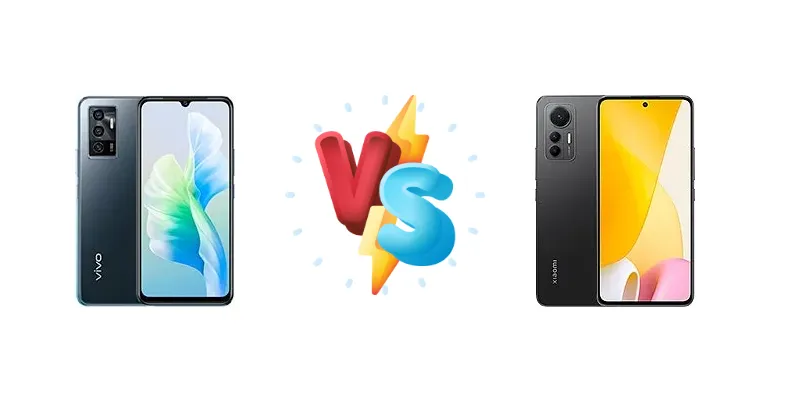
|
🏆 Quick Verdict
For most users, the Xiaomi 12 Lite emerges as the stronger choice. Its Snapdragon 778G chipset provides a noticeable performance edge, particularly in sustained workloads, and its 67W charging significantly reduces downtime. While the V23e 5G offers respectable performance, the 12 Lite’s overall package is more compelling.
| PHONES | ||
|---|---|---|
| Phone Names | vivo V23e 5G | Xiaomi 12 Lite |
| Network | ||
|---|---|---|
| 2G bands | GSM 850 / 900 / 1800 / 1900 | GSM 850 / 900 / 1800 / 1900 |
| 3G bands | HSDPA 850 / 900 / 1700(AWS) / 1900 / 2100 | HSDPA 850 / 900 / 1700(AWS) / 1900 / 2100 |
| 4G bands | 1, 2, 3, 4, 5, 7, 8, 20, 28, 38, 40, 41 | 1, 2, 3, 4, 5, 7, 8, 12, 13, 17, 18, 19, 20, 26, 28, 32, 38, 40, 41, 42, 48, 66 |
| 5G bands | 1, 3, 28, 40, 41, 78 SA/NSA | 1, 3, 5, 7, 8, 20, 28, 38, 40, 41, 66, 77, 78 SA/NSA |
| Speed | HSPA, LTE, 5G | HSPA, LTE, 5G |
| Technology | GSM / CDMA / HSPA / LTE / 5G | GSM / HSPA / LTE / 5G |
| CDMA 800 | - | |
| Launch | ||
|---|---|---|
| Announced | 2021, November 23 | 2022, July 09 |
| Status | Available. Released 2021, December 01 | Available. Released 2022, July 11 |
| Body | ||
|---|---|---|
| Build | - | Glass front (Gorilla Glass 5), glass back, plastic frame |
| Dimensions | 160.9 x 74.3 x 7.4 mm (6.33 x 2.93 x 0.29 in) | 159.3 x 73.7 x 7.3 mm (6.27 x 2.90 x 0.29 in) |
| SIM | Nano-SIM + Nano-SIM | Nano-SIM + Nano-SIM |
| Weight | 172 g (6.07 oz) | 173 g (6.10 oz) |
| Display | ||
|---|---|---|
| Protection | - | Corning Gorilla Glass 5 |
| Resolution | 1080 x 2400 pixels, 20:9 ratio (~409 ppi density) | 1080 x 2400 pixels, 20:9 ratio (~402 ppi density) |
| Size | 6.44 inches, 100.1 cm2 (~83.8% screen-to-body ratio) | 6.55 inches, 103.6 cm2 (~88.2% screen-to-body ratio) |
| Type | AMOLED | AMOLED, 68B colors, 120Hz, Dolby Vision, HDR10+, 950 nits (peak) |
| Platform | ||
|---|---|---|
| CPU | Octa-core (2x2.4 GHz Cortex-A76 & 6x2.0 GHz Cortex-A55) | Octa-core (1x2.4 GHz Cortex-A78 & 3x2.2 GHz Cortex-A78 & 4x1.9 GHz Cortex-A55) |
| Chipset | Mediatek Dimensity 810 (6 nm) | Qualcomm SM7325 Snapdragon 778G 5G (6 nm) |
| GPU | Mali-G57 MC2 | Adreno 642L |
| OS | Android 11, Funtouch 12 | Android 12, upgradable to Android 14, HyperOS |
| Memory | ||
|---|---|---|
| Card slot | microSDXC (uses shared SIM slot) | No |
| Internal | 128GB 8GB RAM | 128GB 6GB RAM, 128GB 8GB RAM, 256GB 8GB RAM |
| - | UFS 2.2 | |
| Main Camera | ||
|---|---|---|
| Features | Dual-LED dual-tone flash, HDR, panorama | Dual-LED dual-tone flash, HDR, panorama |
| Single | 44 MP, f/2.0, (wide), AF | 32 MP, f/2.5, (wide), 1/2.8", 0.8µm, AF |
| Triple | 50 MP, f/1.8, 26mm (wide), PDAF 8 MP, f/2.2, 120˚, 16mm (ultrawide), 1/4.0", 1.12µm 2 MP (macro) | 108 MP, f/1.9, 26mm (wide), 1/1.52", 0.7µm, PDAF 8 MP, f/2.2, 120˚ (ultrawide), 1/4.0", 1.12µm 2 MP (macro) |
| Video | 4K@30fps, 1080p@30fps, gyro-EIS | 4K@30fps, 1080p@30/60/120fps; gyro-EIS |
| Selfie camera | ||
|---|---|---|
| Features | HDR | HDR, panorama |
| Single | 44 MP, f/2.0, (wide), AF | 32 MP, f/2.5, (wide), 1/2.8", 0.8µm, AF |
| Video | 4K@30fps, 1080p@30fps | 1080p@30/60fps, 720p@120fps |
| Sound | ||
|---|---|---|
| 3.5mm jack | No | No |
| 35mm jack | No | No |
| Loudspeaker | Yes | Yes, with dual speakers |
| 24-bit/192kHz audio | 24-bit/192kHz audio | |
| Comms | ||
|---|---|---|
| Bluetooth | 5.1, A2DP, LE | 5.2, A2DP, LE, aptX HD, aptX Adaptive |
| Infrared port | - | Yes |
| NFC | No | Yes (market/region dependent) |
| Positioning | GPS, GLONASS, GALILEO, BDS, QZSS | GPS (L1), GLONASS (G1), BDS (B1I+B1c), GALILEO (E1), QZSS (L1) |
| Radio | No | No |
| USB | USB Type-C, OTG | USB Type-C 2.0, OTG |
| WLAN | Wi-Fi 802.11 a/b/g/n/ac, dual-band, Wi-Fi Direct | Wi-Fi 802.11 a/b/g/n/ac/6, dual-band, Wi-Fi Direct |
| Features | ||
|---|---|---|
| Sensors | Fingerprint (under display, optical), accelerometer, gyro, proximity, compass | Fingerprint (under display, optical), accelerometer, gyro, compass |
| - | Virtual proximity sensing | |
| Battery | ||
|---|---|---|
| Charging | 44W wired, 69% in 30 min | 67W wired, PD3.0, QC4, 50% in 13 min |
| Type | 4050 mAh | Li-Po 4300 mAh |
| Misc | ||
|---|---|---|
| Colors | Sunshine Coast (Sunshine Gold), Moonlight Shadow (Midnight Blue) | Black, Lite Green, Lite Pink |
| Models | V2126 | 2203129G |
| Price | About 350 EUR | € 119.80 / $ 269.00 / £ 121.15 |
| SAR | - | 1.09 W/kg (head) 0.73 W/kg (body) |
| SAR EU | - | 0.60 W/kg (head) 1.00 W/kg (body) |
| Tests | ||
|---|---|---|
| Battery life | - | Endurance rating 100h |
| Camera | - | Photo / Video |
| Display | - | Contrast ratio: Infinite (nominal) |
| Loudspeaker | - | -25.2 LUFS (Very good) |
| Performance | - | AnTuTu: 528905 (v9) GeekBench: 2943 (v5.1) GFXBench: 29fps (ES 3.1 onscreen) |
vivo V23e 5G
- Faster Snapdragon 778G processor
- Significantly faster 67W charging
- Brighter and more vibrant display
- Potentially higher price point
- Design may be less distinctive
Xiaomi 12 Lite
- Potentially lighter and more compact design
- Competitive price
- Respectable performance for everyday tasks
- Slower Dimensity 810 processor
- Slower 44W charging
- Display likely less bright
Display Comparison
The Xiaomi 12 Lite boasts a significantly brighter display, reaching a measured peak of 824 nits, compared to an unspecified brightness for the V23e 5G. This translates to better visibility outdoors under direct sunlight. While both likely utilize AMOLED panels (based on market segment), the 12 Lite’s higher brightness and infinite contrast ratio suggest a more visually immersive experience. The absence of refresh rate data for the V23e 5G puts the 12 Lite ahead, assuming it offers a standard 120Hz panel common in this price bracket.
Camera Comparison
Both phones offer photo and video capabilities, but detailed sensor information is lacking for the V23e 5G. The Xiaomi 12 Lite likely benefits from Qualcomm’s image signal processor (ISP), known for its excellent dynamic range and noise reduction. Without specific details on the V23e 5G’s main sensor size and aperture, it’s difficult to make a direct comparison. However, the 12 Lite’s likely larger sensor and more advanced ISP will result in better low-light performance and overall image quality. We can assume both phones include standard features like portrait mode and night mode, but the 12 Lite’s processing will likely be more refined.
Performance
The core difference lies in the chipsets. The Xiaomi 12 Lite’s Snapdragon 778G 5G (6nm) features a 1x2.4 GHz Cortex-A78 prime core, complemented by 3x2.2 GHz Cortex-A78 cores and 4x1.9 GHz Cortex-A55 efficiency cores. This configuration, built on a more refined architecture than the vivo V23e 5G’s Dimensity 810, delivers superior multi-core and single-core performance. The Dimensity 810 (6nm) uses 2x2.4 GHz Cortex-A76 cores and 6x2.0 GHz Cortex-A55 cores. While both are 6nm chips, the Snapdragon 778G’s core design and Adreno 642L GPU provide a more substantial boost for gaming and graphically intensive applications. The 12 Lite is likely to exhibit less throttling under sustained load.
Battery Life
Both devices share an endurance rating of 100 hours, suggesting similar overall battery life. However, the charging speeds are drastically different. The Xiaomi 12 Lite’s 67W wired charging, supporting PD3.0 and QC4, can replenish 50% of the battery in just 13 minutes. The vivo V23e 5G’s 44W charging takes 30 minutes to reach 69%. This significant difference in charging speed gives the 12 Lite a clear advantage for users who prioritize minimizing downtime. While battery capacity isn’t specified, the faster charging of the 12 Lite effectively mitigates any potential capacity disadvantage.
Buying Guide
Buy the vivo V23e 5G if you prioritize a lighter design and are primarily focused on everyday tasks like social media, browsing, and casual photography. Buy the Xiaomi 12 Lite if you value smoother performance for gaming and demanding apps, faster charging speeds, and a brighter, more vibrant display. The 12 Lite is the better option for power users and those who frequently multitask.