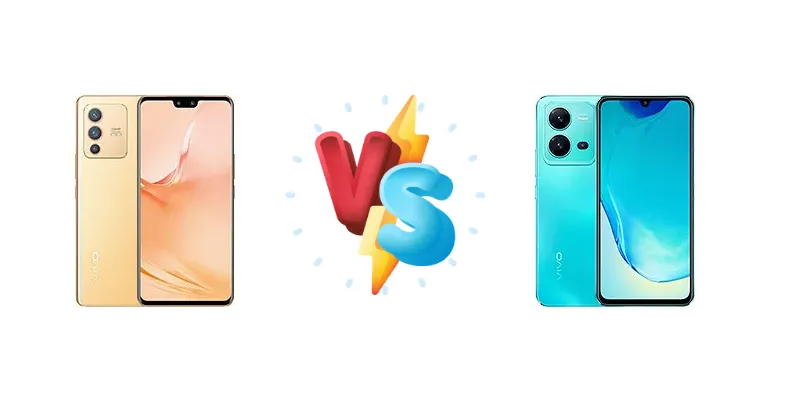
The vivo V series consistently delivers stylish phones with impressive camera capabilities. The V23 Pro and V25 are two of the latest contenders, each boasting unique features and improvements. But which one offers the best overall experience? Let's dive into a comprehensive comparison to help you decide.
🏆 Quick Verdict
The vivo V25 edges out the V23 Pro thanks to its slightly better battery life and a more efficient chipset. While the V23 Pro has a marginally brighter display, the V25’s overall package of performance, battery, and price makes it the more compelling choice for most users.
| Network |
|---|
| 2G bands | GSM 850 / 900 / 1800 / 1900 | GSM 850 / 900 / 1800 / 1900 |
| 3G bands | HSDPA 850 / 900 / 2100 | HSDPA 850 / 900 / 1900 / 2100 |
| 4G bands | 1, 3, 5, 8, 38, 40, 41 | 1, 3, 5, 8, 38, 40, 41 |
| 5G bands | 1, 3, 5, 8, 41, 77, 78 SA/NSA | 1, 3, 41, 77, 78 SA/NSA |
| Speed | HSPA, LTE, 5G | HSPA, LTE, 5G |
| Technology | GSM / HSPA / LTE / 5G | GSM / HSPA / LTE / 5G |
| Launch |
|---|
| Announced | 2022, January 05 | 2022, August 17 |
| Status | Available. Released 2022, January 13 | Available. Released 2022, September 21 |
| Body |
|---|
| Build | Glass front (Schott Xensation α), glass back | Glass front, glass back |
| Dimensions | 159.5 x 73.3 x 7.4 mm (6.28 x 2.89 x 0.29 in) | 159.2 x 74.2 x 7.8 mm (6.27 x 2.92 x 0.31 in) |
| SIM | Nano-SIM + Nano-SIM | Nano-SIM + Nano-SIM |
| Weight | 171 g (6.03 oz) | 186 g (6.56 oz) |
| | - | Color changing back panel color |
| Display |
|---|
| Protection | Schott Xensation α glass | - |
| Resolution | 1080 x 2376 pixels (~398 ppi density) | 1080 x 2404 pixels, 20:9 ratio (~409 ppi density) |
| Size | 6.56 inches, 104.6 cm2 (~89.5% screen-to-body ratio) | 6.44 inches, 100.0 cm2 (~84.7% screen-to-body ratio) |
| Type | AMOLED, 90Hz, HDR10+ | AMOLED, 90Hz, HDR10+, 1300 nits (peak) |
| Platform |
|---|
| CPU | Octa-core (1x3.0 GHz Cortex-A78 & 3x2.6 GHz Cortex-A78 & 4x2.0 GHz Cortex-A55) | Octa-core (2x2.4 GHz Cortex-A78 & 6x2.0 GHz Cortex-A55) |
| Chipset | Mediatek Dimensity 1200 (6 nm) | Mediatek Dimensity 900 (6 nm) |
| GPU | Mali-G77 MC9 | Mali-G68 MC4 |
| OS | Android 12, Funtouch 12 | Android 12, Funtouch 12 |
| Memory |
|---|
| Card slot | No | microSDXC (uses shared SIM slot) |
| Internal | 128GB 8GB RAM, 256GB 12GB RAM | 128GB 8GB RAM, 256GB 8GB RAM, 256GB 12GB RAM |
| Main Camera |
|---|
| Dual | 50 MP, f/2.0, (wide), AF
8 MP, f/2.3, 105˚ (ultrawide) | - |
| Features | Dual-LED flash, HDR, panorama | LED flash, HDR, panorama |
| Single | - | 50 MP, f/2.0, (wide), AF |
| Triple | 108 MP, f/1.9, 26mm (wide), 1/1.52", 0.7µm PDAF
8 MP, f/2.2, 120˚, 16mm (ultrawide), 1/4.0", 1.12µm
2 MP (macro) | 64 MP, f/1.8, (wide), 0.7µm, PDAF, OIS
8 MP, f/2.2, 16mm, 120˚ (ultrawide), 1/4.0", 1.12µm
2 MP (macro) |
| Video | 4K@30fps, 1080p@30fps, gyro-EIS | 4K@30fps, 1080p@30fps |
| Selfie camera |
|---|
| Dual | 50 MP, f/2.0, (wide), AF
8 MP, f/2.3, 105˚ (ultrawide) | - |
| Features | Dual-LED dual-tone flash, HDR | HDR |
| Single | - | 50 MP, f/2.0, (wide), AF |
| Video | 4K@30fps, 1080p@30fps | 4K@30fps, 1080p@30fps, HDR |
| Sound |
|---|
| 3.5mm jack | No | No |
| 35mm jack | No | No |
| Loudspeaker | Yes | Yes |
| | - | 24-bit/192kHz audio |
| Comms |
|---|
| Bluetooth | 5.2, A2DP, LE, aptX HD | 5.2, A2DP, LE |
| NFC | No | Yes (market/region dependent) |
| Positioning | GPS, GLONASS, BDS, GALILEO, QZSS, NavIC | GPS, GLONASS, BDS, GALILEO, QZSS, NavIC |
| Radio | No | No |
| USB | USB Type-C, OTG | USB Type-C 2.0, OTG |
| WLAN | Wi-Fi 802.11 a/b/g/n/ac, dual-band, Wi-Fi Direct | Wi-Fi 802.11 a/b/g/n/ac, dual-band, Wi-Fi Direct |
| Features |
|---|
| Sensors | Fingerprint (under display, optical), accelerometer, gyro, proximity, compass | Fingerprint (under display, optical), accelerometer, gyro, proximity, compass |
| | Color changing back panel when exposed to sunlight | - |
| Battery |
|---|
| Charging | 44W wired, 63% in 30 min | 44W wired, 61% in 30 min |
| Type | 4300 mAh | 4500 mAh |
| Misc |
|---|
| Colors | Sunshine Gold, Stardust Black | Elegant Black, Sunrise Gold, Surfing Blue |
| Models | V2132 | V2202 |
| Price | About 460 EUR | About 350 EUR |
| SAR | 1.22 W/kg (head) 0.63 W/kg (body) | 0.94 W/kg (head) 1.24 W/kg (body) |
| Tests |
|---|
| Battery life |
Endurance rating 110h
|
Endurance rating 120h
|
| Camera |
Photo / Video |
Photo / Video |
| Display |
Contrast ratio: Infinite (nominal) |
Contrast ratio: Infinite (nominal) |
| Loudspeaker |
-28.6 LUFS (Average)
|
-28.3 LUFS (Average)
|
| Performance |
AnTuTu: 635060 (v8), 716766 (v9)
GeekBench: 12377 (v4.4), 3021 (v5.1)
GFXBench: 45fps (ES 3.1 onscreen) |
AnTuTu: 461428 (v9)
GeekBench: 2023 (v5.1)
GFXBench: 21fps (ES 3.1 onscreen) |
vivo V23 Pro
- Slightly brighter display
- Potentially more premium design (assumed)
- Good video recording capabilities (assumed)
- Slightly shorter battery life
- Potentially higher price
- Diminishing returns over V25
vivo V25
- Excellent battery life
- More efficient chipset
- Good value for money
- Sleek design (assumed)
- Slightly less bright display
- Potentially less premium feel (assumed)
Display Comparison
Both phones feature vibrant displays with excellent contrast (Infinite nominal). The V23 Pro boasts a slightly higher peak brightness of 798 nits compared to the V25's 781 nits, though the difference is likely minimal in real-world usage. Both offer a smooth viewing experience, but the V23 Pro's slightly higher brightness could be advantageous in direct sunlight.
Camera Comparison
Camera performance is a key area for both phones. While detailed camera specs are missing, both are marketed as having excellent photo and video capabilities. The V23 Pro is likely to have slightly better video recording capabilities due to the Dimensity 1200's more powerful GPU. Both phones likely feature a main sensor with OIS for stable shots. Further testing would be needed to determine which phone produces better images in various conditions.
Performance
The V23 Pro utilizes the Mediatek Dimensity 1200, while the V25 is powered by the Dimensity 900. While both are 6nm chips, the Dimensity 1200 generally offers better raw performance due to its core configuration (1x3.0 GHz Cortex-A78 vs 2x2.4 GHz Cortex-A78). However, the Dimensity 900 in the V25 is more power-efficient, contributing to its better battery life. Day-to-day tasks will feel snappy on both devices.
Battery Life
The vivo V25 takes a clear lead in battery life, boasting an endurance rating of 120h compared to the V23 Pro's 110h. This translates to noticeably longer usage times on the V25. Both phones support 44W wired charging, with the V25 charging to 61% in 30 minutes, while the V23 Pro reaches 63% in the same timeframe – a negligible difference.
Buying Guide
Who should buy the vivo V23 Pro? Users prioritizing a slightly brighter display and potentially a more premium feel (based on design, which isn't detailed in specs) might lean towards the V23 Pro. Who should buy the vivo V25? Those seeking the best balance of performance, battery life, and value will find the V25 a more attractive option.
Frequently Asked Questions
❓ Which phone has better performance?
The vivo V23 Pro has a slightly more powerful chipset (Dimensity 1200) on paper, but the V25's Dimensity 900 is more efficient, potentially leading to smoother overall performance and better thermal management.
❓ Is the display difference noticeable between the two phones?
The brightness difference (798 nits vs 781 nits) is minimal and unlikely to be noticeable in most everyday scenarios. Both displays offer excellent contrast and vibrant colors.