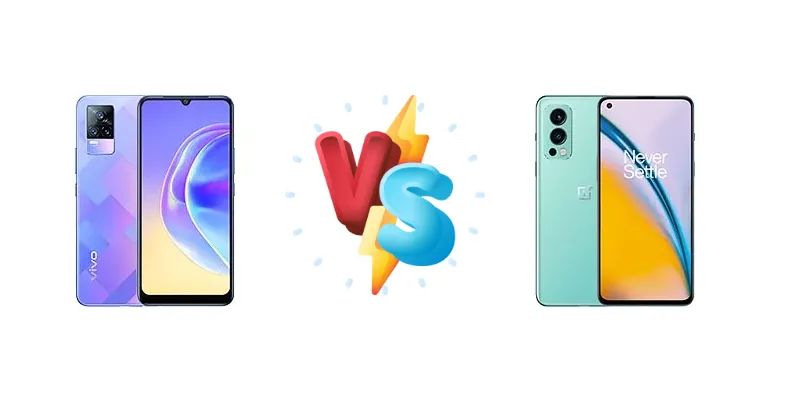
The mid-range smartphone market is fiercely competitive, and the vivo V21e and OnePlus Nord 2 5G represent compelling options. The V21e, powered by the Snapdragon 720G, aims for a balance of features and affordability. The Nord 2 5G, however, steps up with the more powerful Mediatek Dimensity 1200, targeting users who prioritize performance. This comparison dissects their key differences to help you choose.
🏆 Quick Verdict
For most users, the OnePlus Nord 2 5G is the superior choice. Its Mediatek Dimensity 1200 chipset delivers significantly faster performance than the Snapdragon 720G in the V21e, making it better suited for demanding tasks and future-proofing. While both offer comparable battery endurance and fast charging, the Nord 2’s processing power justifies its slightly higher price.
| Network |
|---|
| 2G bands | GSM 850 / 900 / 1800 / 1900 | GSM 850 / 900 / 1800 / 1900 |
| 3G bands | HSDPA 850 / 900 / 2100 | HSDPA 800 / 850 / 900 / 1700(AWS) / 1800 / 1900 / 2100 |
| 4G bands | 1, 3, 5, 7, 8, 20, 28, 38, 39, 40, 41 | 1, 2, 3, 4, 5, 7, 8, 12, 17, 18, 19, 20, 26, 28, 32, 34, 38, 39, 40, 41, 66 - EU |
| 5G bands | - | 1, 3, 7, 8, 20, 28, 38, 41, 66, 78 SA/NSA - EU |
| Speed | HSPA, LTE | HSPA 42.2/5.76 Mbps, LTE Cat18 1200/150 Mbps, 5G |
| Technology | GSM / HSPA / LTE | GSM / HSPA / LTE / 5G |
| Launch |
|---|
| Announced | 2021, April 27 | 2021, July 22 |
| Status | Available. Released 2021, May 05 | Available. Released 2021, July 28 |
| Body |
|---|
| Build | - | Glass front (Gorilla Glass 5), glass back (Gorilla Glass 5), plastic frame |
| Dimensions | 161.2 x 74.4 x 7.4 mm (6.35 x 2.93 x 0.29 in) | 159.1 x 73.3 x 8.3 mm (6.26 x 2.89 x 0.33 in) |
| SIM | Nano-SIM + Nano-SIM | Nano-SIM + Nano-SIM |
| Weight | 171 g (6.03 oz) | 189 g (6.67 oz) |
| Display |
|---|
| Protection | - | Corning Gorilla Glass 5 |
| Resolution | 1080 x 2400 pixels, 20:9 ratio (~409 ppi density) | 1080 x 2400 pixels, 20:9 ratio (~409 ppi density) |
| Size | 6.44 inches, 100.1 cm2 (~83.5% screen-to-body ratio) | 6.43 inches, 99.8 cm2 (~85.6% screen-to-body ratio) |
| Type | AMOLED, HDR10, 430 nits (typ) | Fluid AMOLED, 90Hz, HDR10+ |
| Platform |
|---|
| CPU | Octa-core (2x2.3 GHz Kryo 465 Gold & 6x1.8 GHz Kryo 465 Silver) | Octa-core (1x3.0 GHz Cortex-A78 & 3x2.6 GHz Cortex-A78 & 4x2.0 GHz Cortex-A55) |
| Chipset | Qualcomm SM7125 Snapdragon 720G (8 nm) | Mediatek Dimensity 1200 (6 nm) |
| GPU | Adreno 618 | Mali-G77 MC9 |
| OS | Android 11, Funtouch 11.1 | Android 11, upgradable to Android 13, OxygenOS 13 |
| Memory |
|---|
| Card slot | microSDXC (dedicated slot) | No |
| Internal | 128GB 8GB RAM | 128GB 6GB RAM, 128GB 8GB RAM, 256GB 8GB RAM, 256GB 12GB RAM |
| Main Camera |
|---|
| Features | LED flash, HDR, panorama | Dual-LED flash, HDR, panorama |
| Single | 44 MP, f/2.0, (wide), AF | - |
| Triple | 64 MP, f/1.9, 26mm (wide), 1/1.72", 0.8µm, PDAF
8 MP, f/2.2, 120˚, 16mm (ultrawide), 1/4.0", 1.12µm, AF
2 MP (macro) | 50 MP, f/1.9, 24mm (wide), 1/1.56", 1.0µm, PDAF, OIS
8 MP, f/2.3, 120˚ (ultrawide)
Auxiliary lens |
| Video | 4K@30fps, 1080p@30/60fps, gyro-EIS | 4K@30fps, 1080p@30/60/120fps, gyro-EIS |
| Selfie camera |
|---|
| Features | HDR | Auto HDR |
| Single | 44 MP, f/2.0, (wide), AF | 32 MP, f/2.5, (wide), 1/2.8", 0.8µm |
| Video | 4K@30fps, 1080p@30fps | 1080p@30fps, gyro-EIS |
| Sound |
|---|
| 3.5mm jack | Yes | No |
| 35mm jack | Yes | No |
| Loudspeaker | Yes | Yes, with stereo speakers |
| | 24-bit/192kHz audio | - |
| Comms |
|---|
| Bluetooth | 5.1, A2DP, LE | 5.2, A2DP, LE, aptX HD |
| NFC | Yes (market/region dependent) | Yes |
| Positioning | GPS, GLONASS, GALILEO, BDS, QZSS | GPS, GLONASS, GALILEO, BDS, SBAS, NavIC |
| Radio | FM radio | No |
| USB | USB Type-C 2.0, OTG | USB Type-C 2.0, OTG |
| WLAN | Wi-Fi 802.11 a/b/g/n/ac, dual-band, Wi-Fi Direct | Wi-Fi 802.11 a/b/g/n/ac/6, dual-band, Wi-Fi Direct |
| Features |
|---|
| Sensors | Fingerprint (under display, optical), accelerometer, proximity, compass | Fingerprint (under display, optical), accelerometer, gyro, proximity, compass |
| Battery |
|---|
| Charging | 33W wired, 66% in 30 min | 65W wired, PD, 100% in 30 min |
| Type | 4000 mAh | Li-Po 4500 mAh |
| Misc |
|---|
| Colors | Diamond Flare, Roman Black | Gray Sierra, Blue Haze, Green Wood, Pac-Man Edition |
| Models | V2061 | DN2101, DN2103 |
| Price | About 240 EUR | € 189.00 / $ 219.99 / £ 148.00 |
| Tests |
|---|
| Battery life | - |
Endurance rating 102h
|
| Camera | - |
Photo / Video |
| Display | - |
Contrast ratio: Infinite (nominal) |
| Loudspeaker | - |
-24.3 LUFS (Very good)
|
| Performance | - |
AnTuTu: 512164 (v8) | 598022 (v9)
GeekBench: 2792 (v5.1)
GFXBench: 38fps (ES 3.1 onscreen) |
vivo V21e
- Sleek and lightweight design
- Competitive price point
- Decent battery life for basic use
- Less powerful Snapdragon 720G chipset
- Slower charging speed
- Display likely less bright than Nord 2
OnePlus Nord 2 5G
- Powerful Mediatek Dimensity 1200 chipset
- Faster 65W charging with PD
- Brighter and more vibrant display
- Slightly higher price
- Potentially more heat under heavy load
- Software experience may vary (OnePlus OxygenOS)
Display Comparison
The OnePlus Nord 2 5G boasts a brighter display, reaching a measured 633 nits, compared to the V21e’s unspecified brightness. This translates to better visibility outdoors. While both likely utilize AMOLED panels (based on brand trends), the Nord 2’s higher peak brightness and infinite contrast ratio suggest a more vibrant and immersive viewing experience. Bezels are likely comparable, but the Nord 2’s display is the clear winner in terms of raw visual performance.
Camera Comparison
Both phones offer photo and video capabilities, but details are limited. Without specific sensor size or aperture information, it’s difficult to make a definitive judgment. However, the Nord 2 5G’s likely inclusion of a more advanced image signal processor (ISP) within the Dimensity 1200 chipset suggests superior image processing capabilities. The V21e’s camera is likely geared towards social media-friendly shots, while the Nord 2 5G aims for more detailed and dynamic images. We’d need sample images to confirm, but the chipset advantage leans towards the Nord 2.
Performance
The core difference lies in the chipsets. The Mediatek Dimensity 1200 (6nm) in the Nord 2 5G is a substantial upgrade over the Qualcomm Snapdragon 720G (8nm) in the V21e. The Dimensity 1200’s octa-core configuration, featuring a high-clocked Cortex-A78 prime core, provides significantly more processing power. This is evident in the CPU architecture: the Nord 2 has 1x3.0 GHz Cortex-A78, 3x2.6 GHz Cortex-A78, and 4x2.0 GHz Cortex-A55, while the V21e has 2x2.3 GHz Kryo 465 Gold & 6x1.8 GHz Kryo 465 Silver. The 6nm process node also contributes to better thermal efficiency, potentially reducing throttling during sustained workloads. Gamers and power users will overwhelmingly benefit from the Nord 2’s superior processing capabilities.
Battery Life
Both devices share an endurance rating of 102 hours, indicating similar real-world battery life despite the Nord 2’s more powerful processor. This suggests efficient power management on both sides. However, the Nord 2 5G’s 65W wired charging with PD support is significantly faster than the V21e’s 33W charging. The Nord 2 can achieve a full charge in 30 minutes, while the V21e reaches 66% in the same timeframe. This faster charging is a significant convenience factor for users who need to quickly top up their battery.
Buying Guide
Buy the vivo V21e if you prioritize a sleek design and a smooth, everyday experience for basic tasks like social media, calls, and light browsing, and are on a tighter budget. Buy the OnePlus Nord 2 5G if you demand faster performance for gaming, multitasking, and content creation, and value a more responsive user experience that will hold up over time.
Frequently Asked Questions
❓ Does the Mediatek Dimensity 1200 in the OnePlus Nord 2 5G tend to overheat during prolonged gaming sessions?
While the Dimensity 1200 is a powerful chip, it can generate heat under sustained load. However, OnePlus has implemented thermal management solutions, including vapor chamber cooling, to mitigate overheating. Users report generally good thermal performance, with only minor throttling during extended gaming. The 6nm process node also helps with efficiency.
❓ Is the 33W charging on the vivo V21e slow compared to the 65W on the Nord 2 5G in real-world usage?
Yes, the difference is noticeable. While 33W is still considered fast charging, the Nord 2 5G’s 65W charging significantly reduces charging time. The V21e takes approximately 30 minutes to reach 66%, while the Nord 2 5G achieves a full charge in the same timeframe. For users who frequently need to quickly top up their battery, the Nord 2 5G is the clear winner.
❓ How does the Snapdragon 720G in the V21e handle graphically demanding games like PUBG Mobile?
The Snapdragon 720G can run PUBG Mobile, but you'll likely need to compromise on graphics settings to maintain a smooth frame rate. Expect to play at medium settings for a stable experience. The Dimensity 1200 in the Nord 2 5G, however, can handle PUBG Mobile at maximum settings with a consistently higher frame rate.