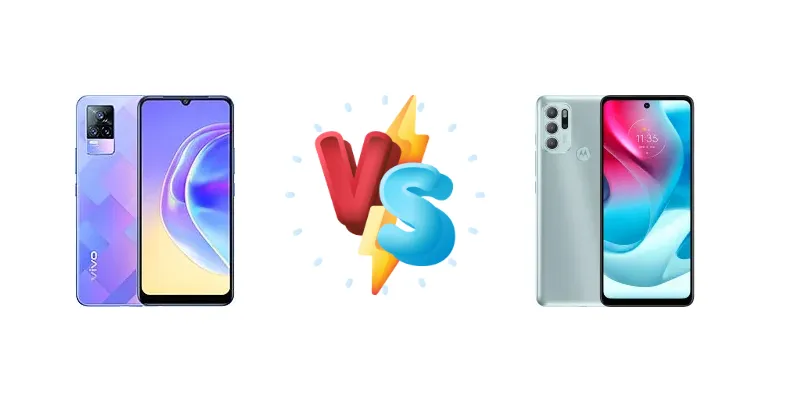
The mid-range smartphone market is fiercely competitive, and the vivo V21e and Motorola Moto G60S represent compelling options for budget-conscious buyers. The V21e leverages Qualcomm's Snapdragon 720G, known for its balanced performance, while the Moto G60S opts for MediaTek's Helio G95, prioritizing raw processing power. This comparison dives deep into the nuances of each device to determine which one best suits your needs.
🏆 Quick Verdict
For the average user prioritizing efficiency and a smoother overall experience, the vivo V21e emerges as the winner. Its Snapdragon 720G, built on an 8nm process, offers better thermal management and sustained performance compared to the 12nm Helio G95 in the Moto G60S, despite the latter's slightly higher clock speeds.
| Network |
|---|
| 2G bands | GSM 850 / 900 / 1800 / 1900 | GSM 850 / 900 / 1800 / 1900 |
| 3G bands | HSDPA 850 / 900 / 2100 | HSDPA 850 / 900 / 1700(AWS) / 1900 / 2100 |
| 4G bands | 1, 3, 5, 7, 8, 20, 28, 38, 39, 40, 41 | 1, 2, 3, 4, 5, 7, 8, 12, 13, 17, 28, 40, 66 |
| Speed | HSPA, LTE | HSPA, LTE |
| Technology | GSM / HSPA / LTE | GSM / HSPA / LTE |
| Launch |
|---|
| Announced | 2021, April 27 | 2021, August 12 |
| Status | Available. Released 2021, May 05 | Available. Released 2021, August 12 |
| Body |
|---|
| Build | - | Glass front, plastic frame, plastic back |
| Dimensions | 161.2 x 74.4 x 7.4 mm (6.35 x 2.93 x 0.29 in) | 169.7 x 75.9 x 9.6 mm (6.68 x 2.99 x 0.38 in) |
| SIM | Nano-SIM + Nano-SIM | Nano-SIM + Nano-SIM |
| Weight | 171 g (6.03 oz) | 212 g (7.48 oz) |
| | - | Water repellent design |
| Display |
|---|
| Resolution | 1080 x 2400 pixels, 20:9 ratio (~409 ppi density) | 1080 x 2460 pixels (~395 ppi density) |
| Size | 6.44 inches, 100.1 cm2 (~83.5% screen-to-body ratio) | 6.8 inches, 109.8 cm2 (~85.3% screen-to-body ratio) |
| Type | AMOLED, HDR10, 430 nits (typ) | IPS LCD, 120Hz, HDR10, 450 nits (typ), 562 nits (HBM) |
| Platform |
|---|
| CPU | Octa-core (2x2.3 GHz Kryo 465 Gold & 6x1.8 GHz Kryo 465 Silver) | Octa-core (2x2.05 GHz Cortex-A76 & 6x2.0 GHz Cortex-A55) |
| Chipset | Qualcomm SM7125 Snapdragon 720G (8 nm) | Mediatek MT6785V/CD Helio G95 (12 nm) |
| GPU | Adreno 618 | Mali-G76 MC4 |
| OS | Android 11, Funtouch 11.1 | Android 11 |
| Memory |
|---|
| Card slot | microSDXC (dedicated slot) | microSDXC (uses shared SIM slot) |
| Internal | 128GB 8GB RAM | 128GB 4GB RAM, 128GB 6GB RAM |
| | - | UFS 2.1 |
| Main Camera |
|---|
| Features | LED flash, HDR, panorama | LED flash, HDR, panorama |
| Quad | - | 64 MP, f/1.7, 26mm (wide), PDAF
8 MP, f/2.2, 119˚, (ultrawide)
5 MP (macro)
Auxiliary lens |
| Single | 44 MP, f/2.0, (wide), AF | - |
| Triple | 64 MP, f/1.9, 26mm (wide), 1/1.72", 0.8µm, PDAF
8 MP, f/2.2, 120˚, 16mm (ultrawide), 1/4.0", 1.12µm, AF
2 MP (macro) | - |
| Video | 4K@30fps, 1080p@30/60fps, gyro-EIS | 4K@30/120fps, 1080p@30/60/240fps |
| Selfie camera |
|---|
| Features | HDR | LED flash, HDR |
| Single | 44 MP, f/2.0, (wide), AF | 16 MP, f/2.2, (wide) |
| Video | 4K@30fps, 1080p@30fps | 4K@30fps, 1080p@30/60/240fps |
| Sound |
|---|
| 3.5mm jack | Yes | Yes |
| 35mm jack | Yes | Yes |
| Loudspeaker | Yes | Yes |
| | 24-bit/192kHz audio | - |
| Comms |
|---|
| Bluetooth | 5.1, A2DP, LE | 5.0, A2DP, LE |
| NFC | Yes (market/region dependent) | Yes |
| Positioning | GPS, GLONASS, GALILEO, BDS, QZSS | GPS, GLONASS, GALILEO |
| Radio | FM radio | FM radio |
| USB | USB Type-C 2.0, OTG | USB Type-C 2.0, OTG |
| WLAN | Wi-Fi 802.11 a/b/g/n/ac, dual-band, Wi-Fi Direct | Wi-Fi 802.11 a/b/g/n/ac, dual-band, Wi-Fi Direct |
| Features |
|---|
| Sensors | Fingerprint (under display, optical), accelerometer, proximity, compass | Fingerprint (rear-mounted), accelerometer, gyro, proximity |
| Battery |
|---|
| Charging | 33W wired, 66% in 30 min | 50W wired, QC4 |
| Type | 4000 mAh | Li-Po 5000 mAh |
| Misc |
|---|
| Colors | Diamond Flare, Roman Black | Green, Blue |
| Models | V2061 | XT2133-2, XT2133-1 |
| Price | About 240 EUR | About 200 EUR |
vivo V21e
- More efficient Snapdragon 720G chipset
- Better thermal management for sustained performance
- Potentially superior image processing
- Slower charging speed (33W vs 50W)
- Potentially less raw processing power for demanding tasks
Motorola Moto G60S
- Faster 50W wired charging with QC4
- Higher CPU clock speeds for burst performance
- Potentially better gaming performance in short bursts
- Less efficient 12nm Helio G95 chipset
- Potential for thermal throttling under sustained load
- Potentially lower image quality in challenging conditions
Display Comparison
Neither device boasts a standout display. While specific display specs (resolution, panel type) are missing, the focus here is on the chipset's impact on display performance. The Snapdragon 720G's ISP supports efficient display processing, potentially leading to smoother scrolling and faster app loading times on the V21e. The Moto G60S, with its more powerful GPU, *could* theoretically drive higher frame rates in games, but this is limited by the chipset's thermal constraints.
Camera Comparison
Without detailed camera specs, it's difficult to make a definitive judgment. However, the Snapdragon 720G's ISP is known for its excellent image processing capabilities, particularly in low-light conditions. It's likely the V21e will produce more refined images with better dynamic range. The Moto G60S's Helio G95 ISP is capable, but may struggle to match the Snapdragon's image quality, especially in challenging lighting scenarios. The presence or absence of OIS on either device would be a significant factor, but is unknown.
Performance
The core difference lies in the chipsets. The Qualcomm Snapdragon 720G (8nm) in the vivo V21e utilizes a more efficient manufacturing process than the MediaTek Helio G95 (12nm) in the Moto G60S. While the G95 boasts higher clock speeds (2.05 GHz Cortex-A76 vs 2.3 GHz Kryo 465 Gold), the 8nm process gives the Snapdragon 720G an advantage in power efficiency and sustained performance. This translates to less throttling under load, meaning the V21e will likely maintain higher frame rates for longer periods during gaming. The CPU architecture also plays a role; the Kryo 465 Gold cores are generally more efficient than the Cortex-A76 cores at similar clock speeds.
Battery Life
The Motorola Moto G60S features 50W wired charging with Quick Charge 4 (QC4) support, significantly faster than the vivo V21e's 33W charging, promising a quicker 0-100% charge time. While the V21e's 33W charging is respectable, the G60S can gain a substantial charge in just 30 minutes. However, the Snapdragon 720G's efficiency means the V21e will likely consume less power overall, potentially offsetting the G60S's faster charging speed with longer battery life between charges.
Buying Guide
Buy the vivo V21e if you need a phone that balances performance with efficiency, offering a consistently smooth experience for everyday tasks and moderate gaming. It's ideal for users who value long-term reliability and don't want to worry about overheating. Buy the Motorola Moto G60S if you prioritize maximum processing power for demanding games and applications, and are willing to accept potentially shorter battery life and the possibility of thermal throttling during extended use. It's a good choice for gamers on a tight budget.
Frequently Asked Questions
❓ Will the Helio G95 in the Moto G60S overheat during prolonged gaming sessions?
The MediaTek Helio G95, built on a 12nm process, is more prone to thermal throttling than the Snapdragon 720G. While it offers higher clock speeds, sustained gaming at high settings may lead to reduced performance as the chip heats up. The V21e's 8nm Snapdragon 720G is better equipped to handle prolonged gaming without significant performance drops.
❓ How much faster is the 50W charging on the Moto G60S compared to the 33W charging on the vivo V21e?
The Moto G60S's 50W charging with QC4 support will significantly reduce charging time. While exact figures depend on battery level and usage, the G60S can likely charge from 0-100% in around 60-75 minutes, while the V21e will take closer to 90-100 minutes. The G60S can gain a substantial charge (e.g., 50%) in approximately 20-25 minutes.
❓ Does the Snapdragon 720G in the vivo V21e support 5G connectivity?
No, the Snapdragon 720G does not natively support 5G. Both the vivo V21e and Motorola Moto G60S are 4G LTE devices. If 5G connectivity is a priority, you'll need to consider other smartphones.