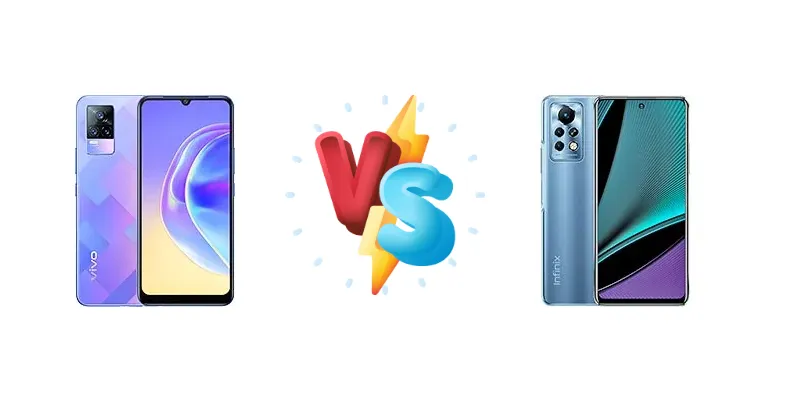
The mid-range smartphone market is fiercely competitive, and the vivo V21e and Infinix Note 11 Pro represent compelling options for budget-conscious buyers. While both aim to deliver a balanced experience, they take different approaches to achieving it. The V21e leverages Qualcomm’s Snapdragon 720G, prioritizing efficiency, while the Note 11 Pro opts for MediaTek’s Helio G96, focusing on raw processing power. This comparison dives deep into the specifics to determine which device offers the best value.
🏆 Quick Verdict
For the average user, the vivo V21e is the stronger choice. Its Snapdragon 720G, built on an 8nm process, offers a more efficient experience, translating to better sustained performance and potentially longer battery life despite similar charging speeds. While the Note 11 Pro boasts a larger display, the V21e’s chipset provides a smoother overall experience.
| Network |
|---|
| 2G bands | GSM 850 / 900 / 1800 / 1900 | GSM 850 / 900 / 1800 / 1900 |
| 3G bands | HSDPA 850 / 900 / 2100 | HSDPA 850 / 900 / 1700(AWS) / 1900 / 2100 |
| 4G bands | 1, 3, 5, 7, 8, 20, 28, 38, 39, 40, 41 | 1, 2, 3, 4, 5, 7, 8, 20, 28, 38, 41, 40 |
| Speed | HSPA, LTE | HSPA, LTE |
| Technology | GSM / HSPA / LTE | GSM / HSPA / LTE |
| | - | 1, 3, 7, 8, 20, 28 |
| Launch |
|---|
| Announced | 2021, April 27 | 2021, October 12 |
| Status | Available. Released 2021, May 05 | Available. Released 2021, November 19 |
| Body |
|---|
| Build | - | Glass front, plastic frame, plastic back |
| Dimensions | 161.2 x 74.4 x 7.4 mm (6.35 x 2.93 x 0.29 in) | 173.1 x 78.4 x 8.7 mm (6.81 x 3.09 x 0.34 in) |
| SIM | Nano-SIM + Nano-SIM | Nano-SIM + Nano-SIM |
| Weight | 171 g (6.03 oz) | 209 (7.37 oz) |
| Display |
|---|
| Resolution | 1080 x 2400 pixels, 20:9 ratio (~409 ppi density) | 1080 x 2460 pixels (~387 ppi density) |
| Size | 6.44 inches, 100.1 cm2 (~83.5% screen-to-body ratio) | 6.95 inches, 114.7 cm2 (~84.5% screen-to-body ratio) |
| Type | AMOLED, HDR10, 430 nits (typ) | IPS LCD, 120Hz |
| Platform |
|---|
| CPU | Octa-core (2x2.3 GHz Kryo 465 Gold & 6x1.8 GHz Kryo 465 Silver) | Octa-core (2x2.05 GHz Cortex-A76 & 6x2.0 GHz Cortex-A55) |
| Chipset | Qualcomm SM7125 Snapdragon 720G (8 nm) | Mediatek MT6781 Helio G96 (12 nm) |
| GPU | Adreno 618 | Mali-G57 MC2 |
| OS | Android 11, Funtouch 11.1 | Android 11, XOS 10 |
| Memory |
|---|
| Card slot | microSDXC (dedicated slot) | microSDXC (dedicated slot) |
| Internal | 128GB 8GB RAM | 128GB 4GB RAM, 128GB 8GB RAM |
| | - | UFS 2.2 |
| Main Camera |
|---|
| Features | LED flash, HDR, panorama | Quad-LED flash, HDR, panorama |
| Single | 44 MP, f/2.0, (wide), AF | 16 MP |
| Triple | 64 MP, f/1.9, 26mm (wide), 1/1.72", 0.8µm, PDAF
8 MP, f/2.2, 120˚, 16mm (ultrawide), 1/4.0", 1.12µm, AF
2 MP (macro) | 64 MP, f/1.7, (wide), 1/1.72", 0.8µm, PDAF
13 MP, f/2.5, 50mm (telephoto), 1/3.1", 1.12µm, PDAF, 2x optical zoom
Auxiliary lens |
| Video | 4K@30fps, 1080p@30/60fps, gyro-EIS | 1440p@30fps |
| Selfie camera |
|---|
| Features | HDR | - |
| Single | 44 MP, f/2.0, (wide), AF | 16 MP |
| Video | 4K@30fps, 1080p@30fps | 1080p@30fps |
| Sound |
|---|
| 3.5mm jack | Yes | Yes |
| 35mm jack | Yes | Yes |
| Loudspeaker | Yes | Yes, with dual speakers |
| | 24-bit/192kHz audio | - |
| Comms |
|---|
| Bluetooth | 5.1, A2DP, LE | Yes |
| NFC | Yes (market/region dependent) | No |
| Positioning | GPS, GLONASS, GALILEO, BDS, QZSS | GPS |
| Radio | FM radio | FM radio |
| USB | USB Type-C 2.0, OTG | USB Type-C 2.0, OTG |
| WLAN | Wi-Fi 802.11 a/b/g/n/ac, dual-band, Wi-Fi Direct | Wi-Fi 802.11 a/b/g/n/ac, dual-band, Wi-Fi Direct |
| Features |
|---|
| Sensors | Fingerprint (under display, optical), accelerometer, proximity, compass | Fingerprint (side-mounted), accelerometer, gyro, proximity, compass |
| Battery |
|---|
| Charging | 33W wired, 66% in 30 min | 33W wired |
| Type | 4000 mAh | 5000 mAh |
| Misc |
|---|
| Colors | Diamond Flare, Roman Black | Mithril Grey, Haze Green, Mist Blue |
| Models | V2061 | X697 |
| Price | About 240 EUR | - |
| Tests |
|---|
| Battery life | - |
Endurance rating 128h
|
| Camera | - |
Photo / Video |
| Display | - |
Contrast ratio: 1610:1 (nominal) |
| Loudspeaker | - |
-23.0 LUFS (Excellent)
|
| Performance | - |
AnTuTu: 290797 (v8), 343527 (v9)
GeekBench: 1800 (v5.1)
GFXBench: 11fps (ES 3.1 onscreen) |
vivo V21e
- More efficient Snapdragon 720G chipset
- Potentially better sustained performance
- Likely better thermal management
- Display size not specified, potentially smaller
- Camera details are limited
Infinix Note 11 Pro
- Larger display for media consumption
- 470 nits peak brightness for outdoor visibility
- 128-hour endurance rating (standardized test)
- Less efficient Helio G96 chipset
- Potential for thermal throttling
- 2MP macro camera offers limited value
Display Comparison
Both the vivo V21e and Infinix Note 11 Pro share a contrast ratio of 1610:1, suggesting similar visual pop. However, the Note 11 Pro’s measured peak brightness of 470 nits gives it a slight edge in outdoor visibility. While neither manufacturer specifies panel technology, the Note 11 Pro’s larger display size is a key differentiator. The V21e’s display size is not specified, but given its focus on a more compact form factor, it’s likely smaller. The lack of high refresh rate panels on either device is a notable omission in this price bracket.
Camera Comparison
Both phones offer 'Photo / Video' capabilities, but specifics are limited. Without detailed sensor information, it’s difficult to make a definitive judgment. However, the focus should be on the main sensor performance. The absence of information regarding Optical Image Stabilization (OIS) on either device suggests reliance on software stabilization. The inclusion of a 2MP macro camera on the Note 11 Pro is likely a marketing feature with limited real-world utility. Image processing styles will likely differ, with vivo typically favoring more vibrant and saturated colors, while Infinix may lean towards a more natural look.
Performance
The core difference lies in the chipsets. The vivo V21e’s Qualcomm Snapdragon 720G (8nm) utilizes a more efficient manufacturing process compared to the Infinix Note 11 Pro’s MediaTek Helio G96 (12nm). This translates to better thermal management and sustained performance under load. While the Helio G96’s Cortex-A76 cores clock slightly higher (2.05 GHz vs 2.3 GHz on the Kryo 465 Gold), the Snapdragon 720G’s architecture and process node provide a more balanced experience. The Note 11 Pro’s larger process node means it will likely throttle more aggressively during prolonged gaming sessions. RAM specifications are not provided, but the Snapdragon 720G benefits from Qualcomm’s optimizations.
Battery Life
Both devices feature 33W wired charging, offering a 66% charge in 30 minutes. The Infinix Note 11 Pro boasts an endurance rating of 128 hours, but this is a standardized test and doesn’t reflect real-world usage. The Snapdragon 720G’s efficiency in the V21e could offset a potentially smaller battery capacity (not specified) compared to the Note 11 Pro, resulting in comparable or even better real-world battery life. The 12nm process of the Helio G96 will consume more power, potentially negating the benefits of a larger battery.
Buying Guide
Buy the vivo V21e if you prioritize sustained performance during gaming and everyday tasks, and value a more power-efficient chipset. This phone is ideal for users who frequently multitask or enjoy mobile gaming for extended periods. Buy the Infinix Note 11 Pro if you prefer a larger screen for media consumption and aren't overly concerned with maximizing performance under heavy load. It’s a good fit for users who primarily browse, stream videos, and engage in casual social media use.
Frequently Asked Questions
❓ Will the Helio G96 in the Infinix Note 11 Pro overheat during prolonged gaming sessions like PUBG or Call of Duty?
The MediaTek Helio G96, built on a 12nm process, is more prone to thermal throttling than the Snapdragon 720G (8nm) in the vivo V21e. While it can handle short gaming bursts, expect performance to decrease over extended periods as the chip heats up. The V21e will likely maintain more consistent frame rates during longer gaming sessions.
❓ Is the 2MP macro camera on the Infinix Note 11 Pro actually useful for taking detailed close-up photos?
Generally, 2MP macro cameras on budget smartphones offer limited image quality. The small sensor size and fixed focus result in soft, often noisy images. While it can be fun to experiment with, don't expect professional-level macro photography from the Note 11 Pro. The V21e's camera system, even without specific details, is likely to produce more usable results.
❓ How long does it realistically take to fully charge both the vivo V21e and Infinix Note 11 Pro with the 33W charger?
Both phones advertise a 66% charge in 30 minutes with their 33W chargers. A full 0-100% charge will likely take around 60-75 minutes for both devices. However, the V21e's more efficient chipset might allow it to maintain a faster charging rate for a longer period, potentially resulting in a slightly quicker full charge.