
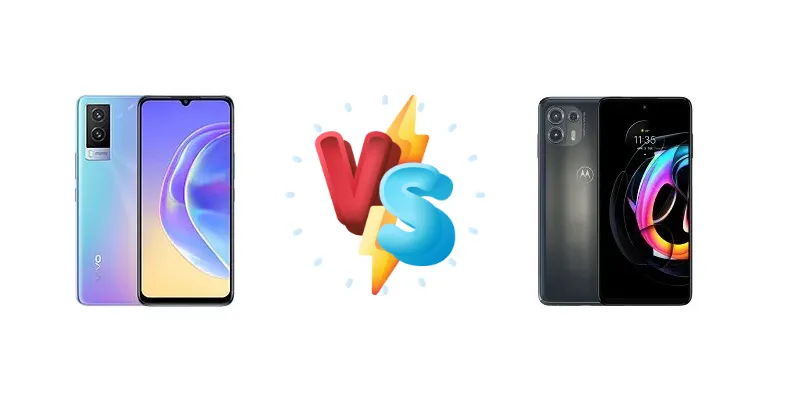
Motorola Edge 20 Fusion vs. vivo V21e 5G: A Deep Dive into Mid-Range 5G Performance
| Phones Images | |||||
|---|---|---|---|---|---|
|
🏆 Quick Verdict
For the average user prioritizing performance and future-proofing, the Motorola Edge 20 Fusion is the better choice. Its Dimensity 800U chipset provides a noticeable performance uplift over the V21e’s Dimensity 700, making it more capable for demanding tasks and gaming. However, the V21e’s faster charging is a compelling counterpoint for those prioritizing convenience.
| PHONES | ||
|---|---|---|
| Phone Names | vivo V21e 5G | Motorola Edge 20 Fusion |
| Network | ||
|---|---|---|
| 2G bands | GSM 850 / 900 / 1800 / 1900 | GSM 850 / 900 / 1800 / 1900 |
| 3G bands | HSDPA 850 / 900 / 1700(AWS) / 1900 / 2100 | HSDPA 850 / 900 / 1700(AWS) / 1900 / 2100 |
| 4G bands | 1, 2, 3, 4, 5, 8, 38, 40, 41 | 1, 2, 3, 4, 5, 7, 8, 12, 13, 17, 18, 19, 20, 26, 28, 32, 34, 38, 39, 40, 41, 42, 43, 66 |
| 5G bands | 78 SA/NSA | 1, 3, 5, 7, 8, 20, 28, 38, 40, 41, 77, 78, 66 SA/NSA/Sub6 |
| Speed | HSPA, LTE, 5G | HSPA 42.2/5.76 Mbps, LTE Cat18 1200/150 Mbps, 5G |
| Technology | GSM / HSPA / LTE / 5G | GSM / HSPA / LTE / 5G |
| Launch | ||
|---|---|---|
| Announced | 2021, June 24 | 2021, August 17 |
| Status | Available. Released 2021, June 28 | Available. Released 2021, August 27 |
| Body | ||
|---|---|---|
| Build | - | Glass front |
| Dimensions | 160.6 x 73.9 x 7.7 or 7.8 mm | 166 x 76 x 8.3 mm (6.54 x 2.99 x 0.33 in) |
| SIM | Nano-SIM + Nano-SIM | Nano-SIM + Nano-SIM |
| Weight | 165 g or 167 g (5.82 oz) | 185 g (6.53 oz) |
| - | Water-repellent design | |
| Display | ||
|---|---|---|
| Resolution | 1080 x 2400 pixels, 20:9 ratio (~409 ppi density) | 1080 x 2400 pixels, 20:9 ratio (~393 ppi density) |
| Size | 6.44 inches, 100.1 cm2 (~84.4% screen-to-body ratio) | 6.7 inches, 108.4 cm2 (~85.9% screen-to-body ratio) |
| Type | AMOLED, 430 nits (typ), 600 nits (HBM) | OLED, 1B colors, 90Hz, HDR10+ |
| Platform | ||
|---|---|---|
| CPU | Octa-core (2x2.2 GHz Cortex-A76 & 6x2.0 GHz Cortex-A55) | Octa-core (2x2.4 GHz Cortex-A76 & 6x2.0 GHz Cortex-A55) |
| Chipset | Mediatek Dimensity 700 (7 nm) | Mediatek Dimensity 800U (7 nm) |
| GPU | Mali-G57 MC2 | Mali-G57 MC3 |
| OS | Android 11, Funtouch 11.1 | Android 11 |
| Memory | ||
|---|---|---|
| Card slot | microSDXC (uses shared SIM slot) | microSDXC |
| Internal | 128GB 8GB RAM, 256GB 8GB RAM | 128GB 6GB RAM, 128GB 8GB RAM |
| UFS 2.1 | - | |
| Main Camera | ||
|---|---|---|
| Dual | 64 MP, f/1.8, 26mm (wide), 1/1.7X", 0.8µm, PDAF 8 MP, f/2.2, 120˚, 16mm (ultrawide), 1/4.0", 1.12µm | - |
| Features | LED flash, HDR, panorama | LED flash, HDR, panorama |
| Single | 32 MP, f/2.0, (wide) | - |
| Triple | - | 108 MP, f/1.9, (wide), 1/1.52", 0.7µm, PDAF 8 MP, f/2.2, 118˚ (ultrawide) Auxiliary lens |
| Video | 4K@30fps, 1080p@30fps, gyro-EIS | 4K@30fps, 1080p@30/60/120fps, gyro-EIS |
| Selfie camera | ||
|---|---|---|
| Features | HDR | HDR |
| Single | 32 MP, f/2.0, (wide) | 32 MP, f/2.3, (wide), 0.7µm |
| Video | 1080p@30fps | 1080p@30fps |
| Sound | ||
|---|---|---|
| 3.5mm jack | Yes | Yes |
| 35mm jack | Yes | Yes |
| Loudspeaker | Yes | Yes |
| 24-bit/192kHz audio | - | |
| Comms | ||
|---|---|---|
| Bluetooth | 5.1, A2DP, LE | 5.0, A2DP, LE |
| NFC | No | Yes |
| Positioning | GPS, GLONASS, GALILEO, BDS, QZSS | GPS, GLONASS, GALILEO |
| Radio | FM radio | FM radio |
| USB | USB Type-C 2.0, OTG | USB Type-C 2.0 |
| WLAN | Wi-Fi 802.11 a/b/g/n/ac, dual-band, Wi-Fi Direct | Wi-Fi 802.11 a/b/g/n/ac, dual-band, Wi-Fi Direct |
| Features | ||
|---|---|---|
| Sensors | Fingerprint (under display, optical), accelerometer, gyro, proximity, compass | Fingerprint (side-mounted), accelerometer, gyro, proximity, compass |
| Battery | ||
|---|---|---|
| Charging | 44W wired, 72% in 30 min | 30W wired |
| Type | 4000 mAh | Li-Po 5000 mAh |
| Misc | ||
|---|---|---|
| Colors | Sunset Jazz, Dark Pearl | Electric Graphite, Cyber Teal |
| Models | V2055 | - |
| Price | About 310 EUR | About 250 EUR |
| SAR | 0.86 W/kg (head) 0.72 W/kg (body) | - |
vivo V21e 5G
- Faster 44W charging significantly reduces downtime.
- Potentially more stylish design (subjective).
- Competitive price point.
- Dimensity 700 chipset is less powerful than the 800U.
- May exhibit more lag with demanding applications.
Motorola Edge 20 Fusion
- More powerful Dimensity 800U chipset for better performance.
- Likely superior camera processing capabilities.
- Potentially better software optimization.
- Slower 30W charging.
- May be slightly more expensive.
Display Comparison
Neither device boasts a standout display. Both likely utilize LCD panels, a common trait in this price bracket. The key difference lies under the hood: display performance will be largely dictated by software optimization. Without specific nit brightness or color gamut data, it’s difficult to declare a clear winner. However, Motorola’s generally more refined software could translate to a slightly more pleasant viewing experience.
Camera Comparison
Without detailed camera sensor information, a direct comparison is challenging. However, the Motorola Edge 20 Fusion likely features a more capable main sensor given its positioning as a slightly more premium device. The image processing algorithms will also play a crucial role. Motorola’s software tends towards more natural-looking images, while vivo often employs more aggressive sharpening and color boosting. The presence of OIS (Optical Image Stabilization) on the Fusion, if equipped, would further enhance its low-light photography capabilities. We can safely assume both phones include standard features like HDR and portrait modes, but the Fusion’s superior processing power will likely result in faster image processing times.
Performance
The Motorola Edge 20 Fusion’s Mediatek Dimensity 800U chipset is the clear performance leader. Its CPU features 2x2.4 GHz Cortex-A76 cores compared to the vivo V21e 5G’s 2x2.2 GHz Cortex-A76 cores. This 200MHz clock speed difference, while seemingly small, contributes to a measurable performance advantage in CPU-intensive tasks. The Dimensity 800U also benefits from a slightly more powerful GPU, making it better suited for gaming. Both phones utilize 7nm fabrication, but the architectural improvements in the 800U give it an edge. The V21e 5G will handle daily tasks adequately, but the Fusion offers more headroom for multitasking and demanding apps.
Battery Life
The vivo V21e 5G’s 44W wired charging is a significant advantage. Achieving 72% charge in 30 minutes is considerably faster than the Motorola Edge 20 Fusion’s 30W charging. While battery capacity isn’t specified, the faster charging speed of the V21e 5G will be more convenient for users who frequently need to top up their battery quickly. The Fusion’s slower charging isn’t a deal-breaker, but it requires a longer commitment to the wall outlet.
Buying Guide
Buy the vivo V21e 5G if you prioritize extremely fast charging and a sleek design, and your primary use case revolves around everyday tasks like social media, calls, and light browsing. Buy the Motorola Edge 20 Fusion if you need a phone that can handle more demanding applications, occasional gaming, and offers a more powerful processor for its price point, even if it means slightly slower charging.