
vivo V21 vs Oppo Reno6 5G: A Deep Dive into Mid-Range 5G Contenders
| Phones Images | |||||
|---|---|---|---|---|---|
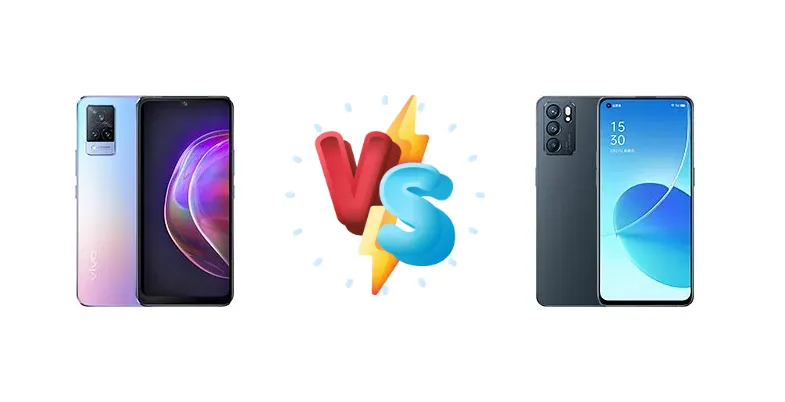
|
🏆 Quick Verdict
For most users, the Oppo Reno6 5G emerges as the stronger choice. Its more advanced Dimensity 900 chipset, coupled with significantly faster 65W charging, provides a noticeable performance and convenience advantage, despite a slightly lower endurance rating.
| PHONES | ||
|---|---|---|
| Phone Names | vivo V21 | Oppo Reno6 5G |
| Network | ||
|---|---|---|
| 2G bands | GSM 850 / 900 / 1800 / 1900 | GSM 850 / 900 / 1800 / 1900 |
| 3G bands | HSDPA 850 / 900 / 1700(AWS) / 1900 / 2100 | HSDPA 800 / 850 / 900 / 1700(AWS) / 1900 / 2100 |
| 4G bands | 1, 2, 3, 4, 5, 7, 8, 20, 28, 38, 39, 40, 41 | 1, 2, 3, 4, 5, 7, 8, 12, 17, 18, 19, 20, 26, 28, 38, 39, 40, 41, 66 - International |
| 5G bands | - | 1, 3, 5, 8, 20, 28, 7, 38, 40, 41, 66, 77, 78 SA/NSA - International |
| Speed | HSPA, LTE | HSPA, LTE, 5G |
| Technology | GSM / HSPA / LTE | GSM / CDMA / HSPA / CDMA2000 / LTE / 5G |
| - | 1, 3, 28, 41, 77, 78 SA/NSA - China | |
| Launch | ||
|---|---|---|
| Announced | 2021, April 27 | 2021, May 27 |
| Status | Available. Released 2021, May 05 | Available. Released 2021, June 11 |
| Body | ||
|---|---|---|
| Build | Glass front, plastic frame, plastic back | Glass front (Gorilla Glass 5), aluminum frame, plastic back |
| Dimensions | 159.7 x 73.9 x 7.3 mm (6.29 x 2.91 x 0.29 in) | 156.8 x 72.1 x 7.6 mm (6.17 x 2.84 x 0.30 in) |
| SIM | Nano-SIM + Nano-SIM | Nano-SIM + Nano-SIM |
| Weight | 176 g (6.21 oz) | 182 g (6.42 oz) |
| Display | ||
|---|---|---|
| Protection | - | Corning Gorilla Glass 5 |
| Resolution | 1080 x 2400 pixels, 20:9 ratio (~409 ppi density) | 1080 x 2400 pixels, 20:9 ratio (~409 ppi density) |
| Size | 6.44 inches, 100.1 cm2 (~84.8% screen-to-body ratio) | 6.43 inches, 99.8 cm2 (~88.3% screen-to-body ratio) |
| Type | AMOLED, 90Hz, HDR10+, 500 nits (typ) | AMOLED, 90Hz, 430 nits (typ), 600 nits (HBM), 750 nits (peak) |
| Platform | ||
|---|---|---|
| CPU | Octa-core (2x2.4 GHz Cortex-A76 & 6x2.0 GHz Cortex-A55) | Octa-core (2x2.4 GHz Cortex-A78 & 6x2.0 GHz Cortex-A55) |
| Chipset | Mediatek Dimensity 800U (7 nm) | Mediatek Dimensity 900 (6 nm) |
| GPU | Mali-G57 MC3 | Mali-G68 MC4 |
| OS | Android 11, Funtouch 11.1 | Android 11, upgradable to Android 12, ColorOS 12 |
| Memory | ||
|---|---|---|
| Card slot | microSDXC (uses shared SIM slot) | No |
| Internal | 128GB 8GB RAM, 256GB 8GB RAM | 128GB 8GB RAM, 256GB 12GB RAM |
| UFS 2.2 | UFS 2.1 | |
| Main Camera | ||
|---|---|---|
| Features | LED flash, HDR, panorama | Color spectrum sensor, LED flash, HDR, panorama |
| Single | 44 MP, f/2.0, (wide), AF, OIS | 32 MP, f/2.4, 26mm (wide), 1/2.8", 0.8µm |
| Triple | 64 MP, f/1.8, 26mm (wide), 1/1.72", 0.8µm, PDAF, OIS 8 MP, f/2.2, 120˚, 16mm (ultrawide), 1/4.0", 1.12µm 2 MP (macro) | 64 MP, f/1.7, 26mm (wide), 1/2.0", 0.7µm, PDAF 8 MP, f/2.2, 119˚ (ultrawide), 1/4.0", 1.12µm 2 MP (macro) |
| Video | 4K@30fps (no OIS), 1080p@30/60fps | 4K@30fps, 1080p@30/60fps |
| Selfie camera | ||
|---|---|---|
| Features | Dual-LED flash, HDR | Panorama |
| Single | 44 MP, f/2.0, (wide), AF, OIS | 32 MP, f/2.4, 26mm (wide), 1/2.8", 0.8µm |
| Video | 4K@30fps (no OIS), 1080p@30fps | 1080p@30fps |
| Sound | ||
|---|---|---|
| 3.5mm jack | No | No |
| 35mm jack | No | No |
| Loudspeaker | Yes | Yes |
| Comms | ||
|---|---|---|
| Bluetooth | 5.1, A2DP, LE | 5.2, A2DP, LE, aptX |
| NFC | No | Yes (market/region dependent) |
| Positioning | GPS, GLONASS, GALILEO, BDS | GPS, GLONASS, BDS, GALILEO, QZSS |
| Radio | No | No |
| USB | USB Type-C 2.0, OTG | USB Type-C 2.0, OTG |
| WLAN | Wi-Fi 802.11 a/b/g/n/ac, dual-band, Wi-Fi Direct | Wi-Fi 802.11 a/b/g/n/ac/6, dual-band, Wi-Fi Direct |
| Features | ||
|---|---|---|
| Sensors | Fingerprint (under display, optical), accelerometer, gyro, proximity, compass | Fingerprint (under display, optical), accelerometer, gyro, proximity, compass |
| Battery | ||
|---|---|---|
| Charging | 33W wired, 63% in 30 min | 65W wired |
| Type | 4000 mAh | Li-Po 4300 mAh |
| Misc | ||
|---|---|---|
| Colors | Dusk Blue, Sunset Dazzle | Stellar Black, Aurora, Blue, Purple |
| Models | V2066, V2108 | PEQM00, CPH2251 |
| Price | About 320 EUR | € 146.99 / ₹ 25,999 |
| SAR | - | 1.14 W/kg (head) 0.08 W/kg (body) |
| SAR EU | - | 0.96 W/kg (head) 1.18 W/kg (body) |
| Tests | ||
|---|---|---|
| Battery life | Endurance rating 123h | Endurance rating 109h |
| Camera | - | Photo / Video |
| Display | Contrast ratio: Infinite (nominal) | Contrast ratio: Infinite (nominal) |
| Loudspeaker | -28.2 LUFS (Average) | -30.0 LUFS (Average) |
| Performance | AnTuTu: 336699 (v8), 365055 (v9) GeekBench: 6516 (v4.4), 1600 (v5.1) GFXBench: 17fps (ES 3.1 onscreen) | AnTuTu: 362450 (v8), 430765 (v9) GeekBench: 2131 (v5.1) |
vivo V21
- Superior battery endurance (123h)
- Potentially more efficient chipset (Dimensity 800U)
- More affordable price point (likely)
- Slower charging speed (33W)
- Less powerful chipset (Dimensity 800U)
- Potentially lower peak display brightness
Oppo Reno6 5G
- Faster charging (65W, 63% in 30min)
- More powerful chipset (Dimensity 900)
- Higher peak display brightness (632 nits)
- Shorter battery endurance (109h)
- Potentially higher price
- May run warmer under sustained load
Display Comparison
Both the vivo V21 and Oppo Reno6 5G boast displays with an 'Infinite' (nominal) contrast ratio, suggesting excellent black levels. However, the Reno6 5G distinguishes itself with a measured peak brightness of 632 nits, offering superior visibility in bright outdoor conditions. While both likely utilize AMOLED panels, the Reno6’s higher brightness is a tangible benefit for outdoor use. The lack of refresh rate information for both devices suggests a standard 60Hz panel, a common trade-off in this price segment.
Camera Comparison
Both devices are listed as having 'Photo / Video' capabilities, lacking specific details. However, the Reno6 5G likely benefits from the more powerful ISP within the Dimensity 900, potentially leading to better image processing. Without sensor size or aperture information, it’s difficult to make a definitive judgment. The absence of details suggests a focus on software optimization rather than groundbreaking hardware. It's reasonable to assume both phones will perform adequately in good lighting conditions, but the Reno6 5G's chipset could provide an edge in low-light scenarios.
Performance
The core difference lies in the chipsets. The Oppo Reno6 5G’s MediaTek Dimensity 900 (6nm) represents a step up from the vivo V21’s Dimensity 800U (7nm). The 6nm process node generally translates to improved power efficiency and thermal performance. Furthermore, the Reno6 5G utilizes Cortex-A78 cores in its CPU configuration, offering a performance advantage over the V21’s Cortex-A76 cores. While both CPUs feature the same 2.4 GHz clock speed for their performance cores, the architectural improvements in the A78 provide a real-world boost. Both phones share the same 6x2.0 GHz Cortex-A55 efficiency cores. This translates to a smoother experience for demanding tasks on the Reno6 5G.
Battery Life
The vivo V21 holds a clear advantage in endurance, achieving a 123-hour rating compared to the Reno6 5G’s 109 hours. However, this advantage is offset by the Reno6 5G’s significantly faster 65W charging, capable of delivering 63% charge in just 30 minutes. The V21’s 33W charging is considerably slower. This means while the V21 lasts longer on a single charge, the Reno6 5G can quickly top up when needed, minimizing downtime. The difference in endurance suggests a more efficient chipset and/or software optimization on the V21, but the Reno6 5G’s charging speed is a compelling counterpoint.
Buying Guide
Buy the vivo V21 if you prioritize maximizing battery life and are comfortable with a slower charging speed. Its 123-hour endurance rating is ideal for users who frequently find themselves away from power outlets. Buy the Oppo Reno6 5G if you value faster performance for multitasking and gaming, and appreciate the convenience of incredibly rapid 65W charging, even if it means slightly less time between charges.