
vivo V21 vs Motorola Edge 20 Fusion: A Deep Dive into Dimensity 800U Performance and Value
| Phones Images | |||||
|---|---|---|---|---|---|
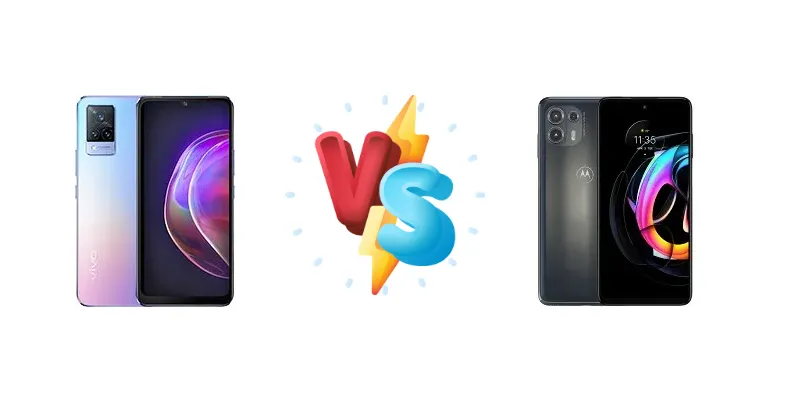
|
🏆 Quick Verdict
For the average user prioritizing sustained usage, the vivo V21 edges out the Motorola Edge 20 Fusion. Its superior 123-hour endurance rating, coupled with 33W fast charging, provides a more reliable all-day experience. While the Edge 20 Fusion offers a comparable chipset, the slightly slower charging and lack of a specified endurance rating make it less appealing for power users.
| PHONES | ||
|---|---|---|
| Phone Names | vivo V21 | Motorola Edge 20 Fusion |
| Network | ||
|---|---|---|
| 2G bands | GSM 850 / 900 / 1800 / 1900 | GSM 850 / 900 / 1800 / 1900 |
| 3G bands | HSDPA 850 / 900 / 1700(AWS) / 1900 / 2100 | HSDPA 850 / 900 / 1700(AWS) / 1900 / 2100 |
| 4G bands | 1, 2, 3, 4, 5, 7, 8, 20, 28, 38, 39, 40, 41 | 1, 2, 3, 4, 5, 7, 8, 12, 13, 17, 18, 19, 20, 26, 28, 32, 34, 38, 39, 40, 41, 42, 43, 66 |
| 5G bands | - | 1, 3, 5, 7, 8, 20, 28, 38, 40, 41, 77, 78, 66 SA/NSA/Sub6 |
| Speed | HSPA, LTE | HSPA 42.2/5.76 Mbps, LTE Cat18 1200/150 Mbps, 5G |
| Technology | GSM / HSPA / LTE | GSM / HSPA / LTE / 5G |
| Launch | ||
|---|---|---|
| Announced | 2021, April 27 | 2021, August 17 |
| Status | Available. Released 2021, May 05 | Available. Released 2021, August 27 |
| Body | ||
|---|---|---|
| Build | Glass front, plastic frame, plastic back | Glass front |
| Dimensions | 159.7 x 73.9 x 7.3 mm (6.29 x 2.91 x 0.29 in) | 166 x 76 x 8.3 mm (6.54 x 2.99 x 0.33 in) |
| SIM | Nano-SIM + Nano-SIM | Nano-SIM + Nano-SIM |
| Weight | 176 g (6.21 oz) | 185 g (6.53 oz) |
| - | Water-repellent design | |
| Display | ||
|---|---|---|
| Resolution | 1080 x 2400 pixels, 20:9 ratio (~409 ppi density) | 1080 x 2400 pixels, 20:9 ratio (~393 ppi density) |
| Size | 6.44 inches, 100.1 cm2 (~84.8% screen-to-body ratio) | 6.7 inches, 108.4 cm2 (~85.9% screen-to-body ratio) |
| Type | AMOLED, 90Hz, HDR10+, 500 nits (typ) | OLED, 1B colors, 90Hz, HDR10+ |
| Platform | ||
|---|---|---|
| CPU | Octa-core (2x2.4 GHz Cortex-A76 & 6x2.0 GHz Cortex-A55) | Octa-core (2x2.4 GHz Cortex-A76 & 6x2.0 GHz Cortex-A55) |
| Chipset | Mediatek Dimensity 800U (7 nm) | Mediatek Dimensity 800U (7 nm) |
| GPU | Mali-G57 MC3 | Mali-G57 MC3 |
| OS | Android 11, Funtouch 11.1 | Android 11 |
| Memory | ||
|---|---|---|
| Card slot | microSDXC (uses shared SIM slot) | microSDXC |
| Internal | 128GB 8GB RAM, 256GB 8GB RAM | 128GB 6GB RAM, 128GB 8GB RAM |
| UFS 2.2 | - | |
| Main Camera | ||
|---|---|---|
| Features | LED flash, HDR, panorama | LED flash, HDR, panorama |
| Single | 44 MP, f/2.0, (wide), AF, OIS | - |
| Triple | 64 MP, f/1.8, 26mm (wide), 1/1.72", 0.8µm, PDAF, OIS 8 MP, f/2.2, 120˚, 16mm (ultrawide), 1/4.0", 1.12µm 2 MP (macro) | 108 MP, f/1.9, (wide), 1/1.52", 0.7µm, PDAF 8 MP, f/2.2, 118˚ (ultrawide) Auxiliary lens |
| Video | 4K@30fps (no OIS), 1080p@30/60fps | 4K@30fps, 1080p@30/60/120fps, gyro-EIS |
| Selfie camera | ||
|---|---|---|
| Features | Dual-LED flash, HDR | HDR |
| Single | 44 MP, f/2.0, (wide), AF, OIS | 32 MP, f/2.3, (wide), 0.7µm |
| Video | 4K@30fps (no OIS), 1080p@30fps | 1080p@30fps |
| Sound | ||
|---|---|---|
| 3.5mm jack | No | Yes |
| 35mm jack | No | Yes |
| Loudspeaker | Yes | Yes |
| Comms | ||
|---|---|---|
| Bluetooth | 5.1, A2DP, LE | 5.0, A2DP, LE |
| NFC | No | Yes |
| Positioning | GPS, GLONASS, GALILEO, BDS | GPS, GLONASS, GALILEO |
| Radio | No | FM radio |
| USB | USB Type-C 2.0, OTG | USB Type-C 2.0 |
| WLAN | Wi-Fi 802.11 a/b/g/n/ac, dual-band, Wi-Fi Direct | Wi-Fi 802.11 a/b/g/n/ac, dual-band, Wi-Fi Direct |
| Features | ||
|---|---|---|
| Sensors | Fingerprint (under display, optical), accelerometer, gyro, proximity, compass | Fingerprint (side-mounted), accelerometer, gyro, proximity, compass |
| Battery | ||
|---|---|---|
| Charging | 33W wired, 63% in 30 min | 30W wired |
| Type | 4000 mAh | Li-Po 5000 mAh |
| Misc | ||
|---|---|---|
| Colors | Dusk Blue, Sunset Dazzle | Electric Graphite, Cyber Teal |
| Models | V2066, V2108 | - |
| Price | About 320 EUR | About 250 EUR |
| Tests | ||
|---|---|---|
| Battery life | Endurance rating 123h | - |
| Display | Contrast ratio: Infinite (nominal) | - |
| Loudspeaker | -28.2 LUFS (Average) | - |
| Performance | AnTuTu: 336699 (v8), 365055 (v9) GeekBench: 6516 (v4.4), 1600 (v5.1) GFXBench: 17fps (ES 3.1 onscreen) | - |
vivo V21
- Superior battery endurance (123h rating)
- Faster 33W charging (63% in 30 min)
- Potentially better display contrast (Infinite ratio)
- Camera specs unknown
- Software experience may be more customized
Motorola Edge 20 Fusion
- Clean, near-stock Android experience
- Identical chipset performance to V21
- Potentially more affordable (market dependent)
- Slower 30W charging
- No endurance rating suggests shorter battery life
- Display specs unknown
Display Comparison
Both the vivo V21 and Motorola Edge 20 Fusion lack detailed display specifications in the provided data, but the V21’s listed 'Infinite' contrast ratio suggests a strong emphasis on vibrant visuals, likely utilizing an AMOLED panel – a common feature in this price bracket. Without knowing the panel type or refresh rate of the Edge 20 Fusion, it’s difficult to assess its display quality. However, the V21’s potential for deeper blacks and more vivid colors gives it a slight edge, assuming it utilizes AMOLED technology. The absence of peak brightness or color accuracy data prevents a more definitive comparison.
Camera Comparison
The provided data doesn’t offer any camera specifications for either device. Given the market positioning, it’s reasonable to assume both phones feature multi-camera setups. However, without knowing sensor sizes, lens apertures, or the presence of Optical Image Stabilization (OIS), a meaningful comparison is impossible. The inclusion of a 2MP macro camera on either device would likely offer limited practical benefit due to its small sensor size and fixed focus. Image processing algorithms will also play a significant role in image quality, and these are brand-specific.
Performance
The core performance of both devices is identical, powered by the Mediatek Dimensity 800U chipset with an octa-core CPU configuration (2x2.4 GHz Cortex-A76 & 6x2.0 GHz Cortex-A55). This means users can expect similar performance in everyday tasks, multitasking, and gaming. The 7nm fabrication process ensures reasonable power efficiency. However, thermal management – not specified – will be a key differentiator in sustained workloads. Without knowing the cooling solutions employed by each manufacturer, it’s impossible to determine which phone will exhibit less throttling during extended gaming sessions.
Battery Life
The vivo V21 boasts an endurance rating of 123 hours, indicating a strong battery life performance. Coupled with 33W wired charging, which can deliver 63% charge in 30 minutes, it offers a convenient charging experience. The Motorola Edge 20 Fusion, however, lacks an endurance rating. Its 30W wired charging is slightly slower than the V21, suggesting a potentially longer full charge time. The absence of an endurance rating implies the Edge 20 Fusion may require more frequent charging, especially with heavy usage. This makes the V21 the clear winner for users prioritizing battery longevity.
Buying Guide
Buy the vivo V21 if you need a phone that consistently lasts through a full day of moderate to heavy use and benefits from relatively quick top-ups. It’s ideal for users who frequently stream media, game, or rely on their phone for work. Buy the Motorola Edge 20 Fusion if you prioritize a clean software experience and are comfortable with potentially needing to charge your device more frequently, or carrying a power bank. It’s a good fit for users who value simplicity and a near-stock Android interface.