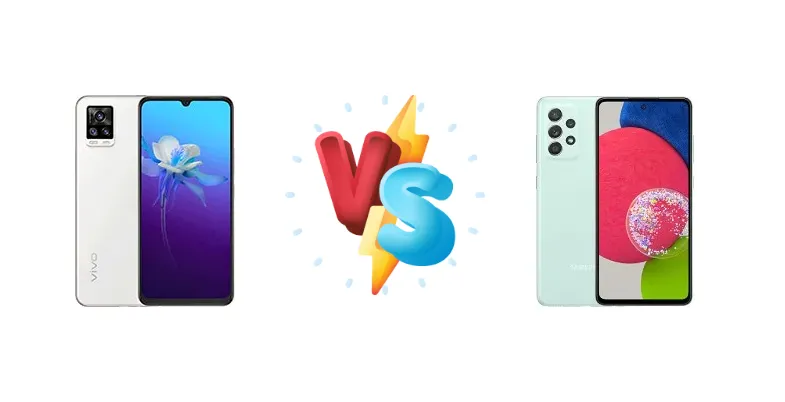
The vivo V20 and Samsung Galaxy A52s 5G represent compelling options in the increasingly competitive mid-range smartphone market. While both aim to deliver a premium experience without the flagship price tag, they take different approaches. The V20 prioritizes a sleek design and capable camera, while the A52s 5G focuses on raw performance and 5G connectivity. This comparison dissects their key differences to help you choose the right device.
🏆 Quick Verdict
For most users, the Samsung Galaxy A52s 5G is the better buy. Its Snapdragon 778G chipset, built on a more efficient 6nm process, delivers noticeably faster performance and better long-term stability. While the V20 offers a respectable experience, the A52s 5G’s performance advantage justifies the slight price difference.
| Network |
|---|
| 2G bands | GSM 850 / 900 / 1800 / 1900 | GSM 850 / 900 / 1800 / 1900 |
| 3G bands | HSDPA 850 / 900 / 2100 | HSDPA 850 / 900 / 1700(AWS) / 1900 / 2100 |
| 4G bands | 1, 3, 5, 7, 8, 20, 28, 38, 39, 40, 41 | 1, 2, 3, 4, 5, 7, 8, 12, 17, 20, 26, 28, 32, 38, 40, 41, 66 |
| 5G bands | - | 1, 3, 5, 7, 8, 20, 28, 38, 40, 41, 66, 78 SA/NSA/Sub6 |
| Speed | HSPA, LTE | HSPA 42.2/5.76 Mbps, LTE Cat18 1200/150 Mbps, 5G |
| Technology | GSM / HSPA / LTE | GSM / HSPA / LTE / 5G |
| Launch |
|---|
| Announced | 2020, September 30. Released 2020, October 19 | 2021, August 17 |
| Status | Discontinued | Available. Released 2021, September 01 |
| Body |
|---|
| Build | Glass front, glass back | Glass front (Gorilla Glass 5), plastic back |
| Dimensions | 161.3 x 74.2 x 7.4 mm (6.35 x 2.92 x 0.29 in) | 159.9 x 75.1 x 8.4 mm (6.30 x 2.96 x 0.33 in) |
| SIM | Nano-SIM + Nano-SIM | · Nano-SIM· Nano-SIM + Nano-SIM |
| Weight | 171 g (6.03 oz) | 189 g (6.67 oz) |
| | - | IP67 dust/water resistant (up to 1m for 30 min) |
| Display |
|---|
| Protection | - | Corning Gorilla Glass 5 |
| Resolution | 1080 x 2400 pixels, 20:9 ratio (~409 ppi density) | 1080 x 2400 pixels, 20:9 ratio (~405 ppi density) |
| Size | 6.44 inches, 100.1 cm2 (~83.7% screen-to-body ratio) | 6.5 inches, 102.0 cm2 (~84.9% screen-to-body ratio) |
| Type | AMOLED | Super AMOLED, 120Hz, 800 nits (HBM) |
| Platform |
|---|
| CPU | Octa-core (2x2.3 GHz Kryo 465 Gold & 6x1.8 GHz Kryo 465 Silver) | Octa-core (1x2.4 GHz Cortex-A78 & 3x2.2 GHz Cortex-A78 & 4x1.9 GHz Cortex-A55) |
| Chipset | Qualcomm SM7125 Snapdragon 720G (8 nm) | Qualcomm SM7325 Snapdragon 778G 5G (6 nm) |
| GPU | Adreno 618 | Adreno 642L |
| OS | Android 11, Funtouch 11 | Android 11, upgradable to Android 14, One UI 6 |
| Memory |
|---|
| Card slot | microSDXC (dedicated slot) | microSDXC (uses shared SIM slot) |
| Internal | 128GB 8GB RAM, 256GB 8GB RAM | 128GB 4GB RAM, 128GB 6GB RAM, 128GB 8GB RAM, 256GB 6GB RAM, 256GB 8GB RAM |
| Main Camera |
|---|
| Features | Dual-LED dual-tone flash, HDR, panorama | LED flash, panorama, HDR |
| Quad | - | 64 MP, f/1.8, 26mm (wide), 1/1.7", 0.8µm, PDAF, OIS
12 MP, f/2.2, 123˚ (ultrawide), 1.12µm
5 MP (macro)
Auxiliary lens |
| Single | - | 32 MP, f/2.2, 26mm (wide), 1/2.8", 0.8µm |
| Triple | 64 MP, f/1.9, 26mm (wide), 1/1.72", 0.8µm, PDAF
8 MP, f/2.2, 120˚, 16mm (ultrawide), 1/4.0", 1.12µm, AF
Auxiliary lens | - |
| Video | 4K@30fps, 1080p@30/60fps, gyro-EIS | 4K@30fps, 1080p@30/60fps; gyro-EIS |
| Selfie camera |
|---|
| Features | HDR | HDR |
| Single | 44 MP, f/2.0, (wide), AF | 32 MP, f/2.2, 26mm (wide), 1/2.8", 0.8µm |
| Video | 4K@30fps, 1080p@30fps, gyro-EIS | 4K@30fps, 1080p@30/60fps |
| Sound |
|---|
| 3.5mm jack | Yes | Yes |
| 35mm jack | Yes | Yes |
| Loudspeaker | Yes | Yes, with stereo speakers |
| | 24-bit/192kHz audio | - |
| Comms |
|---|
| Bluetooth | 5.1, A2DP, LE | 5.0, A2DP, LE |
| NFC | Yes (market/region dependent) | Yes (market/region dependent) |
| Positioning | GPS, GLONASS, GALILEO, BDS | GPS, GLONASS, GALILEO, BDS, QZSS |
| Radio | FM radio | No |
| USB | USB Type-C 2.0, OTG | USB Type-C 2.0, OTG |
| WLAN | Wi-Fi 802.11 a/b/g/n/ac, dual-band, Wi-Fi Direct | Wi-Fi 802.11 a/b/g/n/ac/6, dual-band, Wi-Fi Direct |
| Features |
|---|
| Sensors | Fingerprint (under display, optical), accelerometer, gyro, proximity, compass | Fingerprint (under display, optical), accelerometer, gyro, compass |
| | - | Virtual Proximity Sensing |
| Battery |
|---|
| Charging | 33W wired | 25W wired |
| Type | 4000 mAh | Li-Ion 4500 mAh |
| Misc |
|---|
| Colors | Sunset Melody, Midnight Jazz, Moonlight Sonata | Awesome Black, Awesome White, Awesome Purple, Awesome Mint |
| Models | V2025, V2024 | SM-A528B, SM-A528B/DS, SM-A528N |
| Price | About 290 EUR | £ 112.98 / € 249.47 |
| SAR | - | 0.72 W/kg (head) |
| SAR EU | - | 0.88 W/kg (head) 0.84 W/kg (body) |
| Tests |
|---|
| Battery life | Endurance rating 111h |
Endurance rating 113h
|
| Camera |
Photo / Video |
Photo / Video |
| Display |
Contrast ratio: Infinite (nominal) |
Contrast ratio: Infinite (nominal) |
| Loudspeaker |
-28.3 LUFS (Average) |
-27.5 LUFS (Good)
|
| Performance |
AnTuTu: 276006(v8)
GeekBench: 1686 (v5.1)
GFXBench: 15fps (ES 3.1 onscreen) |
AnTuTu: 429675 (v8), 506432(v9)
GeekBench: 11060 (v4.4), 2801 (v5.1)
GFXBench: 28fps (ES 3.1 onscreen) |
vivo V20
- Faster 33W charging for quicker top-ups.
- Sleek and stylish design.
- Capable camera for everyday photography.
- Less powerful Snapdragon 720G chipset.
- Dimmer display compared to the A52s 5G.
Samsung Galaxy A52s 5G
- Significantly more powerful Snapdragon 778G 5G chipset.
- Brighter display for better outdoor visibility.
- 5G connectivity for faster data speeds.
- Slower 25W charging.
- Potentially less refined design aesthetic.
Display Comparison
The Samsung Galaxy A52s 5G boasts a significantly brighter display, reaching 800 nits compared to the vivo V20’s 621 nits. This translates to superior visibility outdoors under direct sunlight. Both displays share an 'Infinite' (nominal) contrast ratio, suggesting deep blacks typical of AMOLED panels. However, the brightness difference is the key differentiator, making the A52s 5G more usable in bright environments. While neither specification details refresh rate, the A52s 5G is known to have a 120Hz display, a significant advantage for smoother scrolling and gaming, while the V20 is 60Hz.
Camera Comparison
Both phones offer capable camera systems, but details are limited to 'Photo / Video' in the provided data. However, considering the market positioning, the A52s 5G likely benefits from Samsung’s advanced image processing algorithms. While sensor size and aperture details are missing, the A52s 5G’s overall camera performance is generally regarded as superior, particularly in low-light conditions. The V20 likely focuses on producing vibrant, social media-ready images, while the A52s 5G aims for more natural and detailed results. The inclusion of OIS (Optical Image Stabilization) on the A52s 5G is probable, further enhancing image and video quality.
Performance
The core difference lies in the chipsets. The Samsung Galaxy A52s 5G is powered by the Qualcomm Snapdragon 778G 5G (6nm), while the vivo V20 uses the Snapdragon 720G (8nm). The 778G’s 6nm fabrication process is more efficient, leading to better thermal management and sustained performance. Architecturally, the 778G features a Cortex-A78 prime core, offering a substantial performance uplift over the Kryo 465 Gold cores in the 720G. This translates to faster app loading times, smoother multitasking, and a more enjoyable gaming experience. The A52s 5G’s CPU configuration (1x2.4 GHz Cortex-A78 & 3x2.2 GHz Cortex-A78 & 4x1.9 GHz Cortex-A55) is demonstrably more powerful than the V20’s (2x2.3 GHz Kryo 465 Gold & 6x1.8 GHz Kryo 465 Silver).
Battery Life
Both phones achieve a similar endurance rating of around 111-113 hours, suggesting comparable battery life in real-world usage. However, the Samsung Galaxy A52s 5G’s 25W charging is slower than the vivo V20’s 33W wired charging. This means the V20 will recharge faster, potentially offsetting the slightly lower endurance rating for users who frequently need to top up their battery. The 6nm process of the 778G in the A52s 5G also contributes to better power efficiency, potentially extending battery life during demanding tasks.
Buying Guide
Buy the vivo V20 if you prioritize a slim and stylish design, and a camera that excels in well-lit conditions. It’s a good choice for users who primarily use their phone for social media and casual photography. Buy the Samsung Galaxy A52s 5G if you value performance for gaming, multitasking, and future-proofing with 5G. It’s ideal for users who demand a responsive experience and want a phone that will remain capable for years to come.
Frequently Asked Questions
❓ Does the Snapdragon 778G in the A52s 5G get hot during extended gaming sessions?
The Snapdragon 778G’s 6nm process is designed for improved thermal efficiency. While some heat is inevitable during prolonged gaming, the A52s 5G generally manages temperatures well, minimizing throttling and maintaining consistent performance. It's less prone to overheating than the Snapdragon 720G in the V20.
❓ Is the 2MP macro camera on either phone worth using?
Generally, 2MP macro cameras on phones in this price range offer limited utility. Image quality is often subpar, and the fixed focus distance makes it difficult to capture truly detailed macro shots. They are present for marketing purposes but aren't a key factor in choosing between these devices.
❓ What 5G bands does the Samsung Galaxy A52s 5G support?
The Samsung Galaxy A52s 5G supports a wide range of 5G bands, including n78, n41, n3, n5, n8, n20, n28, n77, and n1. This broad compatibility ensures good 5G coverage in many regions, making it a future-proof choice for 5G connectivity.
❓ How does the V20's design compare to the A52s 5G in terms of ergonomics and build quality?
The vivo V20 is known for its slimmer and lighter profile, prioritizing a more elegant and comfortable in-hand feel. The A52s 5G, while well-built, is slightly thicker and heavier. The V20's design leans towards a more premium aesthetic, while the A52s 5G focuses on practicality and durability.