
OnePlus Nord 2 5G vs vivo V20: A Deep Dive into Mid-Range Champions
| Phones Images | |||||
|---|---|---|---|---|---|
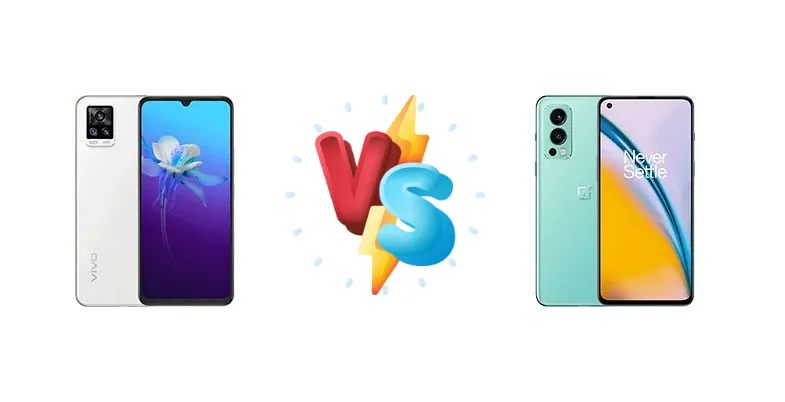
|
🏆 Quick Verdict
For most users, the OnePlus Nord 2 5G emerges as the stronger choice. Its significantly faster Mediatek Dimensity 1200 chipset delivers a smoother experience, especially for demanding tasks, and the 65W charging is a game-changer. However, the vivo V20’s slightly better endurance rating and potentially more refined camera processing make it a viable alternative for those prioritizing battery life and a specific aesthetic.
| PHONES | ||
|---|---|---|
| Phone Names | vivo V20 | OnePlus Nord 2 5G |
| Network | ||
|---|---|---|
| 2G bands | GSM 850 / 900 / 1800 / 1900 | GSM 850 / 900 / 1800 / 1900 |
| 3G bands | HSDPA 850 / 900 / 2100 | HSDPA 800 / 850 / 900 / 1700(AWS) / 1800 / 1900 / 2100 |
| 4G bands | 1, 3, 5, 7, 8, 20, 28, 38, 39, 40, 41 | 1, 2, 3, 4, 5, 7, 8, 12, 17, 18, 19, 20, 26, 28, 32, 34, 38, 39, 40, 41, 66 - EU |
| 5G bands | - | 1, 3, 7, 8, 20, 28, 38, 41, 66, 78 SA/NSA - EU |
| Speed | HSPA, LTE | HSPA 42.2/5.76 Mbps, LTE Cat18 1200/150 Mbps, 5G |
| Technology | GSM / HSPA / LTE | GSM / HSPA / LTE / 5G |
| Launch | ||
|---|---|---|
| Announced | 2020, September 30. Released 2020, October 19 | 2021, July 22 |
| Status | Discontinued | Available. Released 2021, July 28 |
| Body | ||
|---|---|---|
| Build | Glass front, glass back | Glass front (Gorilla Glass 5), glass back (Gorilla Glass 5), plastic frame |
| Dimensions | 161.3 x 74.2 x 7.4 mm (6.35 x 2.92 x 0.29 in) | 159.1 x 73.3 x 8.3 mm (6.26 x 2.89 x 0.33 in) |
| SIM | Nano-SIM + Nano-SIM | Nano-SIM + Nano-SIM |
| Weight | 171 g (6.03 oz) | 189 g (6.67 oz) |
| Display | ||
|---|---|---|
| Protection | - | Corning Gorilla Glass 5 |
| Resolution | 1080 x 2400 pixels, 20:9 ratio (~409 ppi density) | 1080 x 2400 pixels, 20:9 ratio (~409 ppi density) |
| Size | 6.44 inches, 100.1 cm2 (~83.7% screen-to-body ratio) | 6.43 inches, 99.8 cm2 (~85.6% screen-to-body ratio) |
| Type | AMOLED | Fluid AMOLED, 90Hz, HDR10+ |
| Platform | ||
|---|---|---|
| CPU | Octa-core (2x2.3 GHz Kryo 465 Gold & 6x1.8 GHz Kryo 465 Silver) | Octa-core (1x3.0 GHz Cortex-A78 & 3x2.6 GHz Cortex-A78 & 4x2.0 GHz Cortex-A55) |
| Chipset | Qualcomm SM7125 Snapdragon 720G (8 nm) | Mediatek Dimensity 1200 (6 nm) |
| GPU | Adreno 618 | Mali-G77 MC9 |
| OS | Android 11, Funtouch 11 | Android 11, upgradable to Android 13, OxygenOS 13 |
| Memory | ||
|---|---|---|
| Card slot | microSDXC (dedicated slot) | No |
| Internal | 128GB 8GB RAM, 256GB 8GB RAM | 128GB 6GB RAM, 128GB 8GB RAM, 256GB 8GB RAM, 256GB 12GB RAM |
| Main Camera | ||
|---|---|---|
| Features | Dual-LED dual-tone flash, HDR, panorama | Dual-LED flash, HDR, panorama |
| Triple | 64 MP, f/1.9, 26mm (wide), 1/1.72", 0.8µm, PDAF 8 MP, f/2.2, 120˚, 16mm (ultrawide), 1/4.0", 1.12µm, AF Auxiliary lens | 50 MP, f/1.9, 24mm (wide), 1/1.56", 1.0µm, PDAF, OIS 8 MP, f/2.3, 120˚ (ultrawide) Auxiliary lens |
| Video | 4K@30fps, 1080p@30/60fps, gyro-EIS | 4K@30fps, 1080p@30/60/120fps, gyro-EIS |
| Selfie camera | ||
|---|---|---|
| Features | HDR | Auto HDR |
| Single | 44 MP, f/2.0, (wide), AF | 32 MP, f/2.5, (wide), 1/2.8", 0.8µm |
| Video | 4K@30fps, 1080p@30fps, gyro-EIS | 1080p@30fps, gyro-EIS |
| Sound | ||
|---|---|---|
| 3.5mm jack | Yes | No |
| 35mm jack | Yes | No |
| Loudspeaker | Yes | Yes, with stereo speakers |
| 24-bit/192kHz audio | - | |
| Comms | ||
|---|---|---|
| Bluetooth | 5.1, A2DP, LE | 5.2, A2DP, LE, aptX HD |
| NFC | Yes (market/region dependent) | Yes |
| Positioning | GPS, GLONASS, GALILEO, BDS | GPS, GLONASS, GALILEO, BDS, SBAS, NavIC |
| Radio | FM radio | No |
| USB | USB Type-C 2.0, OTG | USB Type-C 2.0, OTG |
| WLAN | Wi-Fi 802.11 a/b/g/n/ac, dual-band, Wi-Fi Direct | Wi-Fi 802.11 a/b/g/n/ac/6, dual-band, Wi-Fi Direct |
| Features | ||
|---|---|---|
| Sensors | Fingerprint (under display, optical), accelerometer, gyro, proximity, compass | Fingerprint (under display, optical), accelerometer, gyro, proximity, compass |
| Battery | ||
|---|---|---|
| Charging | 33W wired | 65W wired, PD, 100% in 30 min |
| Type | 4000 mAh | Li-Po 4500 mAh |
| Misc | ||
|---|---|---|
| Colors | Sunset Melody, Midnight Jazz, Moonlight Sonata | Gray Sierra, Blue Haze, Green Wood, Pac-Man Edition |
| Models | V2025, V2024 | DN2101, DN2103 |
| Price | About 290 EUR | € 189.00 / $ 219.99 / £ 148.00 |
| Tests | ||
|---|---|---|
| Battery life | Endurance rating 111h | Endurance rating 102h |
| Camera | Photo / Video | Photo / Video |
| Display | Contrast ratio: Infinite (nominal) | Contrast ratio: Infinite (nominal) |
| Loudspeaker | -28.3 LUFS (Average) | -24.3 LUFS (Very good) |
| Performance | AnTuTu: 276006(v8) GeekBench: 1686 (v5.1) GFXBench: 15fps (ES 3.1 onscreen) | AnTuTu: 512164 (v8) | 598022 (v9) GeekBench: 2792 (v5.1) GFXBench: 38fps (ES 3.1 onscreen) |
vivo V20
- Longer battery endurance rating (111h)
- Sleek and stylish design (assumed based on brand reputation)
- Potentially more refined image processing
- Less powerful Snapdragon 720G chipset
- Slower 33W charging
- Lower peak display brightness
OnePlus Nord 2 5G
- Significantly faster Mediatek Dimensity 1200 chipset
- Ultra-fast 65W charging (0-100% in 30 mins)
- Brighter display (633 nits)
- Slightly lower battery endurance rating (102h)
- Potentially more aggressive thermal throttling under sustained load
- OxygenOS can be prone to occasional software bugs
Display Comparison
Both the vivo V20 and OnePlus Nord 2 5G feature displays with an 'Infinite' contrast ratio, suggesting deep blacks. However, the Nord 2 5G edges out the V20 with a measured peak brightness of 633 nits compared to the V20’s 621 nits. While the difference isn’t massive, it translates to slightly better visibility in direct sunlight. Both likely utilize AMOLED panels, common in this price bracket, but neither specification details refresh rate or PWM dimming frequency, making it difficult to assess potential eye strain for sensitive users. The Nord 2’s slightly brighter display is a minor advantage for outdoor use.
Camera Comparison
Both phones offer 'Photo / Video' capabilities, but detailed sensor information is lacking. Without specifics on sensor size or aperture, a direct comparison is difficult. However, the chipset difference suggests the Nord 2 5G has more processing power available for image processing and computational photography. The Snapdragon 720G is capable, but the Dimensity 1200’s ISP is more advanced. The absence of details on OIS (Optical Image Stabilization) is a key omission; its presence would significantly impact low-light performance and video stabilization on either device. We can assume both phones will offer a range of shooting modes, but the Nord 2 5G likely has an edge in overall image quality due to its superior processing capabilities.
Performance
The performance gap is the most significant differentiator. The OnePlus Nord 2 5G’s Mediatek Dimensity 1200, built on a 6nm process, is a substantial upgrade over the vivo V20’s Qualcomm Snapdragon 720G (8nm). The Dimensity 1200 boasts a more powerful CPU configuration – a 1x3.0 GHz Cortex-A78 core alongside 3x2.6 GHz Cortex-A78 cores and 4x2.0 GHz Cortex-A55 cores – compared to the Snapdragon 720G’s 2x2.3 GHz Kryo 465 Gold and 6x1.8 GHz Kryo 465 Silver. This translates to faster app loading times, smoother multitasking, and a more responsive gaming experience. The 6nm node also contributes to better thermal efficiency, potentially reducing throttling during sustained workloads.
Battery Life
The vivo V20 holds a slight edge in endurance, achieving a 111-hour rating compared to the Nord 2 5G’s 102 hours. However, this difference is partially offset by the Nord 2 5G’s dramatically faster 65W wired charging, capable of a full charge in just 30 minutes. The V20’s 33W charging is respectable, but significantly slower. This means the Nord 2 5G can quickly top up its battery, mitigating the slightly lower endurance rating. The real-world impact depends on usage patterns; heavy users will benefit more from the Nord 2 5G’s rapid charging, while lighter users might appreciate the V20’s slightly longer run time.
Buying Guide
Buy the vivo V20 if you prioritize all-day battery life and a slim, stylish design, and don't heavily rely on intensive gaming or demanding applications. Buy the OnePlus Nord 2 5G if you value raw performance, incredibly fast charging, and a more responsive user experience, even if it means slightly less battery endurance.