
vivo V20 vs. Apple iPhone SE (2020): A Detailed Comparison of Battery, Performance, and Value
| Phones Images | |||||
|---|---|---|---|---|---|
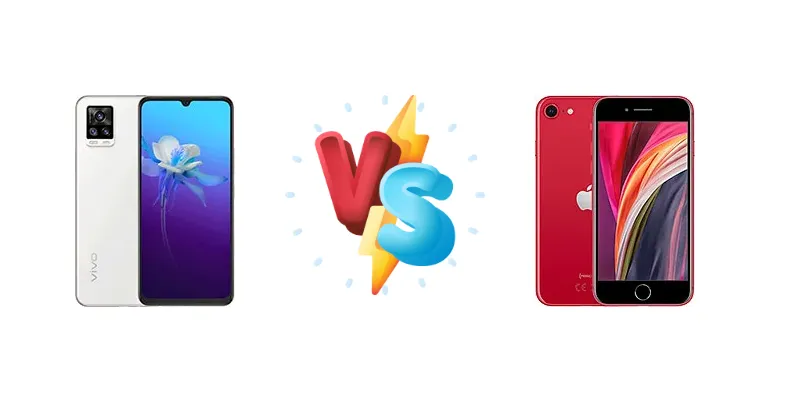
|
🏆 Quick Verdict
For the average user prioritizing battery endurance and fast charging, the vivo V20 is the clear winner. However, if raw performance and the iOS ecosystem are paramount, and you don't mind frequent charging, the iPhone SE (2020) remains a compelling choice.
| PHONES | ||
|---|---|---|
| Phone Names | vivo V20 | Apple iPhone SE (2020) |
| Network | ||
|---|---|---|
| 2G bands | GSM 850 / 900 / 1800 / 1900 | GSM 850 / 900 / 1800 / 1900 |
| 3G bands | HSDPA 850 / 900 / 2100 | HSDPA 850 / 900 / 1700(AWS) / 1900 / 2100 |
| 4G bands | 1, 3, 5, 7, 8, 20, 28, 38, 39, 40, 41 | 1, 2, 3, 4, 5, 7, 8, 11, 12, 13, 17, 18, 19, 20, 21, 25, 26, 28, 29, 30, 32, 34, 38, 39, 40, 41, 42, 46, 48, 66 - A2296 |
| Speed | HSPA, LTE | HSPA 42.2/5.76 Mbps, LTE (5CA) Cat16 1024/150 Mbps, EV-DO Rev.A 3.1 Mbps |
| Technology | GSM / HSPA / LTE | GSM / CDMA / HSPA / EVDO / LTE |
| - | 1, 2, 3, 4, 5, 7, 8, 12, 13, 14, 17, 18, 19, 20, 25, 26, 29, 30, 34, 38, 39, 40, 41, 42, 46, 48, 66, 71 - A2275, A2298 | |
| Launch | ||
|---|---|---|
| Announced | 2020, September 30. Released 2020, October 19 | 2020, April 15 |
| Status | Discontinued | Available. Released 2020, April 24 |
| Body | ||
|---|---|---|
| Build | Glass front, glass back | Glass front, glass back, aluminum frame |
| Dimensions | 161.3 x 74.2 x 7.4 mm (6.35 x 2.92 x 0.29 in) | 138.4 x 67.3 x 7.3 mm (5.45 x 2.65 x 0.29 in) |
| SIM | Nano-SIM + Nano-SIM | Nano-SIM + eSIM |
| Weight | 171 g (6.03 oz) | 148 g (5.22 oz) |
| - | IP67 dust/water resistant (up to 1m for 30 min) Apple Pay (Visa, MasterCard, AMEX certified) | |
| Display | ||
|---|---|---|
| Protection | - | Ion-strengthened glass |
| Resolution | 1080 x 2400 pixels, 20:9 ratio (~409 ppi density) | 750 x 1334 pixels, 16:9 ratio (~326 ppi density) |
| Size | 6.44 inches, 100.1 cm2 (~83.7% screen-to-body ratio) | 4.7 inches, 60.9 cm2 (~65.4% screen-to-body ratio) |
| Type | AMOLED | Retina IPS LCD, 625 nits (typ) |
| Platform | ||
|---|---|---|
| CPU | Octa-core (2x2.3 GHz Kryo 465 Gold & 6x1.8 GHz Kryo 465 Silver) | Hexa-core (2x2.65 GHz Lightning + 4x1.8 GHz Thunder) |
| Chipset | Qualcomm SM7125 Snapdragon 720G (8 nm) | Apple A13 Bionic (7 nm+) |
| GPU | Adreno 618 | Apple GPU (4-core graphics) |
| OS | Android 11, Funtouch 11 | iOS 13, upgradable to iOS 26.1 |
| Memory | ||
|---|---|---|
| Card slot | microSDXC (dedicated slot) | No |
| Internal | 128GB 8GB RAM, 256GB 8GB RAM | 64GB 3GB RAM, 128GB 3GB RAM, 256GB 3GB RAM |
| - | NVMe | |
| Main Camera | ||
|---|---|---|
| Features | Dual-LED dual-tone flash, HDR, panorama | Quad-LED dual-tone flash, HDR, panorama |
| Single | - | 12 MP, f/1.8 (wide), PDAF, OIS |
| Triple | 64 MP, f/1.9, 26mm (wide), 1/1.72", 0.8µm, PDAF 8 MP, f/2.2, 120˚, 16mm (ultrawide), 1/4.0", 1.12µm, AF Auxiliary lens | - |
| Video | 4K@30fps, 1080p@30/60fps, gyro-EIS | 4K@24/30/60fps, 1080p@30/60/120/240fps, HDR, OIS, stereo sound rec. |
| Selfie camera | ||
|---|---|---|
| Features | HDR | HDR |
| Single | 44 MP, f/2.0, (wide), AF | 7 MP, f/2.2 |
| Video | 4K@30fps, 1080p@30fps, gyro-EIS | 1080p@30fps; gyro-EIS |
| Sound | ||
|---|---|---|
| 3.5mm jack | Yes | No |
| 35mm jack | Yes | No |
| Loudspeaker | Yes | Yes, with stereo speakers |
| 24-bit/192kHz audio | - | |
| Comms | ||
|---|---|---|
| Bluetooth | 5.1, A2DP, LE | 5.0, A2DP, LE |
| NFC | Yes (market/region dependent) | Yes |
| Positioning | GPS, GLONASS, GALILEO, BDS | GPS, GLONASS |
| Radio | FM radio | No |
| USB | USB Type-C 2.0, OTG | Lightning, USB 2.0 |
| WLAN | Wi-Fi 802.11 a/b/g/n/ac, dual-band, Wi-Fi Direct | Wi-Fi 802.11 a/b/g/n/ac/6, dual-band, hotspot |
| Features | ||
|---|---|---|
| Sensors | Fingerprint (under display, optical), accelerometer, gyro, proximity, compass | Fingerprint (front-mounted), accelerometer, proximity, gyro, compass, barometer |
| Battery | ||
|---|---|---|
| Charging | 33W wired | 18W wired, 50% in 30 min 7.5W wireless (Qi) |
| Type | 4000 mAh | Li-Ion 1821 mAh (6.91 Wh) |
| Misc | ||
|---|---|---|
| Colors | Sunset Melody, Midnight Jazz, Moonlight Sonata | Black, White, Red |
| Models | V2025, V2024 | A2275, A2296, A2298, iPhone12,8 |
| Price | About 290 EUR | $ 120.00 / C$ 165.75 / £ 99.95 / € 130.89 |
| SAR | - | 1.17 W/kg (head) 1.16 W/kg (body) |
| SAR EU | - | 0.98 W/kg (head) 0.99 W/kg (body) |
| Tests | ||
|---|---|---|
| Battery life | Endurance rating 111h | Endurance rating 59h |
| Camera | Photo / Video | Photo / Video |
| Display | Contrast ratio: Infinite (nominal) | Contrast ratio: 1544:1 (nominal) |
| Loudspeaker | -28.3 LUFS (Average) | -24.1 LUFS (Very good) |
| Performance | AnTuTu: 276006(v8) GeekBench: 1686 (v5.1) GFXBench: 15fps (ES 3.1 onscreen) | AnTuTu: 462253 (v8) GeekBench: 3237 (v5.1) |
vivo V20
- Exceptional battery life (111h endurance)
- Faster 33W wired charging
- Potentially better contrast ratio (infinite nominal)
- Less powerful processor than the iPhone SE
- Camera specs lack detail, suggesting average performance
Apple iPhone SE (2020)
- Significantly faster processor (Apple A13 Bionic)
- Compact and pocketable design
- iOS ecosystem and software support
- Poor battery life (59h endurance)
- Slower charging speeds compared to the vivo V20
- Smaller display size may not suit all users
Display Comparison
The iPhone SE (2020) boasts a measured peak brightness of 670 nits, contrasted by the vivo V20’s 621 nits. While the iPhone SE is brighter, the V20’s infinite (nominal) contrast ratio suggests deeper blacks, though this is a typical marketing claim. The iPhone SE’s 1544:1 contrast ratio is a measurable advantage, offering more vibrant visuals. Both phones feature similar display sizes, but the iPhone SE’s smaller footprint is a key differentiator for users preferring one-handed operation. Neither device specifies refresh rate, implying standard 60Hz panels.
Camera Comparison
Both devices offer photo and video capabilities, but details are limited. Without sensor size or aperture information, a direct comparison is difficult. However, Apple’s image processing pipeline is renowned for its natural color reproduction and dynamic range. The vivo V20 likely relies on software enhancements to compensate for potentially smaller sensors. The absence of detailed camera specs suggests neither phone is positioned as a photography powerhouse, focusing instead on providing adequate image quality for everyday use. The iPhone SE's Smart HDR capabilities are a notable advantage.
Performance
The Apple A13 Bionic chip, fabricated on a 7nm+ process, demonstrably outperforms the Qualcomm Snapdragon 720G (8nm) in raw processing power. The A13’s hexa-core CPU, with its 2x2.65 GHz Lightning cores, provides a significant advantage in single-core performance, crucial for responsive app launches and smooth multitasking. While the Snapdragon 720G’s octa-core configuration (2x2.3 GHz Kryo 465 Gold & 6x1.8 GHz Kryo 465 Silver) is capable, it lags behind the A13 in both CPU and GPU performance. The A13’s architecture is optimized for iOS, resulting in a fluid and efficient user experience.
Battery Life
The vivo V20’s endurance rating of 111 hours is a substantial improvement over the iPhone SE (2020)’s 59 hours. This translates to significantly longer battery life in real-world usage. While the iPhone SE supports 18W wired charging (50% in 30 minutes) and 7.5W wireless charging, the vivo V20’s 33W wired charging offers considerably faster replenishment. The difference in battery endurance is a critical factor for users who prioritize all-day usability and dislike frequent charging.
Buying Guide
Buy the vivo V20 if you need a phone that can comfortably last a full day on a single charge, appreciate fast 33W charging, and prefer a larger display for media consumption. Buy the Apple iPhone SE (2020) if you prioritize a compact form factor, demand the fastest possible performance for gaming and demanding apps, and are invested in the Apple ecosystem.