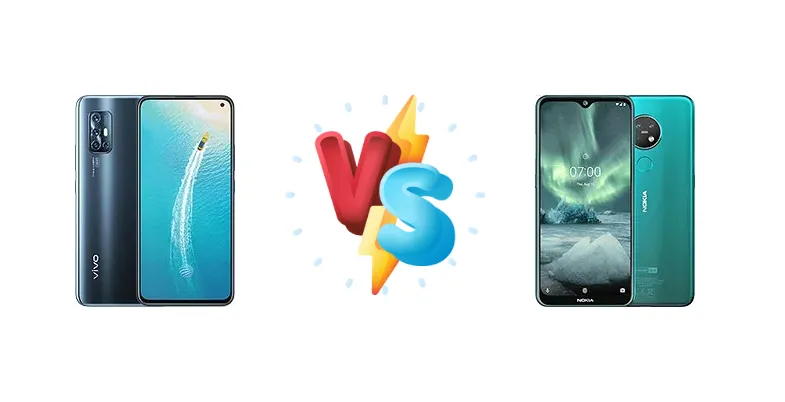
The vivo V17 and Nokia 7.2 represent distinct approaches to the mid-range smartphone market. The V17 prioritizes processing power with the Snapdragon 675, while the Nokia 7.2 focuses on a clean software experience and a respectable display. This comparison dissects their key differences to determine which device delivers the best value.
🏆 Quick Verdict
For most users, the vivo V17 emerges as the stronger choice. Its Snapdragon 675 chipset offers a noticeable performance advantage over the Nokia 7.2’s Snapdragon 660, translating to smoother multitasking and gaming. While both phones share similar battery endurance ratings, the V17’s faster 18W charging is a practical benefit.
| Network |
|---|
| 2G bands | GSM 850 / 900 / 1800 / 1900 | GSM 850 / 900 / 1800 / 1900 |
| 3G bands | HSDPA 850 / 900 / 2100 | HSDPA 850 / 900 / 2100 - ROW |
| 4G bands | 1, 3, 5, 8, 38, 40, 41 | 1, 3, 5, 7, 8, 20, 28, 38, 40, 41 - ROW |
| Speed | HSPA, LTE | HSPA 42.2/5.76 Mbps, LTE (2CA) Cat6 300/50 Mbps or LTE Cat4 150/50 Mbps |
| Technology | GSM / HSPA / LTE | GSM / HSPA / LTE |
| | 1, 3, 5, 7, 8, 38, 40, 41 | 1, 3, 5, 8, 40, 41 - IN |
| Launch |
|---|
| Announced | 2019, November 23. Released 2019, December | 2019, September 05. Released 2019, September 23 |
| Status | Discontinued | Discontinued |
| Body |
|---|
| Build | Glass front, plastic back, plastic frame | Glass front (Gorilla Glass 3), glass back (Gorilla Glass 3), plastic frame |
| Dimensions | 159 x 74.2 x 8.5 mm (6.26 x 2.92 x 0.33 in) | 159.9 x 75.2 x 8.3 mm (6.30 x 2.96 x 0.33 in) |
| SIM | · Nano-SIM· Nano-SIM + Nano-SIM | · Nano-SIM· Nano-SIM + Nano-SIM |
| Weight | 176 g (6.21 oz) | 180 g (6.35 oz) |
| Display |
|---|
| Protection | - | Corning Gorilla Glass 3 |
| Resolution | 1080 x 2400 pixels, 20:9 ratio (~409 ppi density) | 1080 x 2280 pixels, 19:9 ratio (~400 ppi density) |
| Size | 6.44 inches, 100.1 cm2 (~84.9% screen-to-body ratio) | 6.3 inches, 99.1 cm2 (~82.4% screen-to-body ratio) |
| Type | Super AMOLED | IPS LCD, HDR10 |
| Platform |
|---|
| CPU | Octa-core (2x2.0 GHz Kryo 460 Gold & 6x1.7 GHz Kryo 460 Silver) | Octa-core (4x2.2 GHz Kryo 260 Gold & 4x1.8 GHz Kryo 260 Silver) |
| Chipset | Qualcomm SDM675 Snapdragon 675 (11 nm) | Qualcomm SDM660 Snapdragon 660 (14 nm) |
| GPU | Adreno 612 | Adreno 512 |
| OS | Android 9.0 (Pie), Funtouch 9.2 | Android 9.0 (Pie), upgradable to Android 11, Android One |
| Memory |
|---|
| Card slot | microSDXC (dedicated slot) | microSDXC (dedicated slot) |
| Internal | 128GB 8GB RAM, 256GB 8GB RAM | 64GB 4GB RAM, 64GB 6GB RAM, 128GB 4GB RAM, 128GB 6GB RAM |
| | UFS 2.1 | eMMC 5.1 |
| Main Camera |
|---|
| Features | LED flash, HDR, panorama | Zeiss optics, LED flash, panorama, HDR |
| Quad | 48 MP, f/1.8, (wide), 1/2.0", 0.8µm, PDAF
8 MP, f/2.2, 13mm (ultrawide), 1/4.0", 1.12µm
2 MP (macro)
Auxiliary lens | - |
| Triple | - | 48 MP, f/1.8, (wide), 1/2.0", 0.8µm, PDAF
8 MP, f/2.2, 13mm (ultrawide), 1/4.0", 1.12µm
Auxiliary lens |
| Video | 4K@30fps, 1080p@30/60fps | 4K@30fps, 1080p@30fps (gyro-EIS) |
| Selfie camera |
|---|
| Features | HDR | Zeiss optics, HDR |
| Single | 32 MP, f/2.5, 23mm (wide), 1/2.8", 0.8µm | 20 MP, f/2.0, (wide), 1/3", 0.9µm |
| Video | 1080p@30fps | 1080p@30fps |
| Sound |
|---|
| 3.5mm jack | Yes | Yes |
| 35mm jack | Yes | Yes |
| Loudspeaker | Yes | Yes |
| Comms |
|---|
| Bluetooth | 5.0, A2DP, LE | 5.0, A2DP, EDR, LE, aptX |
| NFC | No | Yes (excl. India) |
| Positioning | GPS, GLONASS, GALILEO, BDS | GPS, GLONASS, GALILEO, BDS |
| Radio | No | FM radio |
| USB | USB Type-C 2.0, OTG | USB Type-C 2.0, OTG |
| WLAN | Wi-Fi 802.11 a/b/g/n/ac, dual-band, Wi-Fi Direct | Wi-Fi 802.11 b/g/n/ac, dual-band, Wi-Fi Direct |
| Features |
|---|
| Sensors | Fingerprint (under display, optical), accelerometer, gyro, proximity, compass | Fingerprint (rear-mounted), accelerometer, gyro, proximity, compass |
| Battery |
|---|
| Charging | 18W wired | 10W wired |
| Type | 4500 mAh, non-removable | Li-Po 3500 mAh, non-removable |
| Misc |
|---|
| Colors | Admiral Blue, Glacier Ice White, Midnight Ocean Black | Cyan Green, Charcoal, Ice |
| Models | 1919 | TA-1193, TA-1178, TA-1196, TA-1181 |
| Price | About 270 EUR | About 240 EUR |
| SAR | 0.99 W/kg (head) 0.25 W/kg (body) | 1.15 W/kg (head) 0.90 W/kg (body) |
| SAR EU | - | 0.99 W/kg (head) 1.44 W/kg (body) |
| Tests |
|---|
| Audio quality | - |
Noise -93.0dB / Crosstalk -93.4dB |
| Battery life | - |
Endurance rating 69h
|
| Camera | - |
Photo / Video |
| Display | - |
Contrast ratio: 1342:1 (nominal) |
| Loudspeaker | - |
-29.6 LUFS (Average)
|
| Performance | - |
AnTuTu: 139495 (v7), 164484 (v8)
GeekBench: 5440 (v4.4), 1398 (v5.1)
GFXBench: 8.1fps (ES 3.1 onscreen) |
vivo V17
- Faster Snapdragon 675 processor
- 18W fast charging
- Potentially better image processing
- Less detailed display specifications
- Funtouch OS may not appeal to all users
Nokia 7.2
- Clean Android One software
- Brighter display (585 nits)
- Zeiss optics for potentially better image quality
- Slower Snapdragon 660 processor
- Slower 10W charging
- Less powerful GPU
Display Comparison
The Nokia 7.2 boasts a brighter display, reaching a measured 585 nits, compared to the V17’s unspecified peak brightness. Both share a 1342:1 contrast ratio, suggesting similar black levels and color depth. However, the Nokia 7.2’s higher brightness is a clear advantage for outdoor visibility. The V17’s display specifications are less detailed, making a direct comparison of color accuracy difficult, but the Nokia 7.2’s calibration is generally well-regarded.
Camera Comparison
Both devices feature photo and video capabilities, but detailed camera specifications are limited. Without sensor size or aperture information, a direct comparison is challenging. However, the V17’s chipset likely provides more advanced image signal processing (ISP) capabilities, potentially leading to better low-light performance and dynamic range. The Nokia 7.2 benefits from its Zeiss optics, which are known for their color accuracy and sharpness, but the Snapdragon 660’s ISP may be a limiting factor. The presence of a 2MP macro lens on both devices is largely a marketing gimmick and unlikely to deliver significant improvements in image quality.
Performance
The vivo V17’s Snapdragon 675, built on an 11nm process, offers a significant architectural advantage over the Nokia 7.2’s 14nm Snapdragon 660. The 675’s Kryo 460 cores (2x2.0 GHz Gold & 6x1.7 GHz Silver) provide a more efficient and powerful CPU configuration than the 660’s (4x2.2 GHz Gold & 4x1.8 GHz Silver). This translates to faster app loading times and smoother multitasking on the V17. While both are capable of handling everyday tasks, the V17 will exhibit less lag under heavier workloads. The 11nm process also contributes to better thermal efficiency, potentially reducing throttling during prolonged gaming sessions.
Battery Life
Both the vivo V17 and Nokia 7.2 achieve an endurance rating of 69 hours, indicating similar battery life under typical usage. However, the V17’s 18W wired charging is significantly faster than the Nokia 7.2’s 10W charging. This means the V17 can replenish its battery much quicker, reducing downtime. While battery capacity isn’t specified for either device, the faster charging speed of the V17 provides a tangible benefit for users who frequently need to top up their battery.
Buying Guide
Buy the vivo V17 if you need a phone capable of handling demanding apps and occasional gaming without significant slowdown. It’s ideal for users who prioritize performance and faster charging. Buy the Nokia 7.2 if you prefer a clean, bloatware-free Android One experience and a well-calibrated display, and are willing to trade some processing power for software simplicity and potentially longer software support.
Frequently Asked Questions
❓ Does the Snapdragon 660 in the Nokia 7.2 struggle with graphically intensive games like PUBG?
The Snapdragon 660 can run PUBG, but you’ll likely need to lower the graphics settings to achieve a consistently smooth frame rate. The V17’s Snapdragon 675 offers a more comfortable gaming experience with higher settings and fewer frame drops.
❓ Is the Android One software on the Nokia 7.2 guaranteed to receive timely updates and security patches?
Nokia is committed to providing regular updates and security patches for its Android One devices. However, the update schedule can vary. While generally reliable, it's not a guarantee of immediate updates like some flagship devices.
❓ How significant is the difference in charging time between the 18W and 10W chargers?
The difference is substantial. The V17’s 18W charger can significantly reduce charging time, potentially adding several hours of usage with just a 30-minute charge, compared to the Nokia 7.2’s slower 10W charger.
❓ Does the vivo V17 have any noticeable bloatware pre-installed?
vivo’s Funtouch OS is known to include pre-installed apps, often referred to as bloatware. While some can be uninstalled, it’s a consideration for users who prefer a clean software experience like the Nokia 7.2’s Android One.