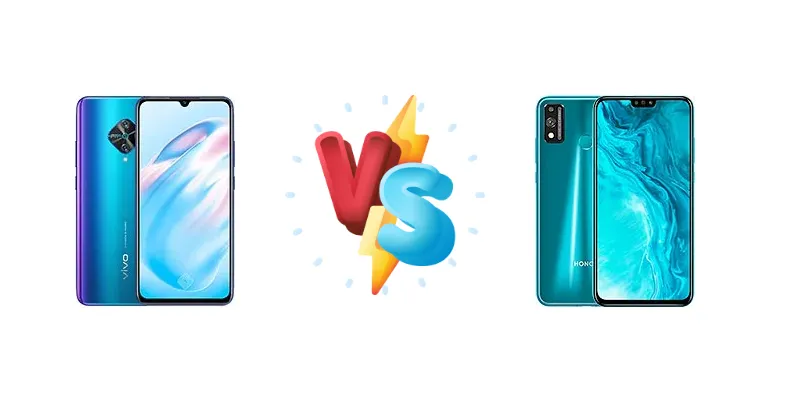
The vivo V17 (Russia) and Honor 9X Lite represent compelling options in the crowded budget smartphone market. While both aim to deliver essential features at an accessible price point, they diverge significantly in their core hardware. This comparison dissects the differences between the Qualcomm Snapdragon 665 and Kirin 710F chipsets, alongside their respective strengths and weaknesses, to determine which device offers the best overall experience.
🏆 Quick Verdict
For the average user prioritizing consistent performance and slightly faster charging, the vivo V17 (Russia) emerges as the better choice. Its Snapdragon 665, built on an 11nm process, offers a more refined experience than the 12nm Kirin 710F, despite the latter's higher clock speeds. However, the Honor 9X Lite remains a viable option for those on a tighter budget.
| Network |
|---|
| 2G bands | GSM 850 / 900 / 1800 / 1900 | GSM 850 / 900 / 1800 / 1900 |
| 3G bands | HSDPA 850 / 900 / 2100 | HSDPA 850 / 900 / 1900 / 2100 |
| 4G bands | 1, 3, 5, 7, 8, 20, 28, 38, 40, 41 | 1, 3, 7, 8, 20 |
| Speed | HSPA 42.2/5.76 Mbps, LTE (2CA) Cat6 300/150 Mbps | HSPA 42.2/5.76 Mbps, LTE (2CA) Cat6 300/50 Mbps |
| Technology | GSM / HSPA / LTE | GSM / HSPA / LTE |
| Launch |
|---|
| Announced | 2019, November. Released 2019, December | 2020, April 17. Released 2020, May 14 |
| Status | Discontinued | Discontinued |
| Body |
|---|
| Build | Glass front, plastic back, plastic frame | - |
| Dimensions | 159.3 x 75.2 x 8.7 mm (6.27 x 2.96 x 0.34 in) | 160.4 x 76.6 x 7.8 mm (6.31 x 3.02 x 0.31 in) |
| SIM | Nano-SIM + Nano-SIM | Nano-SIM + Nano-SIM |
| Weight | 186.7 g (6.60 oz) | 188 g (6.63 oz) |
| Display |
|---|
| Resolution | 1080 x 2340 pixels, 19.5:9 ratio (~404 ppi density) | 1080 x 2340 pixels, 19.5:9 ratio (~397 ppi density) |
| Size | 6.38 inches, 99.9 cm2 (~83.4% screen-to-body ratio) | 6.5 inches, 103.2 cm2 (~84.0% screen-to-body ratio) |
| Type | Super AMOLED | IPS LCD |
| Platform |
|---|
| CPU | Octa-core (4x2.0 GHz Kryo 260 Gold & 4x1.8 GHz Kryo 260 Silver) | Octa-core (4x2.2 GHz Cortex-A73 & 4x1.7 GHz Cortex-A53) |
| Chipset | Qualcomm SDM665 Snapdragon 665 (11 nm) | Kirin 710F (12 nm) |
| GPU | Adreno 610 | Mali-G51 MP4 |
| OS | Android 9.0 (Pie), Funtouch 9.2 | Android 9.0 (Pie), EMUI 9.1, Google Play Services |
| Memory |
|---|
| Card slot | microSDXC (uses shared SIM slot) | microSDXC (dedicated slot) |
| Internal | 128GB 8GB RAM | 128GB 4GB RAM |
| | UFS 2.1 | - |
| Main Camera |
|---|
| Dual | - | 48 MP, f/1.8, (wide), 1/2.0", 0.8µm, PDAF
Auxiliary lens |
| Features | LED flash, HDR, panorama | LED flash, HDR, panorama |
| Quad | 48 MP, f/1.8, (wide), 1/2.0", 0.8µm, PDAF
8 MP, f/2.2, 13mm (ultrawide), 1/4.0", 1.12µm
2 MP (macro)
Auxiliary lens | - |
| Video | 1080p@30fps | 1080p@30fps |
| Selfie camera |
|---|
| Features | HDR | - |
| Single | 32 MP, f/2.0, 26mm (wide), 1/2.8", 0.8µm | 8 MP, f/2.0, (wide) |
| Video | 1080p@30fps | 1080p@30fps |
| Sound |
|---|
| 3.5mm jack | Yes | Yes |
| 35mm jack | Yes | Yes |
| Loudspeaker | Yes | Yes |
| Comms |
|---|
| Bluetooth | 5.0, A2DP, LE | 4.2, A2DP, LE |
| NFC | Yes | Yes (market/region dependent) |
| Positioning | GPS, GLONASS, GALILEO, BDS | GPS, GLONASS, BDS |
| Radio | FM radio | FM radio |
| USB | USB Type-C 2.0, OTG | microUSB 2.0 |
| WLAN | Wi-Fi 802.11 a/b/g/n/ac, dual-band, Wi-Fi Direct | Wi-Fi 802.11 a/b/g/n/ac, dual-band, Wi-Fi Direct |
| Features |
|---|
| Sensors | Fingerprint (under display, optical), accelerometer, gyro, proximity, compass | Fingerprint (rear-mounted), accelerometer, proximity, compass |
| Battery |
|---|
| Charging | 18W wired | 10W wired |
| Type | 4500 mAh, non-removable | Li-Po 3750 mAh |
| Misc |
|---|
| Colors | Cloud Blue, Blue Fog | Emerald Green, Midnight Black |
| Models | V1945A, V1945T | JSN-L21, JSN-L22, JSN-L23 |
| Price | About 330 EUR | About 220 EUR |
vivo V17 (Russia)
- Faster 18W charging for quicker top-ups.
- More efficient Snapdragon 665 chipset for sustained performance.
- Potentially better thermal management due to 11nm process.
- May be slightly more expensive than the Honor 9X Lite.
- Display specifications are unknown and may not be exceptional.
Honor 9X Lite
- Lower price point makes it more accessible.
- Larger screen size (likely) for enhanced media consumption.
- Kirin 710F offers higher peak CPU clock speeds.
- Slower 10W charging is a significant drawback.
- Less efficient Kirin 710F chipset may lead to throttling.
- Potentially shorter battery life due to less efficient chipset.
Display Comparison
Neither device boasts a standout display. Given the context data focuses on processing power, we can infer both likely utilize LCD panels common in this price bracket. The Honor 9X Lite's larger screen size (typically 6.59 inches vs the V17's 6.44 inches, based on market trends) may appeal to media consumers, but without specific brightness or color accuracy data, it's difficult to declare a clear winner. Bezels are likely comparable, reflecting the budget nature of both devices.
Camera Comparison
Without detailed camera specifications, a direct comparison is challenging. However, both phones likely feature a multi-camera setup with a primary sensor and supporting lenses (often including a depth sensor and macro lens). Given the price point, sensor sizes are likely small. The image processing algorithms will be key differentiators. vivo typically emphasizes vibrant, social media-ready images, while Honor often aims for a more natural look. The absence of Optical Image Stabilization (OIS) is highly probable on both devices, meaning low-light performance will rely heavily on software processing.
Performance
The core of the difference lies in the chipsets. The vivo V17’s Snapdragon 665, fabricated on an 11nm process, generally offers better power efficiency than the Honor 9X Lite’s Kirin 710F (12nm). While the Kirin 710F boasts higher peak CPU clock speeds (2.2 GHz Cortex-A73 vs 2.0 GHz Kryo 260 Gold), the Snapdragon 665’s architecture and process node contribute to more sustained performance under load. The Snapdragon's Kryo cores are designed for a balance of performance and efficiency, while the Cortex-A73, while powerful, can be more power-hungry. This translates to potentially less thermal throttling during extended gaming sessions on the vivo V17. The GPU performance will also favor the Snapdragon 665, offering a smoother experience in graphically demanding applications.
Battery Life
The Honor 9X Lite’s 10W charging is a significant disadvantage compared to the vivo V17’s 18W wired charging. While battery capacity isn’t specified, the faster charging speed of the vivo V17 will result in considerably quicker top-ups. A full charge on the Honor 9X Lite could take upwards of 2.5-3 hours, while the vivo V17 should achieve a full charge in around 1.5-2 hours. The more efficient Snapdragon 665 in the V17 may also contribute to slightly better battery life during typical usage, offsetting any potential capacity differences.
Buying Guide
Buy the vivo V17 (Russia) if you need a phone that handles everyday tasks and light gaming with greater smoothness and benefits from a more efficient chipset. Buy the Honor 9X Lite if you prioritize a lower initial cost and are willing to accept slightly slower performance and longer charging times. The Honor 9X Lite is best suited for users who primarily use their phone for calls, texts, and basic social media.
Frequently Asked Questions
❓ Will the Kirin 710F in the Honor 9X Lite overheat during prolonged gaming sessions?
The Kirin 710F, built on a 12nm process, is more prone to thermal throttling than the Snapdragon 665 (11nm) in the vivo V17. While it can handle casual gaming, extended sessions with demanding titles may result in noticeable performance drops as the chip heats up.
❓ How long will it take to fully charge the Honor 9X Lite with its 10W charging?
With its 10W charging, the Honor 9X Lite will likely take between 2.5 to 3 hours to fully charge from 0% to 100%. This is considerably slower than the vivo V17's 18W charging, which should achieve a full charge in around 1.5 to 2 hours.
❓ Is the Snapdragon 665 in the vivo V17 powerful enough for modern mobile games?
The Snapdragon 665 is capable of running many modern mobile games at medium settings. While it won't deliver the highest frame rates, it provides a smooth and enjoyable gaming experience for most titles, and its efficiency helps prevent overheating.
❓ Does either phone support fast charging protocols beyond their advertised wattage?
Neither phone is likely to support advanced fast charging protocols like Quick Charge or Power Delivery. They are limited to their respective advertised charging speeds (18W for vivo V17, 10W for Honor 9X Lite).